Things to do in Hanyin
Explore top experiences
Top 10 attractions in Hanyin


The Longest Day in Chang'an Theme Block
The Longest Day in Chang'an Theme Block is based on the culture of Tang Shijing culture, with the IP of the series "The Longest Day in Chang'an" as the theme, and with immersive experience as the core, in architecture, soft decoration, coins, characters, clothing, language, music Tang-style packaging in fields such as stories etc. At the same time, around the in-depth immersive story experience, supporting catering, cultural and creative, performing arts and other business content are set up to create an overall Tang space play, Tang-style market experience, themed immersive interaction, and Tang music, song and dance performances, cultural social leisure, etc. are integrated into the cultural experience of the whole Tang market.China · Xi'an

White Emperor City Qutang Gorge Scenic Spot
White Emperor City Qutang Gorge Scenic Spot is located by the river in Fengjie County, Chongqing, at the western entrance of the Yangtze River's Three Gorges. It consists of two parts: White Emperor City and Qutang Gorge. A historic island city surrounded by water meets a majestic and precipitous gorge gateway, where natural landscapes, Three Kingdoms relics, and millennia of poetry converge. When cruising through the Three Gorges, the gorge's panoramic scroll often begins unfolding here. White Emperor City, originally named White Emperor City Qutang Gorge Scenic Spot, was built by Gongsun Shu in the late Western Han Dynasty as a fortified city, where he proclaimed himself the "White Emperor," a name that has endured to this day. During the Three Kingdoms period, Liu Bei retreated here after his failed eastern campaign and entrusted his son to Zhuge Liang on his deathbed. The colorful sculptures in the Entrusting the Orphan Hall at the White Emperor Temple recreate this historical episode. Interestingly, while the temple's name remains unchanged, it now enshrines Liu Bei and Zhuge Liang, who were honored during the Ming Dynasty. The Mingliang Hall, Wuhou Shrine, and Star-Gazing Pavilion are built along the mountainside, while the eastern and western stele forests display inscriptions from various dynasties, worth a slow-paced appreciation. The site is also renowned as the "City of Poetry": Li Bai, pardoned and returning east, penned the timeless line "Leaving at dawn the White Emperor crowned with cloud"; Du Fu, residing in Kuizhou for nearly two years, left behind over 400 poems; and Liu Yuxi composed "Bamboo Branch Songs" while serving as the governor of Kuizhou. After the Three Gorges Reservoir was filled, the rising river level turned White Emperor Mountain into an isolated island in the high gorge's flat lake, accessible only via a long covered bridge. The Qutang Gorge stretches approx. 8 km in total. Though not the longest among the Three Gorges, it is renowned for its majestic and precipitous scenery. The gorge entrance, called Kuimen or Qutang Pass, features the sheer cliffs of Chijia Mountain and Baiyan Mountain standing opposite each other, abruptly narrowing the river. Here, the Yangtze forces its way through the pass, which has served as the vital waterway to and from Sichuan since ancient times. It also appears on the back of the fifth series CNY 10 banknote. While sailing through the gorge, visitors can spot the hanging coffins at Wind Box Gorge high on the cliffs, the orderly arranged Meng Liang's Ladder holes on Baiyan Mountain's precipice, and numerous cliff inscriptions. When visiting, consider first walking across the covered bridge to the island to explore the Tuogu Hall, stele forest, and Star Observation Pavilion, then head to the Kuimen viewing platform behind Baidi Temple—directly facing Kuimen, it offers the same perspective as depicted on the back of the CNY 10 banknote. Matching a bill with the actual view for photos has become a classic activity. To truly experience the canyon's narrowness and the river's rush, take a boat through Qutang Gorge—looking back at the cliffs from the water is far more awe-inspiring than viewing from the shore.China · Fengjie County

Xi'an Beilin Museum
The Xi'an Beilin Museum is located near Wenchang Gate, consisting of sections such as the stele forest and stone carving art. The stele forest, composed of steles and epitaphs from various dynasties, is the highlight of the museum, including steles by famous calligraphers like Yan Zhenqing, Liu Gongquan, and Huaisu, as well as the "Stone Classics of Filial Pietyand the Kaicheng Stone Classics, two stone tablets from the Tang dynasty. The collection contains numerous exquisite stone inscriptions In the Xi'an Beilin Museum, you can appreciate steles and epitaphs from various dynasties, with a collection spanning over 2000 years. Among the treasures are: Yan Zhenqing's "Yan Qinli stele", "Yan family temple stele" and others are standard "Yan style"; Liu Gongquan's "Mysterious Pagoda Stele of Master Dada" is a typical representative work of "Liu style"; the "Stele inscription of the preface to the sacred teachings of the Tang Dynasty's Tripitaka"; the renowned cursive script master Huaisu's "Thousand-character classic" exhibits unrestrained brushwork. The Classic of Filial Piety on Stone Tablet and the Kaicheng Stone Classics are very popular Besides the stone carvings by calligraphy masters, the two most popular stone tablets among travelers are the Classic of Filial Piety on Stone Tablet and the Kaicheng Stone Classics. The Classic of Filial Piety on Stone Tablet is a Confucian classic. Its inscriptions were written by two emperors in four scripts: Emperor Xuanzong of Tang (Li Longji) wrote the main text in clerical script and added small annotations in regular script, later adding marginal notes in running script after the tablet was carved. The tablet's heading was written in seal script by Emperor Suzong of Tang (Li Heng). The Kaicheng Stone Classics were carved in the second year of the Kaicheng era (837 AD) during Emperor Wenzong of Tang's reign, comprising twelve classical texts including the Book of Songs, Book of Documents, Book of Rites, Book of Changes, and Spring and Autumn Annals. You can purchase rubbing copies When browsing in the Xi'an Beilin Museum, you can also admire exquisite stone carvings such as the tomb gate with four divine creatures, the six steeds of Zhao Mausoleum from the Tang Dynasty, the meeting of Confucius and Laozi, and the azure dragon and vermilion bird in the "Stone carving art gallery". After the visit, you can purchase "rubbings" made from the original steles.China · Xi'an

Giant Wild Goose Pagoda Cultural Leisure Scenic Area
The Giant Wild Goose Pagoda Cultural Leisure Scenic Area centers on the famous Tang Dynasty Big Wild Goose Pagoda and integrates Tang Dynasty cultural exhibits, landscaped gardens, and urban leisure. The scenic area consists of the North Square, South Square, and the Yanta East, West, and South Gardens, all connected by the theme of Tang culture. The North Square is the core area, featuring a large musical fountain in the center where water jets rise and fall with the rhythm of the music, making it a highlight for visitors. The Yanta West Garden focuses on Shaanxi folk customs, featuring sculptures that showcase traditional Guanzhong life and customs. The South Square features a bronze statue of Master Xuanzang and is a great spot for photographing the entire pagoda. After the lights come on in the evening, the musical fountain and the illuminated pagoda create a stunning display, making it a signature experience for night tours of the scenic area. When visiting, you can arrive at the square early to secure a good viewing spot. After the performance, you can stroll along the cultural corridor and admire the Tang Dynasty-themed sculptures on both sides.China · Xi'an

Yinghu Lake scenic spot
Yinghu Lake, a national AAAA-level tourist attraction, national water conservancy scenic area and provincial tourist resort, is a practical education base for study trips of primary and secondary school students in Shaanxi Province. The attraction is located 15 km southwest of Ankang city center. With a vast water area of 77 square km, Yinghu Lake features scattered islands and peninsulas, expansive waters and clear quality that consistently meets national Class II water standards. Yinghu lake is an eco-tourism destination focused on sightseeing, water recreation, and leisure vacations, renowned as a distinctive attraction showcasing the natural scenery of Qinba and Hanshui. It offers diverse experiences: Yuxing island with birdsong, floral fragrance, and adorable pets; Jinluo island, named for romance, witnessing love stories; Zhinv stone narrating ancient legends that spark imagination; Hanshui street creating a fairy-tale ambiance, dreamlike and enchanting; plus a water sports center where passion dances with lake views. A one-stop solution for sightseeing, vacations, family-friendly fun, and sports, Yinghu lake ensures your journey transcends mere scenery.Ankang · 46.3 km from Hanyin

Shennongjia Tourism Area
Shennongjia covers an enormous area which includes multiple towns and forests as well as the tourism areas of Shennong Peak, Tianyan (“heavenly swallow”), Xiangxiyuan River, and Yuquan River, of which Shennong Peak is the most famous. The Shennongjia Forestry District contains expansive virgin forest full of towering trees and lush vegetation, creating nature's own fresh oxygen. At Shennong Peak, you can climb onto of the “roof of central China” and see cute but rare golden snub-nosed monkeys. According to legend, this is where the ape-like “Shennongjia wild man” roams.China · Shennongjia

Shiquan Ancient Street
Shiquan Ancient Street is located in the southern part of Shiquan County, Shaanxi Province. The houses here are unique in shape, simple and elegant, and well-arranged. There are teahouses, small department stores and other shops along the street. On weekends, the street is bustling with people and lively.Shiquan · 29.3 km from Hanyin

Daming Palace National Heritage Park
The Daming Palace, the grand imperial court of the Tang Empire, served as the political center and national symbol of the dynasty. As one of the "Three Great Palaces" (Daming Palace, Taiji Palace, and Xingqing Palace) in Chang'an, it was the largest and known as the "Eastern Palace." From Emperor Gaozong's reign onward, 17 Tang emperors conducted state affairs here for over 240 years. This magnificent architectural complex stood as one of the world's most expansive palace compounds during its time. The lines from poet Wang Wei's "Morning Court at Daming Palace in Response to Jia Sheren" – "The nine heavens' gates swing open to reveal the palace; envoys from myriad nations bow before the imperial crown" – epitomize the grandeur of Tang Dynasty's golden age, showcasing the empire's majestic authority and the solemn magnificence of imperial ceremonies. The Daming Palace was first built in the 8th year of Emperor Taizong's Zhenguan era (634 AD), covering an area of approx. 3.2 km². The entire palace complex can be divided into two main sections: the outer court for official assemblies and the inner court for residence and entertainment. The outer court centers around the Hanyuan Hall (outer court), Xuanzheng Hall (middle court), and Zichen Hall (inner court), while the inner court features the Taiye Pool along with over 30 auxiliary halls, pavilions, and observatories. The term "Daming" first appeared in the "Daming" chapter of "The Book of Songs: Greater Odes." According to the "Mao Commentary," it signifies: "King Wen possessed brilliant virtue, so Heaven again commanded King Wu. As King Wen and King Wu succeeded one another, their brilliant virtue daily grew more vast, hence the name Daming." Like the name Weiyang Palace, which also originates from "The Book of Songs," Daming Palace served as a self-motivating symbol inspired by the diligent governance and wisdom of the Zhou kings. The origin of Daming Palace is also associated with a fascinating legend. During its initial construction, an ancient bronze mirror was unearthed at the site. The renowned statesman Wei Zheng recognized it as the "Qin Mirror," a national treasure once used by Emperor Qin Shi Huang to eliminate political dissidents. Legend claims this mirror could reveal a person's internal organs with astonishing clarity. More significantly, it could distinguish loyal ministers from treacherous ones and predict the rise and fall of dynasties. After Daming Palace's completion, the Qin Mirror was hung in the imperial court to ward off evil spirits, giving rise to the idiom "a bright mirror hung high" (symbolizing impartial justice). With this treasure safeguarding the palace, the atmosphere became one of supreme integrity and enlightenment—hence the name "Daming Palace" (Great Illumination Palace). On March 4, 1961, Daming Palace was designated by the State Council of the People's Republic of China as one of the first batch of National Key Cultural Relics Protection Units. In 2010, Xi'an established Daming Palace National Heritage Park on the original site. On June 22, 2014, the Daming Palace ruins were successfully inscribed on the UNESCO World Heritage List as part of the "Silk Roads: the Routes Network of Chang'an-Tianshan Corridor." On October 18, 2021, the Daming Palace ruins were selected among the "Top 100 Archaeological Discoveries of the Century." The Daming Palace of the Tang Dynasty was a magnificent architectural complex in Chang'an city. The park is built on the ruins of Daming Palace, where visitors can see foundation remains of palaces like Hanyuan Hall and admire the restored miniature model of Daming Palace. The attraction has a south gate and an east gate, with the south gate serving as the main entrance where the visitor center is located. Visitors are recommended to enter through the south gate. The heritage park consists of both free and paid sections, with the paid area covering the core attractions including the Danfeng Gate Ruins Museum at Daming Palace National Heritage Park, Hanyuan Hall Ruins, Xuanzheng Hall, Zichen Hall Ruins, and the Daming Palace Ruins Museum. The Daming Palace National Heritage Park - Danfeng Gate served as the main southern entrance to the Daming Palace, facing the 176m-wide Danfeng Gate Avenue. North of the Danfeng Gate lies the central north-south axis of the palace complex, featuring structures like the Hanyuan Hall, Xuanzheng Hall, Zichen Hall, Penglai Hall, Hanliang Hall, and Xuanwu Hall. Most other palace buildings were arranged along this central axis. According to Yonglu historical records, the Daming Palace's architectural layout progressed from Danfeng Gate to Hanyuan Hall and then to Zichen Hall further north - all three major structures were built atop hills. The front court area occupied the highest point of Longshou Mountain, with the terrain dropping sharply by several meters beyond this section toward the northern slopes. The Hanyuan Hall, Xuanzheng Hall, and Zichen Hall were the three main halls of Daming Palace, with Hanyuan Hall serving as the principal throne hall. Flanking the Xuanzheng Hall were two key government offices - the Secretariat and Chancellery - along with the Hongwen Academy and Hongshi Archives. Parallel to the central axis, two longitudinal streets ran east and west, created by aligned gateways piercing through three transverse palace walls. The northern side of Longshou Hill served as the rear court, featuring low-lying terrain where water from the Longshou Village canal was diverted to form a lake—Taiye Pool. The emperor's sleeping quarters and auxiliary halls were mostly concentrated on the elevated grounds of Longshou Hill southeast of Taiye Pool, while the areas for handling state affairs and hosting banquets with officials were situated on the high ground southwest of the pool. The expansive, flat northern shore of Taiye Pool accommodated recreational facilities and auxiliary views, such as the Shicui Hall, Horse Racing Tower, and Cockfighting Platform. The Linde Hall, built approx. during the Linde era of Emperor Gaozong of Tang, stood on the elevated land west of Taiye Pool in northern Daming Palace. As previously mentioned, there were also over 30 other detached halls, pavilions, and viewing platforms in the vicinity. At the attraction, visitors can view the foundation ruins of major halls and the palace outlines recreated with light steel structures on these ruins. Inside the Daming Palace National Heritage Museum, you'll see artifacts unearthed from the site, including royal utensils and vessels. In the northeast corner of the museum, there's a 1:15 scale miniature model of Daming Palace where you can "walk" along its streets and immerse yourself in the grandeur of Tang Dynasty's imperial palace. Inside the Danfeng Gate Museum at Daming Palace National Heritage Park near the south gate, the ruins of the gate tower from the original Danfeng Gate of Daming Palace National Heritage Park are preserved. This site represents one of the largest documented city gates in Chinese history.China · Xi'an

mei nv shai xiu
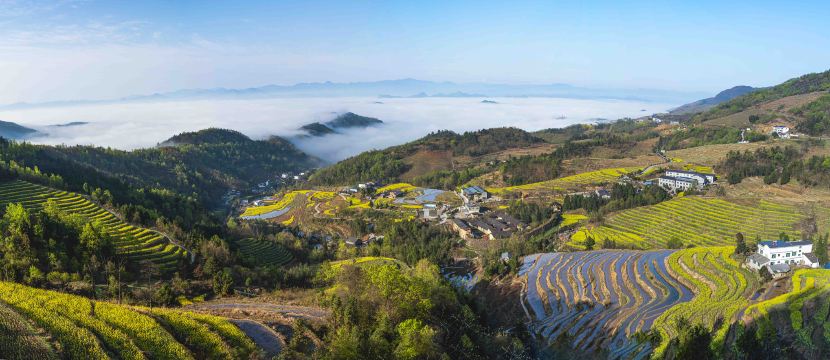
Hanyin · 12.4 km from downtown

Xi'an Drum Tower
The Xi'an Drum Tower faces the bell tower and is one of the iconic buildings of the ancient city. The drum tower was first built in the 13th year of the Hongwu reign of the Ming Dynasty (1380). Climbing the drum tower, you can see a large drum 1.8 m high and 24 red drums engraved with the 24 solar terms, which are very impressive. The drum tower also exhibits furniture, porcelain, and calligraphy and paintings by Qi Baishi from the Ming and Qing dynasties. Xi'an Drum Tower is one of the largest drum towers in China. Its base is a tall rectangular platform with north-south passageways that are 6 m in both height and width. The tower on the platform has two stories, upper and lower, with a roof covered in green glazed tiles. On the south side of Xi'an Drum Tower, there is a plaque inscribed with "Land of culture and military prowess," which, together with the plaque at Shanhaiguan, is hailed as "China's two great plaques." Unfortunately, it was destroyed during turbulent times, and what we see now is a replica. When visiting Xi'an Drum Tower, you can also enjoy the ancient-inspired "morning bell and evening drum" performance. Between the drum tower and the bell tower lies the bell and drum tower square, adorned with green grass and red flowers, featuring a uniquely designed musical fountain. The night view here is beautiful, perfect for photography. Behind the drum tower is the Muslim Quarter, home to numerous delicious foods.China · Xi'an
Experiences you can't miss in Hanyin
Featured Day tours in Hanyin
View all Day tours


Free things to do in Hanyin


What travelers say about Hanyin

IamkaybeeOctober 13, 2026
4.0
As a historical C-drama fan, visiting The Longest Day in Chang’an Theme Block was exciting! 🏮 The traditional architecture made us feel like we had stepped back into ancient China.However, our booking experience was confusing. We weren’t told that banquet seats needed to be reserved in advance, and without a Chinese mobile number, we struggled. Thankfully, a helpful staff member managed to get us seats, although my sister and I had to sit separately.The included dress-up experience was also disappointing. The makeup was rushed, and we looked far too pale, so we removed it straight after the banquet. We had hoped to walk around in hanfu and fully immerse ourselves in the experience.Overall, we’d love to do it again, but next time, we’d skip the banquet and dress-up package. ❤️
The Longest Day in Chang'an Theme Block

_We***51October 10, 2026
5.0
It's great in every way. The only starting point for the Three Gorges Summit hike is Baidi City, and the scenery is beautiful. Food and drinks on the mountain cost 10 yuan per serving. There are many steep uphill sections, and the hike is about 10 kilometers and takes about 6 hours. After the hike, there are local private cars available for 30 yuan per person to take you down the mountain from the high-speed rail station or other places.
White Emperor City Qutang Gorge Scenic Spot

sarah10yyqOctober 11, 2026
5.0
Professor Liu is exceptionally knowledgeable, and his explanations were remarkably clear and detailed. He could eloquently describe each artifact. I learned a great deal of new knowledge from his explanations and gained a new understanding of our history. I am very grateful to him for his three-hour lecture.
Xi'an Beilin Museum

Anonymous userOctober 5, 2026
5.0
I went during the National Day holiday, entering through the North Gate. If you go early, you can drive in and park at the boat dock. Later, due to traffic restrictions, cars aren't allowed in, so you'll have to park outside and take the shuttle bus or walk in. The island scenery is beautiful. This saves you from having to go to Houliu Water Town to take a boat; you get both a boat ride and scenic views here, making it more cost-effective. I recommend it.
Yinghu Lake scenic spot

M23***53October 16, 2026
5.0
Shennongjia, located in Hubei Province, is known as the "Roof of Central China" and a World Natural Heritage site. Its dense primeval forests are home to golden monkeys, boasting an exceptional ecosystem and earning it the title of a "green miracle." The scenery is picturesque and breathtaking, with stunning views at every turn.
Shennongjia Tourism Area

最美不过路上的风景May 31, 2025
5.0
Shiquan Ancient Street is a stone-paved ancient street in Shiquan County, close to the Han River, with a long history. The well-preserved East Gate and West Gate, as well as the rebuilt South Gate, make people feel like they have traveled back to ancient times. Walking on the ancient street, you can feel the strong historical atmosphere.
The food on Shiquan Ancient Street is mouth-watering, especially the inflated steamed bun, which is crispy on the outside and soft and crispy on the inside. It is a unique delicacy in Shiquan Old Street. Tasting these delicacies will undoubtedly add a unique fun to the trip.
Shiquan Old Street is brightly lit at night, and the big red lanterns under the eaves illuminate the entire street, creating a warm and romantic atmosphere. The Shiguo Fish Restaurant is very lively and is a good place to taste local food and enjoy nightlife.
Shiquan Ancient Street

天空不知道芸在哪里October 18, 2026
4.0
✅Advantages
1. Rich in history: This is the original site of the Tang Dynasty imperial palace, far exceeding the scale of the Forbidden City. Standing on the rammed earth foundation of Hanyuan Hall, one can directly experience the grand scale of "all nations paying tribute," creating a strong sense of antiquity. The museum within the park displays artifacts and miniature palace models, allowing visitors to understand the original appearance of the palace and compensating for the fact that only the earthen platform remains of the ruins.
2. User-friendly zoning and convenient transportation: A large area of the outer park is free, suitable for locals to stroll, picnic, fly kites, and take children; it is directly accessible by Metro Line 4 and is adjacent to Xi'an Railway Station, making arrival and departure very convenient.
3. Relatively relaxed atmosphere, unlike the crowds at popular tourist attractions. The lakeside of Taiye Pond is lush with vegetation, offering beautiful scenery in spring and autumn, perfect for leisurely strolls and relaxation.
⚠️Disadvantages
1. Almost no restored buildings remain; most are just rammed earth platforms and foundation mounds. 1. Without knowledge of Tang Dynasty history and without guided tours, it might just seem like a large earthen mound.
2. The park is extremely large, making walking tiring. The core paid area is largely open, with little shade in the summer sun, resulting in a huge amount of walking. Those with average stamina are advised to purchase a sightseeing electric cart; otherwise, you'll be very exhausted afterward.
3. Commercial facilities within the park are limited. There are few shops, water fountains, and limited dining options, so it's best to bring your own water and snacks.
4. It caters to polarized tastes: history buffs and those who enjoy historical ruins will love it; those seeking grand architecture and Instagram-worthy photos will find it less interesting.
Daming Palace National Heritage Park

山风_RanOctober 9, 2026
4.0
Online reviews say locals don't go up this building and it's not worth it. Personally, I think it's worth a visit. You can see Xi'an's central axis and get a distant view of the Drum Tower from the Bell Tower. It's not exceptionally beautiful, but it's alright.
As for the exhibits inside, I felt they were just so-so. Most of the content has little to do with the Bell and Drum Towers, and I don't know why they're displayed there. Perhaps because there's not much to see, we didn't stay long; we just walked around, took some photos, and came down.
Xi'an Drum Tower


