
Things to do in Jingyang
Explore top experiences
Top 10 attractions in Jingyang


Qinhan Civilization Museum
The Qin Han Museum of Shaanxi History Museum is located in the core area of Qinchuangyuan and Weihe Science and Technology Innovation Belt in Qinhan New Town, Xixian New District. It is an important part of the large-scale comprehensive cultural tourism project Daqin Civilization Park. It is a collection of cultural relic protection, display and exhibition, academic research, science education, It is a modern museum with a strong traditional style that integrates tourism services and other functions. The Qin Han Museum of Shaanxi History Museum adopts the appearance of a high platform building. The exhibition area is located on a high platform on the first floor, and public activity areas such as tourism services are located in the "hall" on the high platform. It can not only meet the use requirements of different functions of the museum, but also It also presents the high-platform architectural modeling characteristics of the Qin and Han palaces of "high pavilions and beautiful palace rooms". Spreading out the plane of the museum area, each unit is distributed according to the layout of "Wei River runs through the capital, with Xiang Tianhan, crossing the bridge to the south, and Fa Qiangniu", with Yaoguang, Kaiyang, Yuheng, Tianquan, and Tianquan among the Big Dipper. The five stars of Tianji form a symmetrical layout and are connected to each other through overhead corridors. The axis determined with Yuheng as the center is set on the extension of the central axis of Palace No. 1 of Qin Xianyang Palace. Among them, the main building adopts the form of a high platform to meet different functions. At the same time, it also shows the characteristics of Qin and Han palaces such as "high terraces and pavilions, beautiful palaces and rooms, complex roads and empty roads, horizontal bridges and waves, lofty towers, and combination of palaces and gardens." The origin of high platform construction is very early, such as the Lutai of the Yin Shang Dynasty and the Lingtai of the Zhou Dynasty. From the Warring States Period to the Qin and Han Dynasties, the style of building platforms was very popular. The museum adopts the appearance of a high platform building, with the exhibition area located on a high platform on the first floor, and public activity areas such as tourism services located in the "hall" on the high platform. The interior is divided into five exhibition halls with an exhibition area of about 11,300 square meters, including the main exhibition hall "Qin and Han Civilizations", the ruins exhibition hall "Cities and Tombs", the art exhibition hall "Technology and Beauty", the temporary exhibition hall and the public archaeological center. The core main exhibition hall explains the achievements and role of this period in the development of Chinese civilization at multiple levels and angles from the aspects of politics, economy, military, culture, science and technology, and foreign exchanges of the Qin and Han dynasties - this is not only the ancient politics of our country The era when the system was created was also the era when academic thought was laid, and it was also the era when the Chinese nation, with the "Han" as the main body, was formed. The exhibition halls on both sides are the permanent special exhibitions "City and Mausoleum" and "Technology and Beauty", which not only echo and in-depth explanation of the basic display of "Qin and Han Civilization", but also display the splendor and splendor of Qin and Han civilization from the aspects of archeology and art respectively. Specifically, "Cities and Tombs" aims to explore the role of capitals and mausoleums as the true carriers of civilized society through the analysis of four major sites in Yongcheng, Yueyang, Xianyang, and Chang'an based on the results of archaeological excavations. position in an ongoing process of development. "Technology and Beauty" mainly uses material remains such as sculptures, murals, portrait stones, and ceramic models to show the rich and diverse image world of people during the Qin and Han Dynasties, and also reveal people's understanding of the universe, life and death at that time. The temporary exhibition hall extended outwards can realize the multi-purpose effect of one hall. Temporary exhibitions, academic conferences and lecture salons can be held here, and it is planned to be built into a Qin and Han archaeological and historical research center. Nowadays, museums are also getting rid of the boring traditional exhibitions and adding a large number of perceivable and immersive technological means to make cultural relics come alive. For example, the digital exhibition hall and public archaeological center in the Qin and Han Museum use digital technology to present the food, clothing, housing, transportation, and social customs of the Qin and Han Dynasties, and then combine it with the display of archaeological results to tell archaeological stories in an all-round way and popularize archaeological knowledge.Xianyang · 13.6 km from Jingyang

Xi'an Land of Giants
Xi'an Daren Kingdom (formerly Lehua Happy World) is a national AAAA-level cultural tourism benchmark project developed by Shaanxi Lehua Happy World Cultural Development Co., Ltd. Located in Jinghe New Town, Xixian New Area, Shaanxi Province, the project integrates classical culture with modern entertainment, innovatively combining four dimensions: "amusement + cultural tourism + commerce + local culture." It redefines the oriental fantasy amusement space, reshapes the cultural tourism routes of Xi'an's ancient capital, fills the gap in the cultural-commercial-tourism integration sector of Xixian New Area, and has become a must-visit landmark in the region. The park integrates 38 flagship attractions including Asia's largest roller coaster cluster, 6 themed zones (joy square, dinosaur valley, echo valley, boulder mountains, starry woodland and moon lake), 21 immersive themed scenes, over 500 daily local folk performances, 28 themed leisure brands and the giant's hotel. Offering year-round fun for all ages with full-scene experiences, it creates a deeply immersive, trendy and dreamy holiday destination. Since its opening, Lehua Cultural Tourism has consistently invested hundreds of millions of CNY annually in product upgrades, continuously leading new trends in cultural tourism, breaking the industry's homogeneity dilemma, and constantly enhancing experiences to create surprises. In the future, it will continue to use innovation as its engine, deeply cultivate classic IPs, and bring visitors more exciting, refined, and culturally charming new joyful experiences.Jingyang · 8.9 km from downtown

Zhengguo Canal Scenic Area
Located in northwest of Wangqiao Town, Jingyang County, Xianyang City, the Zhengguo Canal Scenic Spot is divided into five zones: Jinghe River Geological Park, Jinghe River Canyon Sightseeing Area, Heigouqi Gorge Area, Wenjing Lake Resort and Beizhong Mountain Tourist Area. Located in the scenic spot, the Zhengguo Canal site is a large irrigation project built by the Qin State during the Warring States Period and is one of the three largest water conservancy projects, along with Sichuan's Dujiangyan Irrigation System and Guangxi's Lingqu Canal.Jingyang · 29.9 km from downtown

Han Yangling National Archaeological Site Park
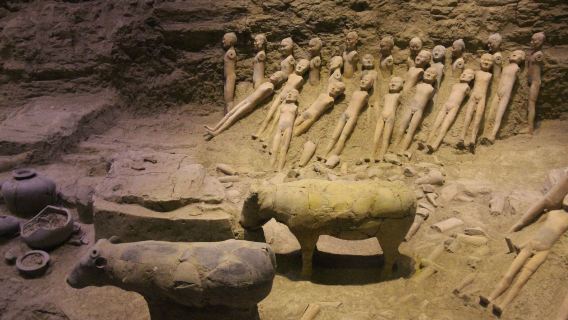
The Yangling Museum of Emperor Jing of Han Dynasty is located on the bank of Wei River in the northern suburbs of Xi'an. It is an archaeological site museum built based on the Yangling of Han Dynasty, a national key cultural relic protection unit. It was officially completed and opened in 1999. It is now a national first-class museum, a national archaeological site park, and a national AAAA-level tourist Attraction. 1. Main attractions As a large-scale site protection and display museum, Hanyang Mausoleum was rated as one of the top ten archaeological discoveries of the year and listed in the top 100 archaeological discoveries in China in the 20th century for its rich archaeological results, complete site preservation and complete protection and display system. It is China's first underground site museum that allows immersive experience. It is also one of the largest site museums in China with an area of more than 3,000 acres. It is famous both at home and abroad for its advanced and unique cultural relics protection concepts and display methods. Four basic exhibition halls have been built, including the Hanyang Mausoleum Archaeological Exhibition Hall, the Imperial Mausoleum Outer Storage Pit Site Protection and Exhibition Hall, the Nanquemen Site Protection and Exhibition Hall, and the Deyang Temple Site Protection and Exhibition Area, as well as natural landscapes such as the blooming rose garden, the colorful cherry blossom forest, and the swaying hundred-acre ginkgo forest. Here, you can not only feel the majestic and profound Han culture, appreciate the beautiful garden scenery, but also get a rare experience of the authenticity of the archaeological site, which can trigger Unlimited historical imagination. The Imperial Mausoleum's Outer Storage Pit Site Protection Exhibition Hall The outer storage pits are an important part of the imperial mausoleum, with 81 pits surrounding the imperial mausoleum. The Imperial Mausoleum Outer Storage Pit Protection Exhibition Hall is the world's first fully underground site museum using advanced cultural relic protection technology, built on 10 outer storage pits in the northeast of the imperial mausoleum. The hollow coated electrically heated glass curtain wall and passages in the museum separate the cultural relics and tourists in two completely different temperature and humidity environments. Under the premise of scientifically protecting the cultural relics, tourists can appreciate the archaeological excavation site and related relics from close range and from multiple angles in a mysterious environment. It is a model of the perfect combination of modern technology and heritage protection. In addition, the holographic imaging program uses internationally advanced film and television imaging technology to interpret the real historical events of the year, traveling through time and space, immersing tourists' thoughts in the colorful court life of the former Western Han emperors. Hanyangling Archaeological Exhibition Hall The Hanyang Mausoleum Archaeological Exhibition Hall is a comprehensive exhibition hall with a unique architectural style and novel display methods. The unique exterior structure of the ruins is consistent with the overall ancient historical environment of the mausoleum, creating a sense of historical vicissitudes. The exhibition halls on the upper and lower floors are based on the historical background, archaeological discoveries and protection and inheritance of Han Yang Mausoleum. Nearly a thousand fine cultural relics are exhibited. Through beautiful pottery figurines, simple and elegant utensils, and seals that follow etiquette and regularity, etc., the exhibition strives to present the history of the Han Dynasty, the archaeology of Han Yang Mausoleum, and the results of protection, display and utilization from multiple angles. The design that combines the sense of history with modern elements makes the elements of Han culture perfectly fit with the connotation of the site. It wipes off the dust of history and walks into the era that was later revered as the "Reign of Wen and Jing" with the audience, appreciates the scene of governance that has been passed down for thousands of years, touches the memory of Han culture that is deeply rooted in the blood of the nation, and appreciates the stories behind the cultural relics. Nanquemen Site Protection Exhibition Hall Nanque Gate is the southern gate of the four gates of the imperial mausoleum, also known as Zhuque Gate. It consists of two groups of symmetrically connected "three-que" buildings. It is the earliest, highest-level and largest imperial mausoleum que building site discovered so far. The Nanque Gate Site Protection and Exhibition Hall looks like a Han-style que gate building, which not only protects the existing site completely, but also shows tourists the majestic and tall style of the "three-que" building that only the emperors of the Han Dynasty could enjoy. Deyang Temple Ruins Protection and Exhibition Area The Deyang Temple Ruins are extremely important architectural ruins in the Yangling Mausoleum, covering an area of 60,000 square meters. The plane is a "U"-shaped double corridor structure, with a regular shape and a large scale, comparable to the ritual architecture in the southern suburbs of Chang'an City in the Han Dynasty. It is the best-preserved imperial mausoleum temple architectural ruins discovered so far. In terms of protection and display techniques, the original state of the ruins is combined with partial restoration and elevation, and large-scale greening is adopted, so that this precious ruins can be effectively protected and tourists can appreciate the grand momentum of the Western Han Dynasty ancestral temple architecture. Park scenery In order to further promote China's excellent traditional culture, promote the integration of culture and tourism, realize the consensus that culture is the soul of tourism and tourism is the carrier of culture, and strengthen the international competitiveness of China's cultural and tourism industries. Our institute uses green landscape as the site identification system and creates characteristic landscapes such as "Rose Garden", "Cherry Blossom Garden" and "Ginkgo Forest". Among them, the "Ginkgo Forest" has held nine consecutive unique "Hanyang Mausoleum Golden Autumn Ancient" Ginkgo Festival series activities since 2014, in November every year when the ginkgo leaves enter the viewing period. Since then, when talking about the "Ginkgo Forest", it is necessary to go to Hanyang Mausoleum. Self-driving route 1. Visitors from Xi'an can drive north from Weiyang Road, take the Xitong Expressway, cross the Weihe River Bridge and drive onto the Airport Highway to arrive. 2. Visitors from Xi'an (Xi'an Ring Road) and Xi'an Xianyang International Airport can take the Qinhan New City exit of the airport expressway and drive eastward toward Lanchi Avenue, then follow Lanchi Avenue, Zhengyang 3rd Road, and Lanchi 3rd Road to the South Gate of Hanyang Mausoleum; or drive eastward along Lanchi Avenue via County Road 101 to the airport highway. 3. From Xianyang, drive east on Lanchi Avenue, then take Zhengyang 3rd Road and Lanchi 3rd Road to the South Gate of Hanyang Mausoleum; or drive east on Lanchi Avenue and take County Road 101 to the Airport Highway. (Note: Due to the progress of road maintenance, it is recommended to refer to the navigation results.) Kind tips 1.The airport highway entrance is the recommended entrance to the Attraction. 2. Visitors can enter the park with their valid ID card and reservation QR code. 3.People over 65 years old, the disabled, pregnant women and other people with mobility difficulties can be given priority for inspection and entry into the park under the guidance of security staff. Minors, the elderly and Seniors with mobility difficulties must be accompanied by their family members when visiting. 4.If you have any questions after reading this guide, please call the consulting service hotline: 029-62657530, 029-62657569. Thank you for your understanding and cooperation, and wish you a pleasant visit!Xianyang · 13.6 km from Jingyang

Xi'an City Wall
Xi'an City Wall is a landmark of this ancient city. The city walls that we see now were built in the early years of the Ming dynasty and they are now more than 600 years old. The walls were built on the foundations of the imperial city of the Tang Dynasty and they are formed together with a series of defensive installments such as moats and turrets. At present, Xi'an City Wall can be accessed by many city gates. Visitors can choose the nearest one to them. The South Gate is the visitor entrance of Xi'an City and is also the city gate with more tourists. Cycling on the ancient walls is a good experience. Riding on the wall overlooking the ancient capital of the thirteenth dynasty, you will have a feeling of travelling through time.Xi'an · 29.6 km from Jingyang

China West Airport Group Museum of Heritage
Western Airport MuseumFeaturing Tang Dynasty-inspired architecture, the structure showcases a grand and majestic style.Western Airport MuseumFocusing on artifacts unearthed during the various construction phases of Xi'an Xianyang International Airport and supplemented by related archaeological finds from the Hongduyuan area, the exhibition showcases the process of cultural relic preservation and archaeological excavation during airport development. It not only displays a rich collection of artifacts but also combines history with modern technology through innovative presentation methods and technological means, such as interactive imaging and AR artifact displays, offering visitors an immersive historical experience. Additionally,Western Airport MuseumIt also introduced the "15-min cultural experience" initiative, showcasing artifact stories through standalone display cases to accommodate visitors' fast-paced browsing.Xianyang · 10 km from Jingyang

Shaanxi History Museum
History background: Shaanxi History Museum is located in the northwest of the Dayan Pagoda in Xi'an. It is one of the landmark attractions of Xi'an. The museum was planned in 1983, started in the summer of 1986, and officially opened on June 20, 1991. It was named Shaanxi History Museum. In 2016, Shaanxi History Museum was selected as "China's 20th Century Architectural Heritage" by the Chinese Cultural Relics Society and the Chinese Architectural Society. Museum Features: Shaanxi History Museum is a large modern museum, and its completion marks a new milestone in the development of China's museum industry. This museum is a Tang-style building complex with a "central hall and four corner towers". The main and secondary buildings are well-organized, the heights are staggered, and the momentum is solemn. It integrates national traditions, local characteristics and the spirit of the times. The museum covers an area of 65,000 square meters, and houses more than 380,000 cultural relics ranging from simple stone tools used in the initial stage of ancient humans to various artifacts in social life before 1840, covering a time span of more than one million years. The cultural relics are not only numerous and diverse, but also of high quality and wide value. The collections in the museum are dazzling and exquisite. It is an art hall that showcases the history and culture of Shaanxi and ancient Chinese civilization, and is known as the "Pearl of the Ancient Capital, the Treasure House of China." There are many treasures in the museum, including bronzes from the Shang and Zhou dynasties, pottery figurines from various dynasties, gold and silver utensils from the Han and Tang dynasties, and murals from Tang tombs. Most of them are treasures from the prosperous periods of the Han and Tang dynasties, and some of them are fine items that are prohibited from leaving the country. Collection treasures: There are three exhibition halls in the center of the museum. The first exhibition hall displays cultural relics from the prehistoric civilization of Lantian ape-man 1.15 million years ago to the Qin Dynasty; the second exhibition hall displays cultural relics from the Han Dynasty and the Wei, Jin, Southern and Northern Dynasties; and the third exhibition hall is mainly cultural relics from the prosperous Tang Dynasty. Each exhibition hall has its own treasure. There are special exhibition halls on the east and west sides of the central hall. On the west side, there is a "Special Exhibition of Tang Dynasty Treasures (Treasure Hall, Cultural Relics Unearthed in Hejiacun)", where many fine gold and silver wares from the heyday of the Tang Dynasty were transferred to be exhibited. On the east side, there is a "Treasures of Tang Dynasty Murals Exhibition", which exhibits a number of authentic Tang Dynasty tomb murals. The tripod The tripod is placed in the first exhibition hall at the entrance of the museum, and it can be said to be the treasure of the first exhibition hall. The replica is placed here, and the original is kept in the warehouse. Inscription on the outer wall: The inscription "All under heaven is the king's land; all the people are the king's subjects" reflects the land ownership system in the Western Zhou Dynasty. There are four lines of inscriptions with 28 characters on the inner wall of the Yi Ding. The general meaning is: In early August of a certain year, Wang Jiang took back the land originally given to Shi Lu and gave it to Yi, who then made this tripod to commemorate it. Queen's Seal: One of the treasures worth seeing in the second exhibition hall is the jade seal of the empress of the Han Dynasty, which is displayed separately. The seal is made of Xinjiang Hetian mutton-fat jade and is engraved with a Chihu, symbolizing royal power. Three-color camel figurines carrying music: This world-famous tri-color camel figurine carrying music is located in the third exhibition hall of Shaanxi History Museum. Its overall appearance and color are well preserved. There are seven men sitting on the camel's back, holding different musical instruments in their hands. Among them, the figurine holding the clapboard is listening attentively, as if intoxicated by the wonderful music. The woman in the middle is performing, and the camel opens its mouth wide and looks up to the sky, as if it is also singing with its master. Gold-inlaid animal head agate cup: This cultural relic, located in the special exhibition "Tang Dynasty Relics Special Exhibition", is one of the first 64 national treasures listed by the State Administration of Cultural Heritage that are never allowed to be exhibited abroad. There are also many other treasures such as black-glazed oil-drip bowls, green-glazed porcelain pots with handles, gilded silver bamboo-joint copper incense burners, gold bowls with mandarin duck and lotus petal patterns, and so on.Xi'an · 35.2 km from Jingyang

Xi'an Bell Tower
Xi'an Bell Tower is one of the larger and well-preservedBell tower, originally built in 1384, during the Hongwu reign of the Ming Dynasty,Bell towerLocated in the heart of Xi'an, it is one of the landmarks of the ancient city, radiating east, south, west, and north streets from its center, connecting to the east, south, west, and north gates of the Xi'an city wall respectively. The Xi'an Bell Tower was originally located on Guangji Street in the west. As the city center shifted eastward, it was relocated toDrum towerEast side, today's location. The Xi'an Bell Tower features a typical Ming Dynasty architectural style, with a square brick-and-stone base at the bottom and a triple-eaved pyramidal roof structure at the top, covered with dark green glazed tiles. The gilded pinnacle at the roof's apex is particularly striking under sunlight. Each side of the base has a central arched doorway approx. 6 m high, which were interconnected and once served as passageways for the intersection of four major streets—east, south, west, and north—allowing pedestrian and vehicular traffic. These doorways are now sealed, with a traffic roundabout built around them and an underground pedestrian passage. The entrance to the Xi'an Bell Tower is located within this underground passage, accessible via a spiral staircase. Inside the tower, there is a replica of the "Jingyun Bell," whose original was cast in the second year of Emperor Ruizong's Jingyun era (711 AD) during the Tang Dynasty and is now housed in the Xi'an Beilin Museum. Standing on the Xi'an Bell Tower, you can see the four main streets extending east, south, west, and north from the Xi'an Bell Tower. Around the Xi'an Bell Tower, there are bustling commercial areas and not far awayDrum towerTravelers can also enjoy wonderful historical performances when visiting the Xi'an Bell Tower.Xi'an · 31.3 km from Jingyang

Museums in Xi'an
Xi'an Museum Tour explores imperial, archaeological, and artistic key museums with immersive activities, revealing the ancient capital's history across thirteen dynasties. Imperial Mausoleum Site Museums:Unearth the secrets of the Terracotta Army. At this UNESCO-listed site, witness the “Eighth Wonder of the World”—a stunning display ideal for history enthusiasts and families to explore the legacy of the Qin Dynasty. Archaeological Science & Art Museums:Get hands-on with the science of excavation. Here, visitors engage with restored artifacts, tech-assisted archaeology, and exhibits on cultural progress—highlighting the blend of science and art behind uncovering the past. Stele Calligraphy Art Museums:Dialogue with stone-carved classics. Home to steles, epitaphs, and calligraphic masterpieces, this museum offers a journey through the evolution of script, Confucian texts, and the legacy of Central Plains civilization. Prehistoric Sites & City History Museums:Trace the roots of ancient Chang'an. The Banpo Museum showcases a 6,000-year-old matriarchal village, while Xi'an Museum combines the Xiaoyan Pagoda landscape with artifacts from Zhou to Tang dynasties, illustrating the city's birth and growth. Museum Combo Tour: A curated combination of museum visits that weaves together iconic collections to form a holistic understanding of Chang'an from multiple perspectives, offering profound insights into the cultural legacy of this ancient capital of thirteen dynasties.China · Xi'an

Daming Palace National Heritage Park
The Daming Palace, the grand imperial court of the Tang Empire, served as the political center and national symbol of the dynasty. As one of the "Three Great Palaces" (Daming Palace, Taiji Palace, and Xingqing Palace) in Chang'an, it was the largest and known as the "Eastern Palace." From Emperor Gaozong's reign onward, 17 Tang emperors conducted state affairs here for over 240 years. This magnificent architectural complex stood as one of the world's most expansive palace compounds during its time. The lines from poet Wang Wei's "Morning Court at Daming Palace in Response to Jia Sheren" – "The nine heavens' gates swing open to reveal the palace; envoys from myriad nations bow before the imperial crown" – epitomize the grandeur of Tang Dynasty's golden age, showcasing the empire's majestic authority and the solemn magnificence of imperial ceremonies. The Daming Palace was first built in the 8th year of Emperor Taizong's Zhenguan era (634 AD), covering an area of approx. 3.2 km². The entire palace complex can be divided into two main sections: the outer court for official assemblies and the inner court for residence and entertainment. The outer court centers around the Hanyuan Hall (outer court), Xuanzheng Hall (middle court), and Zichen Hall (inner court), while the inner court features the Taiye Pool along with over 30 auxiliary halls, pavilions, and observatories. The term "Daming" first appeared in the "Daming" chapter of "The Book of Songs: Greater Odes." According to the "Mao Commentary," it signifies: "King Wen possessed brilliant virtue, so Heaven again commanded King Wu. As King Wen and King Wu succeeded one another, their brilliant virtue daily grew more vast, hence the name Daming." Like the name Weiyang Palace, which also originates from "The Book of Songs," Daming Palace served as a self-motivating symbol inspired by the diligent governance and wisdom of the Zhou kings. The origin of Daming Palace is also associated with a fascinating legend. During its initial construction, an ancient bronze mirror was unearthed at the site. The renowned statesman Wei Zheng recognized it as the "Qin Mirror," a national treasure once used by Emperor Qin Shi Huang to eliminate political dissidents. Legend claims this mirror could reveal a person's internal organs with astonishing clarity. More significantly, it could distinguish loyal ministers from treacherous ones and predict the rise and fall of dynasties. After Daming Palace's completion, the Qin Mirror was hung in the imperial court to ward off evil spirits, giving rise to the idiom "a bright mirror hung high" (symbolizing impartial justice). With this treasure safeguarding the palace, the atmosphere became one of supreme integrity and enlightenment—hence the name "Daming Palace" (Great Illumination Palace). On March 4, 1961, Daming Palace was designated by the State Council of the People's Republic of China as one of the first batch of National Key Cultural Relics Protection Units. In 2010, Xi'an established Daming Palace National Heritage Park on the original site. On June 22, 2014, the Daming Palace ruins were successfully inscribed on the UNESCO World Heritage List as part of the "Silk Roads: the Routes Network of Chang'an-Tianshan Corridor." On October 18, 2021, the Daming Palace ruins were selected among the "Top 100 Archaeological Discoveries of the Century." The Daming Palace of the Tang Dynasty was a magnificent architectural complex in Chang'an city. The park is built on the ruins of Daming Palace, where visitors can see foundation remains of palaces like Hanyuan Hall and admire the restored miniature model of Daming Palace. The attraction has a south gate and an east gate, with the south gate serving as the main entrance where the visitor center is located. Visitors are recommended to enter through the south gate. The heritage park consists of both free and paid sections, with the paid area covering the core attractions including the Danfeng Gate Ruins Museum at Daming Palace National Heritage Park, Hanyuan Hall Ruins, Xuanzheng Hall, Zichen Hall Ruins, and the Daming Palace Ruins Museum. The Daming Palace National Heritage Park - Danfeng Gate served as the main southern entrance to the Daming Palace, facing the 176m-wide Danfeng Gate Avenue. North of the Danfeng Gate lies the central north-south axis of the palace complex, featuring structures like the Hanyuan Hall, Xuanzheng Hall, Zichen Hall, Penglai Hall, Hanliang Hall, and Xuanwu Hall. Most other palace buildings were arranged along this central axis. According to Yonglu historical records, the Daming Palace's architectural layout progressed from Danfeng Gate to Hanyuan Hall and then to Zichen Hall further north - all three major structures were built atop hills. The front court area occupied the highest point of Longshou Mountain, with the terrain dropping sharply by several meters beyond this section toward the northern slopes. The Hanyuan Hall, Xuanzheng Hall, and Zichen Hall were the three main halls of Daming Palace, with Hanyuan Hall serving as the principal throne hall. Flanking the Xuanzheng Hall were two key government offices - the Secretariat and Chancellery - along with the Hongwen Academy and Hongshi Archives. Parallel to the central axis, two longitudinal streets ran east and west, created by aligned gateways piercing through three transverse palace walls. The northern side of Longshou Hill served as the rear court, featuring low-lying terrain where water from the Longshou Village canal was diverted to form a lake—Taiye Pool. The emperor's sleeping quarters and auxiliary halls were mostly concentrated on the elevated grounds of Longshou Hill southeast of Taiye Pool, while the areas for handling state affairs and hosting banquets with officials were situated on the high ground southwest of the pool. The expansive, flat northern shore of Taiye Pool accommodated recreational facilities and auxiliary views, such as the Shicui Hall, Horse Racing Tower, and Cockfighting Platform. The Linde Hall, built approx. during the Linde era of Emperor Gaozong of Tang, stood on the elevated land west of Taiye Pool in northern Daming Palace. As previously mentioned, there were also over 30 other detached halls, pavilions, and viewing platforms in the vicinity. At the attraction, visitors can view the foundation ruins of major halls and the palace outlines recreated with light steel structures on these ruins. Inside the Daming Palace National Heritage Museum, you'll see artifacts unearthed from the site, including royal utensils and vessels. In the northeast corner of the museum, there's a 1:15 scale miniature model of Daming Palace where you can "walk" along its streets and immerse yourself in the grandeur of Tang Dynasty's imperial palace. Inside the Danfeng Gate Museum at Daming Palace National Heritage Park near the south gate, the ruins of the gate tower from the original Danfeng Gate of Daming Palace National Heritage Park are preserved. This site represents one of the largest documented city gates in Chinese history.Xi'an · 28.3 km from Jingyang
Experiences you can't miss in Jingyang
Featured Day tours in Jingyang
View all Day tours
Free cancellation
Instant confirmation
Book now for tomorrow
From€61.10

Free cancellation
Instant confirmation
Book now for tomorrow
From€42.81

Free cancellation
Instant confirmation
Book now for tomorrow
From€57.90
Free cancellation
Instant confirmation
Book now for tomorrow
From€64.30

Free cancellation
Book now for tomorrow
From€26.55
Free cancellation
Instant confirmation
From€71.61

Featured Cultural experiences in Jingyang
View all Cultural experiences
4.5/5
· 30 reviews· 805 bookedFree cancellation
Instant confirmation
26 bookings in 7 days
From€26.52

4.8/5
· 102 reviews· 925 bookedFree cancellation
Instant confirmation
Book now for tomorrow
22 consecutive positive reviews
From€97.74

4.2/5
· 54 reviews· 844 bookedFree cancellation
Instant confirmation
Book now for today
47 bookings in 7 days
From€31.93
5.0/5
· 141 reviews· 746 bookedFree cancellation
Instant confirmation
Book now for tomorrow
100 consecutive positive reviews
From€44.19

5.0/5
· 31 reviews· 87 bookedFree cancellation
Instant confirmation
Book now for today
31 consecutive positive reviews
From€178.61

4.5/5
· 2 reviews· 67 bookedInstant confirmation
From€68.38

5.0/5
· 2 reviews· 43 bookedInstant confirmation
Book now for today
From€35.93
Featured Food & drink in Jingyang
View all Food & drink
Instant confirmation
Book now for tomorrow
From€50.82

4.5/5
· 2 reviewsFree cancellation
Instant confirmation
From€54.09

4.7/5
· 75 reviews· 1.6k bookedFree cancellation
Book now for today
23 consecutive positive reviews
From€34.19

Free cancellation
Instant confirmation
Book now for tomorrow
5% off
Limited-time sale
From€66.63€70.14

4.6/5
· 29 reviews· 566 bookedFree cancellation
Instant confirmation
25 bookings in 7 days
10% off
Limited-time sale
From€35.53€39.48

4.4/5
· 19 reviews· 345 bookedInstant confirmation
Book now for today
From€35.93

4.9/5
· 14 reviews· 121 bookedFree cancellation
Instant confirmation
From€37.99
5.0/5
· 1 reviewFree cancellation
Instant confirmation
Book now for today
From€50.95
Featured Outdoor experiences in Jingyang
View all Outdoor experiences
5.0/5
· 3 reviews· 31 bookedFree cancellation
Instant confirmation
Book now for tomorrow
From€82.58
Free cancellation
Instant confirmation
From€36.57
Free cancellation
Book now for tomorrow
From€26.55

Free cancellation
Instant confirmation
From€26.07

From€104.58
Free things to do in Jingyang
Qinhan Civilization Museum
Xianyang · 13.6 km from JingyangChina West Airport Group Museum of Heritage
Xianyang · 10 km from JingyangShaanxi History Museum
Xi'an · 35.2 km from Jingyang
Huaxia Tourist Xi'an Resort
Xi'an · 25.5 km from Jingyang
Grand Tang Mall
Xi'an · 36.6 km from Jingyang
Qin Xianyang Palace Site Museum
Xianyang · 12.8 km from Jingyang
Xi'an Muslim Quarter
Xi'an · 31.1 km from Jingyang
Changling Mausoleum
Xianyang · 11.1 km from Jingyang
Xi'an Expo Park
Xi'an · 30.3 km from Jingyang
YONGXING FANG
Xi'an · 31.4 km from Jingyang
What travelers say about Jingyang

M48***76October 3, 2026
5.0
⭐⭐⭐⭐⭐ Five-star review! Highly recommend Ms. Yanzi from the Qin and Han Dynasty Hall of the Shaanxi History Museum!
Ms. Yanzi's explanations are professional and solid, and her presentation is vivid and engaging. Our group wasn't a premium small group tour, but the quality of the explanations far exceeded my expectations. Compared to several premium small group tours I've attended before, it was just as good, and much more affordable. My daughter is particularly fascinated by Qin Dynasty history and listened attentively throughout the entire tour, especially enjoying Ms. Yanzi's explanations. Following Ms. Yanzi through the Qin and Han Dynasty Hall, she clearly explained the stories behind the Qin and Han artifacts, making the whole experience incredibly enjoyable and well worth it!
Qinhan Civilization Museum

M23***22October 7, 2026
5.0
It's great, the price is reasonable, and the kids had a lot of fun. It's a great place with many roller coasters, both thrilling and mild. We were tourists and spent the whole day there. Thumbs up!
Xi'an Land of Giants

_We***32October 23, 2026
5.0
My second visit to the Zheng Guo Canal Scenic Area was once again captivating, leaving me deeply moved by the breathtaking scenery of this canyon. Zheng Guo Lake shimmered in the sunlight; a gentle bamboo raft ride offered picturesque views of the cliffs on either side. Reaching the waterfall, the sun shone brightly, and a rainbow appeared amidst the mist – so soothing! The Via Ferrata at Fuyuntai, perched atop a cliff overlooking the Jinghe River Canyon, was thrilling and exhilarating. This day trip combined the grandeur of a thousand-year-old water conservancy project with the natural beauty of the mountains and rivers, making it a fulfilling and perfect experience.
Zhengguo Canal Scenic Area

pekingwangOctober 24, 2026
5.0
You can walk around the burial mound of Emperor Jing of Han's tomb; it's quite convenient to get a ride-hailing service. Only a small portion of the underground burial pits has been excavated. The best part is its proximity to the city center. The journey takes about one to one and a half hours…
Han Yangling National Archaeological Site Park
M22***57October 26, 2026
4.0
This is a unique attraction, worth a visit.
The shopping area on the city wall is also quite unique, selling uniform traditional clothing for photo opportunities. There are also photo opportunities along the city wall.
The only drawback is the bicycles; there are no child seats, and seniors over 60 are not allowed to ride. This eliminates many family and parent-child cycling experiences, keeping many such consumers out.
Xi'an City Wall

魔法师王紫儿June 26, 2026
5.0
Xi'an Xianyang International Airport Museum (Terminal 5) is a rare archaeological site museum within an airport in China, built upon over 3,500 ancient tombs discovered during its construction. The museum features "underground artifacts, above-ground exhibitions," combining authentic archaeological sites with modern displays, showcasing approximately 120 precious artifacts, including the stone sarcophagus from the Northern Zhou Dynasty's Shi Jun Tomb, which is being exhibited for the first time. This innovative "airport + museum" model allows passengers to experience the civilization of the Zhou, Qin, Han, and Tang dynasties while waiting for their flights, making it a model of cultural tourism integration and well worth a special trip. But remember to visit it before security! It's located in the baggage check-in area.
China West Airport Group Museum of Heritage

153***77October 25, 2026
5.0
Not bad, but if you really want to book the free one, it's even more cost-effective.....................................
Shaanxi History Museum

山泉里October 26, 2026
5.0
The Bell Tower is a landmark ancient building in Xi'an. During my visit, the second and third floors of the tower were under maintenance and closed to the public. Visitors could only tour from the second-floor terrace, and the ticket price was reduced from 30 yuan per person to 15 yuan per person. The Bell Tower is built on the central axis of the ancient city. Standing atop the Bell Tower, one can see the Drum Tower and Yongning Gate in the distance, as well as the bustling commercial district and constant flow of traffic surrounding the Bell Tower Square, experiencing the profound history and modern vitality of this ancient capital. To enter the Bell Tower, one must pass through the Bell Tower Square underground passage (connected to the Bell Tower subway station). A couplet on the second floor aptly expresses the feelings of climbing the tower: "Ancient sites can be found, but time cannot be relived; palaces and towers recall the past; Zhongnan Mountain remains evergreen, the Wei River flows eternally; poetry and music, bells and drums, enter a new sound."
Xi'an Bell Tower

天空不知道芸在哪里October 18, 2026
4.0
✅Advantages
1. Rich in history: This is the original site of the Tang Dynasty imperial palace, far exceeding the scale of the Forbidden City. Standing on the rammed earth foundation of Hanyuan Hall, one can directly experience the grand scale of "all nations paying tribute," creating a strong sense of antiquity. The museum within the park displays artifacts and miniature palace models, allowing visitors to understand the original appearance of the palace and compensating for the fact that only the earthen platform remains of the ruins.
2. User-friendly zoning and convenient transportation: A large area of the outer park is free, suitable for locals to stroll, picnic, fly kites, and take children; it is directly accessible by Metro Line 4 and is adjacent to Xi'an Railway Station, making arrival and departure very convenient.
3. Relatively relaxed atmosphere, unlike the crowds at popular tourist attractions. The lakeside of Taiye Pond is lush with vegetation, offering beautiful scenery in spring and autumn, perfect for leisurely strolls and relaxation.
⚠️Disadvantages
1. Almost no restored buildings remain; most are just rammed earth platforms and foundation mounds. 1. Without knowledge of Tang Dynasty history and without guided tours, it might just seem like a large earthen mound.
2. The park is extremely large, making walking tiring. The core paid area is largely open, with little shade in the summer sun, resulting in a huge amount of walking. Those with average stamina are advised to purchase a sightseeing electric cart; otherwise, you'll be very exhausted afterward.
3. Commercial facilities within the park are limited. There are few shops, water fountains, and limited dining options, so it's best to bring your own water and snacks.
4. It caters to polarized tastes: history buffs and those who enjoy historical ruins will love it; those seeking grand architecture and Instagram-worthy photos will find it less interesting.
Daming Palace National Heritage Park


