
Things to do in Pingliang
Explore top experiences
Top 10 attractions in Pingliang


Kongtong Mountain
Kongtong Mountain has a long history and rich cultural connotations. It is the holy place where the ancestor of humanities, Xuanyuan Huangdi, climbed the mountain and asked questions. According to legend, Emperor Xuanyuan visited the western frontier after his achievements and personally visited Kongtong Mountain to ask Guangchengzi, who lived in seclusion in Kongtong Mountain, for advice on how to govern the country and maintain health. Kongtong became famous forever. Kongtong is the cradle of religion where the three religions unite and respect and prosper together. According to Taoist classics, the predecessor of Laozi, the founder of Taoism, was Guangchengzi who practiced in Kongtong, and Guangchengzi was the teacher of the Yellow Emperor. Therefore, Kongtong Mountain is known as "the first Taoist mountain in the world." In addition, Buddhism and Confucianism have made great progress in Kongtong Mountain. Kongtong Mountain is the birthplace of the Kongtong School, the five major martial arts schools in China. Kongtong martial arts is one of the five major martial arts schools along with Shaolin, Wudang, Emei and Kunlun. Kongtong martial arts is closely connected with Taoist culture. It is mysterious and strange, with unique characteristics. It is a wonder of Chinese martial arts. Kongtong Mountain belongs to the Danxia landform in high-altitude areas, which has extremely high scientific research value and extremely beautiful natural scenery. The ancients commented that "Kongtong's mountains and rivers are the best in Guansai", and another commented that "it has the majesty of the mountains in the north and the beauty of the mountains in the south." Kongtong Mountain is one of the country's first batch of 5A-level tourist attractions, a national geological park, one of the "50 Places Worth Visiting for Foreigners in China", and one of the first batch of "Chinese Tourism Culture Demonstration Sites". It is a natural kingdom of animals and plants, with various species of animals and plants. There are more than 1,300 species, and the forest coverage rate reaches more than 90%.Pingliang · 12.4 km from downtown

Queen Mother of the West Cultural Scenic Area
The Queen Mother of the West Cultural Scenic Area is a national 4A-level attraction, located 1 km northwest of the Jingchuan county seat, and is divided into the Wangmu Palace and Dayun Temple along National Highway 312. The Wangmu Palace was first built in the second year of the Yuanfeng era of the Western Han Dynasty and was renovated twice during the early Song Dynasty and the Jiajing period of the Ming Dynasty. In 1992, the local government and the public jointly renovated it, successively building main structures such as the Queen Mother of the West Hall, the Eastern King Father Hall, and the Memorial Hall. Below Huishan Mountain, at the confluence of two rivers, the "Huiwu" (Returning House) was built, which is said to be the residence of the Queen Mother of the West and the place where the Queen Mother of the West and the Eastern King Father met. The Wangmu Palace was carved into the mountain, with a "Hui" character-shaped floor plan and three-story cave eaves on the outside. The cave is 11 m high, 12.6 m wide, and 10 m deep, with more than 200 Buddha statues carved around the central pillar and on the three sides of the cave walls, along with 22 large and small Buddha niches. A Buddha statue, approx. 4 m high, is sculpted on the front of the central pillar; it is a clay sculpture with a stone core, featuring a plump figure, and is a work from the Tang Dynasty. There are three layers of statues on each wall inside the cave, totaling over a hundred, making it one of the famous caves on the ancient Silk Road in China. There are numerous steles in the Wangmu Palace, among which the "Wangmu Palace Eulogy Stele" is the most prominent, known as a "treasure." The Yaochi (Jade Pool) was built at the southern foot of Huishan Mountain; legend has it that it is the palace of the Queen Mother of the West, where she held the Flat Peach Banquet and entertained the immortals. The grand gathering of the Queen Mother of the West is held on the 20th day of the third lunar month every year. At that time, people from all directions come to pay their respects, creating a sea of people and flourishing incense. There are many Wangmu Palaces in China, but with historical materials, inscriptions, and ancient folk customs as evidence, the Jingchuan Wangmu Palace is the first true palace in the world, and the Jingchuan county seat is therefore known as the "famous city of Queen Mother of the West culture in China." In February 2001, the Wangmu Palace was approved by the National Tourism Administration as a national 4A-level tourist attraction.Jingchuan · 1.6 km from downtown

Yunya Temple National Forest Park
Yunya Temple National Forest Park combines the spectacular natural landscapes, exquisite ancient cave art, and picturesque waterscapes, making it a rare natural and cultural destination on the Loess Plateau and in Northwest China. With immense aesthetic, cultural, and scientific value, it has long been hailed as the "Pearl of Longshang." The park blends the rugged grandeur of northern scenery with the delicate charm of southern rainforests. It has been designated as a National Forest Park, National Water Conservancy Scenic Area, Major National Historical and Cultural Site, AAAA-level Tourist Attraction, Provincial Scenic Area, and Provincial Geopark. The park features stunning mountain views, towering peaks, dense forests, tranquil streams, scattered caves, and birdsong along winding paths—perfect for a leisurely walk. For those eager to explore further, such as Guanshan Tianchi Chaonaqiu or the millennia-old cave art at Chenjiadong, taking a bus or driving is recommended!Zhuanglang · 26.8 km from downtown

Haizhaigou Sceneic Area
Pingliang Haizhaigou Attraction is located in Liugou Village, Dazhai Hui Township, Kongtong District, Pingliang City, Gansu Province. Relying on rural green mountains and waters, pastoral scenery, local culture and other resources, it takes ecological conservation, tourism production, eco-tourism, leisure sightseeing, outdoor sports and other functions as its positioning, to create a leisure and tourism destination that integrates ecological leisure and vacation, sports experience, health care and elderly care, farming and reading and study.Pingliang · 21.6 km from downtown

South Grotto Temple
The South Grotto Temple and the North Grotto Temple in Qingyang, Gansu were excavated in the same period. There are 5 existing stone shrines in the South Grotto Temple, only the first and fourth caves have statues. Cave No. 1 is the main cave, and there are square niches on both sides of the cave door on the wall. The cave is 13 meters high, 17 meters long and 24 meters wide, and it is rectangular. Entering the cave door, there are seven Buddha statues with a height of 6 meters standing on the three walls. This arrangement of seven Buddhas and one hall is not seen in any large grottoes in China. The head and hands of the seven Buddhas are larger than normal proportions, and the body is fatter and shorter, simple and robust, showing the spirit of the northern nationality. The Buddha statue has a high nose and big ears, a plump face, a kind expression, a sincere shape, a solemn expression, and a condescending view of all beings. Among the seven Buddhas, there are thirteen Bodhisattvas who are serving and serving, with graceful manners and graceful standing. Cave No. 4 was excavated in the Tang Dynasty. The cave is 5 square meters and is square in shape. The statues are made of clay. Manjushri, Samantabhadra and Avalokitesvara are in the center. The South Grottoes represent a unique art form of Chinese Buddhist grottoes.Jingchuan · 8.5 km from downtown
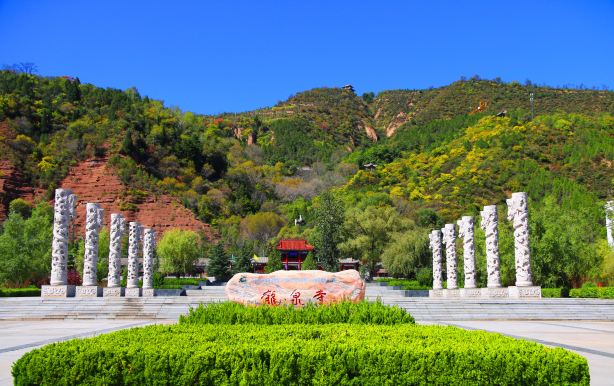
Longquan Temple
Longquan Temple is located on the hillside of Fengshan Mountain on the north side of Chongxin County, Pingliang City. It is a tourist attraction in Chongxin County. The temple is built on the mountain, with streams and trees in the mountains. You can come here to worship Buddha and pray for blessings, and you can also roam among the mountains and rivers to feel leisurely and comfortable. Fengshan Mountain where Longquan Temple is located is about 300 meters high. It is generally appropriate to walk around here for 2-3 hours. The mountain is surrounded by green trees, and there are two springs, Guanzhu Spring and Nonglu Spring, and a stream flowing along the mountain. The environment is very beautiful. The entire temple is built on the mountain, and the buildings are built along the hillside. You can come to worship Buddha and pray for blessings. On the west side of the temple, there is a Qijia cultural site with underground houses, pottery kilns, etc. You can visit and visit the ancients. In the mountains of Longquan Temple, there are also sculptures of giant dragons, Zuixian Pavilion, Xiyan Spring, Panlong Pavilion, Longtan, Longspit Rainbow and other landscapes, which can be visited by strolling.Chongxin · 1.6 km from downtown

Pingliang Museum
The predecessor of Pingliang Museum was thePingliang Regional Museum, established in 1979. It is situated on Baota Liang, the former site of Yan'en Temple within the Ming Dynasty Prince Han's Zijin City. It is a national public cultural institution affiliated with the Pingliang Municipal Bureau of Culture, Radio, Television, Press and Publication. It is a division-level institution and one of only 3 national second-grade museums among city (prefecture) museums in Gansu. Its main functions include social education, cultural relic collection and research, exhibitions, and archaeological excavations. The museum houses 11,565 items across more than 10 categories, including bronzeware, ceramics, gold and silver ware, jade artifacts, stone inscriptions, murals, calligraphy, paintings, and shadow puppets. Among these, 842 are classified as national precious cultural relics. It is a comprehensive historical and cultural museum that integrates cultural relic collection, exhibitions, academic research, and social education. It opened to the public in 2008, receiving nearly 1,000 visitors daily and approx. 300,000 visitors annually.Pingliang · 5 km from downtown

Kongtong Ancient Town
The overall design of the ancient town imitates the architectural style of Ming and Qing Dynasties. The four city gates creatively restore the ancient Pingliang city gates. The roads are crisscrossed, surrounded by flowing water, and the scenic spots are inlaid in it. It not only shows the profoundness of Kongtong culture, but also reflects the beauty of southern gardens, and runs through the traditional cultural landscape and the ecological and environmental protection concept of harmony between man and nature.Pingliang · 7.8 km from downtown

Zhuanglang Terraced Fields
Zhuanglang · 18.3 km from downtown

Liuhu Park
Liuhu Lake is located in the center of Pingliang City, covering an area of more than 88,000 square meters, or 133 acres, of which the lake area is 32 acres. It is a famous natural landscape garden in Longdong. Liuhu Lake was built in the first year of Xining, Emperor Shenzong of the Northern Song Dynasty (AD 1068). Cai Ting, then the prefect of Weizhou, drew springs into the lake. Because willow trees are suitable for water, willows are planted everywhere. . During the Jiajing period of Ming Dynasty, King Zhao Wang of Han Dynasty occupied the garden and made a large-scale expansion. After Qianlong in the Qing Dynasty, it was repaired several times. In the fifth year of Qianlong (AD 1740), it was renamed "Baiquan Academy" and later changed to "Gaoshan Academy". In the early years of Tongzhi, Liuhu Lake was destroyed by war. In the 12th year of Tongzhi, Zuo Zongtang, the governor of Shaanxi and Gansu, stationed in Pingliang, restored it again, changed its name to "Liuhu Academy", and inscribed the plaque "Liuhu". In 1926, it was changed to the Seventh Normal School of Gansu Province. The victory of Willow Lake begins with the warm spring. There is a warm spring on the ground, the water temperature is about 17 ℃, and the four seasons are smooth. The warm spring is the source of Liuhu Lake. There is a stone tablet next to the spring. On it is the two characters of "Nuanquan" inscribed by Zuo Zongtang, and below it is "Plain cool and high and cold, the water spring is very cold. Also" and other inscriptions. Now the warm spring has been renovated and surrounded by iron fences to protect it. Willow Lake is famous for its peculiar "willow in the lake, willow in the lake". In the late spring, the catkins are light and fluttering in the lake. It is known as "Liuhu Lake Qingxue" and is listed as one of the eight scenic spots in Pingliang. "The clear light reflects the wild pond, and the white snow spreads all over the sky. Jade shavings dance in the air, and pieces of silver light go crazy around the shore. The clothes are wet under the moon, and the face is not cold before the wind. Willow Lake is full of West Lake interest. , provoked the saucy people to grow up." This is the ancients' ode to "Liuhu Qingxue".Pingliang · 935m from downtown
Free things to do in Pingliang


What travelers say about Pingliang

Anonymous userOctober 21, 2026
5.0
This is the premier Taoist site and definitely worth a visit. The mountain is very high, and the steep steps are difficult to climb up and even more difficult to descend. We took the scenic area bus to Zhongtai, climbed the Imperial City, and then walked to Xiangshan. We took the scenic area bus down the mountain in 40 minutes.
Kongtong Mountain

M29***62April 22, 2020
5.0
Dayun Temple in Jingzhou was built on the original site of Daxingguo Temple in the Sui Dynasty. The stone casket, relic bottle and relics under the original pagoda base were taken out, and the most skilled craftsmen in China at that time who were good at making miniature gold and silver wares were invited to select the most precious pearls, jade and gems of the time. The highest wisdom of an era was condensed, and gold and silver were carved to make gilded bronze boxes and gold and silver coffins. 14 Buddha bone relics were placed in glazed bottles and matched with stone caskets. They were reburied in the underground palace in 694 AD, and a pagoda was built to enshrine them. This was 180 years earlier than the underground palace of Famen Temple in Fufeng, Shaanxi.
Queen Mother of the West Cultural Scenic Area
Anonymous userOctober 10, 2024
4.0
As the most famous scenic spot in Zhuanglang County, the overall impression is good, with typical Danxia landforms, and the playability is equivalent to the Xianren Cliff Scenic Area in Tianshui, and the area is larger, with grottoes, temples, reservoirs, and pleasant scenery. It may take more than 6 hours to visit all of them. There are many guide maps in the scenic area, and basically every small scenic spot has one, which is better than many scenic spots. The only small drawback is that there is only a simple toilet from the entrance of the scenic area to the reservoir dam, which is far away and very inconvenient.
Yunya Temple National Forest Park
Anonymous userAugust 2, 2025
3.0
They are all rushing for the UFO🛸 suspension bridge...
Haizhaigou Sceneic Area

行走毛毛December 9, 2025
5.0
China has many grottoes worth visiting, and today I'd like to recommend the South Grotto Temple in Pingliang. It's not as famous as the North Grotto Temple, but I prefer its tranquility. There aren't many tourists; I could enjoy it all to myself. Although it has suffered some significant weathering, it doesn't detract from its grandeur.
South Grotto Temple

M49***66August 14, 2023
5.0
Longquan Temple is a large-scale temple, covering an area of more than 16,000 square meters and a building area of more than 4,000 square meters. The overall layout of the building is three courtyards. The first courtyard is from the mountain gate under the Kuixing Tower. After entering the temple, there is a welcoming pine tree to welcome and see off the people coming and going. The buildings in the first courtyard include the City God Temple, the God of Vehicles Temple, the God of Roads Temple, the Tai Sui Temple, the God of Fire Temple, the Dharma Protector Hall, the Grand Theater, the Dragon Sculpture, and the Release Pond.
Longquan Temple

开心天涯客January 12, 2021
4.0
This is a relatively large comprehensive museum located in the center of Pingliang City. The building is simple and beautiful, and the collection is rich. Its special feature is that there are many historical artifacts unearthed locally. They are ancient, well-preserved, and of great historical and cultural value.
Pingliang Museum

No.5旋风小子June 26, 2022
4.0
This ancient town is a commercial ancient town at the foot of Kongtong Mountain. There is a small town here, but now it is much larger due to commercial reasons. You can still buy some water here before going up.
Kongtong Ancient Town

北京黄非红May 20, 2022
5.0
Zhuanglang Rice Terraces are large-scale rice terraces. They are free and spectacular to watch from the mountain. There is a viewing pavilion on the roadside at the top of the mountain. The pavilion is a bit short, so it would be better to build a high viewing platform for viewing. It is even more beautiful when the flowers bloom.
Zhuanglang Terraced Fields

有文化的女士February 20, 2023
4.0
The sky and water merge into one, making it a great weekend getaway for kids in all seasons. There are many activities for kids to enjoy, including boating, painting, fishing, and playing in the playground. There are also bumper cars, but younger children need to be accompanied by their parents.
Liuhu Park


