Things to do in Rongjiang
Explore top experiences
Top 10 attractions in Rongjiang


Rongjiang Dali Dong Village Scenic Area
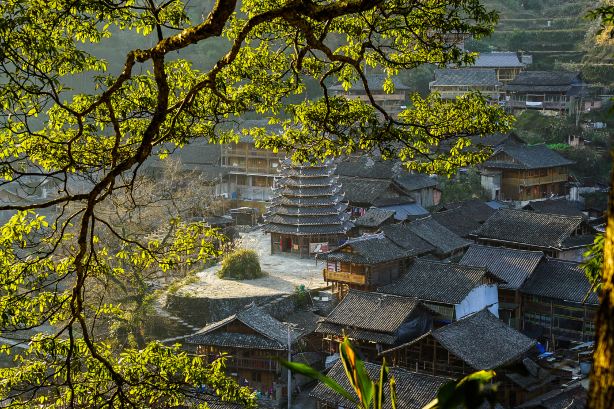
Rongjiang Dali Dong Village Scenic Area is hidden deep within the mountains and valleys of Qiandongnan. It is an ancient Dong village with a history of over 600 years. The entire village's architecture is constructed using mortise and tenon joints, without a single nail or rivet. The stilt-style wooden buildings, built along the creek, are arranged in a well-ordered, staggered manner, featuring both Dong-style courtyard houses and clusters of old granaries and grain-drying racks; five Wind and Rain Bridges—Zaitou, Shangbu, Zhongbu, Xiabu, and Zaiwei—span across the creek, their blue-tiled wooden corridors forming a bridge complex view that is rare among Dong villages. A four-cornered, nine-layered, dense-eave, pointed-roof Drum Tower stands in the village, where Dong Grand Songs and Dong operas have been passed down from generation to generation. When there are rehearsals or visitors, singing can be heard in the Drum Tower. The village is surrounded by towering ancient trees, with groves of ancient nanmu trees providing dense shade, making it exceptionally quiet.Rongjiang · 16.8 km from downtown

Sanbao Qianhu Dong Village Scenic Area
Chejiang Sanbao Dong Village, also known as "Thousand Household Dong Village", is a village with a relatively dense population of Dong people in the country. It consists of three villages, Zhanglu, Zhaitou and Motang, with more than 800 households and more than 3,000 people. After entering the village, I saw an ancient banyan tree, and there was a cobblestone-paved street among the trees, which the locals called: Flower Street. Flower Street is about 500 meters long. There is a sculpture at the end of the road, consisting of a man and a woman, the man's name is Zhulang, and the woman's name is Niangmei. In the 1950s, China once made a movie called "Qin Niangmei", which told a Chinese-style "Romeo and Juliet" story, and this is the hometown of Niangmei. Because of its unique natural conditions and strong ethnic customs, Sanbao Dong Village has become one of the tourist attractions for Chinese and foreign tourists to Dong Township.Rongjiang · 4.6 km from downtown

Baibei Miao Village
Baibei Miao Village is one of the oldest Miao villages in Moon Mountain. Historical records record that the Ming Dynasty moved from Damiao Mountain in Guangxi along the Liujiang River. It has a long history and has a simple, strong ethnic characteristics and rich ethnic cultural heritage. It was designated as a Miao folk village in Southeast Guizhou. The Miao bird feather clothes here are colorful and simple and unique, reflecting the skillful and delicate embroidery craftsmanship and unique aesthetic taste of the Miao people. The Drum Tibetan Festival is one of the most solemn and ancient traditional festivals of the Miao people. It is held every thirteen years. It kills pigs and cattle, worships ancestors, and entertains guests and friends. The festival is grand in scale and warm in atmosphere. In addition, the "Ancient Scoop Dance" and "Lusheng Dance" of the Baibei Miao people are cheerful and lively in rhythm. Baibei Miao Village is known as the "open-air Miao Folk Museum".Rongjiang · 36.9 km from downtown

Xiaodanjiang Village
A small river flows around Xiaodanjiang Village, which is nestled against the mountains and situated by the water. Surrounded by mountains on all sides, the village is embraced by lush green mountains and bamboo forests, with layers of rolling peaks of primeval forests all around, and is rich in authentic and traditional Miao culture.Rongjiang · 48.5 km from downtown

Zaidang Dong Village
Zaidang Dong Village is located in the northeast of Rongjiang County, Guizhou, surrounded by ancient maple trees, gurgling creeks, rural pastoral scenery, and unique charm. The Dong people living here belong to one of the six major branches of the Dong people in Rongjiang. The buildings of the Dong people here are also very distinctive, among which the "ganlan" buildings reflect the traditional architectural style of the Dong people. There is a Dong nationality drum tower in the village. It was built in the Qianlong period of the Qing Dynasty. It has a majestic appearance and unique shape. This is the hometown of the famous Dong people's great songs. The Dong nationality big song is a polyphonic music with a branch tone. The lyrics mainly sing about love, sing praises to the heroes of the nation, and reproduce real life and history. The customs of the Dong people in Zaidang include the intriguing marriage custom of "not falling out of the husband's family", the "Sacrificing Sa" festival that has been handed down for thousands of years and bears the imprint of the matriarchal clan of the Dong people, and the Dong people on the sixth day of the sixth lunar month to thank the cattle. "Cow Washing Festival".Rongjiang · 14.7 km from downtown

Xijiang Qianhu Miao Village
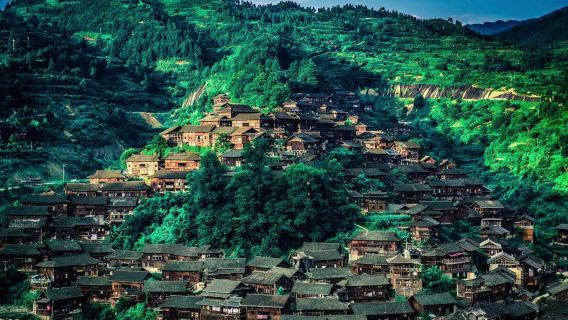
Xijiang Qianhu Miao Village is a collection of over ten natural villages built along the mountainside, inhabited by the "Xi" clan of the Miao people. The village features layers of wooden stilt houses on the slopes, with coffee-colored old houses nestled against lush green mountains. The Baishui River divides the village in two. The side of the river (to the left after entering the Xiaobei Gate for travelers) is mainly a commercial pedestrian street, while the opposite side (to the right after entering the Xiaobei Gate for travelers) is primarily the viewing platform overlooking the village. Upon arriving at Xijiang Qianhu Miao Village, you'll see a gate with the plaque "Xijiang Qianhu Miao Village" after getting off at the parking lot. From this gate to the village is a 1.5 km walk, which you can cover either by electric bikes or on foot. After this 1.5 km stretch, you'll encounter another gate similar to the one at the parking lot, also bearing the "Xijiang Qianhu Miao Village" plaque—this marks the true entrance to the village. First drink the welcoming wine, then enter the village. The first thing you see is the commercial pedestrian street, selling a dazzling array of Miao ethnic specialty products. The most eye-catching are the Miao silver ornaments. Kongbai in Xijiang town of Leishan near the Miao village is a well-known silversmith village, where almost all the men master the silver ornament making techniques, and the craftsmanship of Miao silver is exquisite. The performance venue in the pedestrian street area offers Miao ethnic song and dance shows. You can also visit the Xijiang Miao Ethnic Museum and the Drum Head's House (the Miao king's residence, where a bronze drum is enshrined). Alternatively, take a stroll along the Baishui River to see the wind-and-rain bridges with roofed eaves sheltering from the elements, or the low, narrow wooden plank bridges. At the end of the village lies a pastoral landscape, where even during peak season few visitors come. Across the river is a station for electric bikes to the viewing platform, but walking there isn't far, and several spots along the way offer excellent views. Upon reaching the viewing platform, wait for nightfall—the grand spectacle of Xijiang is just beginning. Thousands of lights illuminate from beneath the eaves of wooden stilt houses, dotted like stars to outline the entire Miao village in the shape of an ox head. It's hard to imagine such a brilliantly lit scene in a mountain village. Returning to the viewing platform at dawn, the Miao village is shrouded in mist as the first sunlight gilds the wooden houses golden. Smoke curls up from chimneys, marking the start of a new day. In Miao villages, you can often see Miao women with their hair buns coiled on top of their heads and adorned with large flowers. Just looking isn't enough—you can also rent a few sets of Miao costumes to dress up as a Miao woman yourself. It's especially beautiful and very popular among young women. Xijiang Qianhu Miao Village has mature tourism development, with no worries about food and accommodation. For dining, the famous option is the long-table banquet. Restaurants in the village will often ask if you'd like to try it—simply joining tables to make them longer counts as a long-table banquet, serving as a fun experience. The authentic long-table banquet is held outdoors, with dozens of tables connected end-to-end, sometimes so long that you can't see from one end to the other. These are set up during important festivals or when significant group tours visit, so don't miss the chance if you encounter one. The cuisine of southeastern Guizhou tends to be sour, and the village's specialty dishes include sour fish soup, pickled vegetables, and cured meat.Leishan · 71.6 km from Rongjiang

Jiabang Terraced Fields
Jiabang Terraced Fields is located in the northeast of Jiabang Township in the west of Congjiang County. It is a masterpiece of the Miao people's stockades for generations. The stilted buildings scattered among the terraced fields with unique Miao Township characteristics are like notes in a staff. The terraced fields climb up from the Jiache River Valley around the mountain ridges, like a "heavenly ladder" connecting the heaven and the earth, with a height difference of nearly a thousand meters. The rice fields of the Miao people are built along the mountains and change with the topography of the mountains. Jiabang terraced fields are the essence of the world's terraced fields, not only large in scale, but also beautiful in lines. It is more beautiful than the Yuanyang terraced fields in Yunnan, more spectacular and attractive than the Longsheng terraced fields in Guangxi, especially the mountain villages, small villages and terraced fields among the terraced fields complement each other and integrate with nature, reflecting the beauty of harmony between human beings and nature. . While glutinous rice is grown in the Jiabang terraces, carp and ducks are also raised. This ancient system of rice, fish and duck co-production has been listed as an important global agricultural cultural heritage.Congjiang · 38.3 km from Rongjiang

Huangguoshu Scenic Area
The Huangguoshu Scenic Area is located in Anshun, Guizhou, centered around the Huangguoshu Waterfall. Surrounded by deep gorges, dense vegetation, and dotted with limestone caves and stone forests, it is a typical karst landscape area. The waterfall's name originates from the locally abundant "Huangguoshu" (Ficus virens). Ming Dynasty traveler Xu Xiake visited and documented this site, contributing to its fame. The scenic area primarily consists of three main sections: the Great Waterfall, Tianxing Bridge, and Doupotang. Most travelers follow the sequence of Doupotang, Tianxing Bridge, and finally the Great Waterfall, saving the most spectacular view for last. The grand waterfall has a drop of nearly 80 m and a width of over 100 m. The Baishui River plunges from the cliff top into Rhinoceros Pool, creating a vast mist. Multiple viewing platforms around it allow visitors to experience its grandeur, wonder, steepness, and beauty from different angles—above, below, front, back, left, and right. A particularly unique experience lies behind the waterfall: a 100 m long Water Curtain Cave runs horizontally through its midsection, featuring cave windows and halls. Reaching through a window, one can touch the cascading water. The cave served as the filming location for the Water Curtain Cave in the 1986 TV series Journey to the West. Due to the heavy humidity inside, bringing a raincoat in advance is recommended. Tianxing Bridge is renowned for its harmonious blend of rocks, water, trees, and caves—where rocks rise from the water, caves hide within rocks, and trees stand beside caves. The stepping stones along the path are engraved with dates, allowing travelers to find their own "birthday stone." The attraction is divided into upper and lower sections. Many travelers turn back after completing the upper section, missing the Silver Chain Waterfall in the lower part—where water cascades like silver chains into a funnel-shaped pool, the highlight of Tianxing Bridge. The Doupotang waterfall is located approx. 1 km upstream from the grand waterfall. With a width of over 100 m at its crest, the water spreads out smoothly like a beaded curtain. During the high-water season, its deep roar earns it the nickname "roaring waterfall." The scene of the four pilgrims leading their horse across the river in the 1986 TV series Journey to the West was filmed here. In summer and fall, the waterfalls are full and powerful, while in winter and spring, the flow becomes gentler, offering different viewing experiences. Nearby, visitors can also enjoy local snacks like sticky rice, love tofu, and Anshun spring rolls.China · Zhenning

Fanjing Mountain
Fanjing Mountain is located in Tongren, northeastern Guizhou province, with an elevation of 2,572 m. As the highest peak of the Wuling Mountains, it is a member of the UNESCO "Man and Biosphere" program, a World Natural Heritage site, and a national 5A-level tourist attraction. The Mount Fanjing Biosphere Reserve covers a total area of 428.63 km². The mountain is characterized by its pristine wilderness, majestic peaks, layered ridges, crisscrossing streams, and cascading waterfalls. Its iconic attractions include the Red Clouds Golden Summit, Yuejing Mountain, the 10,000-meter Sleeping Buddha, Mushroom Rock, the Ten Thousand Scrolls of Scriptures, Jiulong Pool, and Phoenix Mountain. Mount fanjing was originally named "three valleys", derived from "pure land of brahma". The buddhism here originated in the tang dynasty and flourished in the ming dynasty, making it a historic buddhist mountain. Additionally, mount fanjing boasts abundant wildlife resources, including rare species such as the guizhou golden monkey and dove tree. Mount Fanjing is the main peak of the Wuling mountain range, located at the junction of Jiangkou, Yinjiang, and Songtao counties. With its massive and majestic form reaching into the clouds, it was revered as the ancestor of famous mountains as early as the beginning of the Ming dynasty and is a renowned Buddhist sacred site. Additionally, Mount Fanjing boasts vast areas for viewing red leaves. Every fall, the layered forests are dyed in vibrant hues, with the red leaves complementing the mountain temples. Here, you can take a cable car to overlook the endless stretches of red foliage or stroll along the mountain paths, surrounded by fiery red leaves on both sides and above. The red cloud golden summit is the core of Foshan. The two temples standing majestically on the peak, with two buddhas presiding, create an infinite dharma realm. This masterpiece of the Southern Song Dynasty's White Lotus Society in constructing a "pure land on earth" is a miracle in the history of Buddhist development on famous mountains. Take the sightseeing bus from the attraction entrance to the cableway, then ride the cableway up and walk straight to the top to see the famous "mushroom stone." True to its name, it has a large top and a small base, resembling a mushroom, standing approx. 10 m tall and having been on the mountain for 1 billion years. To the left of the mountaintop is the red golden cloud summit, and to the right is the old golden summit, both incredibly spectacular.China · Jiangkou

Elephant Hill Scenic Area
The Elephant Hill Scenic Area is located in the heart of Guilin, at the confluence of the Li River and the Peach Blossom River. It derives its name from its resemblance to a giant elephant stretching its trunk to drink from the sweet waters of the Li River. In his work "Records of Elephant Hill," Shu Shu, a Qing Dynasty official from the Ministry of Works, wrote: "The marvels of Guangxi lie in its mountains; the marvels of Guangxi's mountains lie in their rocks, and the elephant-shaped hill facing the provincial capital is the most marvelous of all." With its lifelike form, the attraction captivates visitors and stands as a quintessential representation of Guilin's landscape. In 1995, it was designated as the city emblem of Guilin. The main attractions in the scenic area include: Elephant Hill and Water Moon, Puxian Pagoda, Elephant Hill Scenic Area and Guilin Sanhua Liquor, Elephant Hill Scenic Area - Love Island, and Elephant Hill Scenic Area - Yunfeng Temple Taiping Heavenly Kingdom Exhibition Hall. Elephant trunk hill and water moon cave "Elephant trunk hill and water moon" is a spectacular wonder here, as described in the poem by Ji Bei Hermit of the Song Dynasty.Harmony of water, moon and caveThe poem reads: "The moon is beneath the water, the moon floats upon the water. The water flows but the moon stays, the moon departs yet the water still flows." On a moonlit night, visiting the Water Moon Cave at the Elephant Trunk Hill attraction presents a magical scene where the moon in the sky, the cave, and the water reflect each other beautifully. Inside the cave, you can find the "Poem and Preface of the Morning Sun Pavilion" by Zhang Xiaoxiang from the Song Dynasty and works by Fan Chengda.Inscription on the water and moon caveAnd over 50 precious cliff carvings including Lu You's poetry manuscripts. Xiangshan scenic area - Puxian pagoda Winding up along the rocky cliffs, you can see the Puxian pagoda standing tall amidst the greenery from afar. Built during the Ming dynasty, this 13.6m-high solid brick lama-style pagoda has a history of over 400 years. On the northern side of the pagoda, there is a line-engraved bluestone statue of a bodhisattva, with the mantra "Namo Puxian Bodhisattva" inscribed above it, hence the name Puxian pagoda in the Xiangshan attraction. Buddhist scriptures record that Puxian bodhisattva's mount is a six-tusked white elephant, making the pagoda's location atop Xiangshan mountain a perfect embodiment of this scripture. Elephant Hill Scenic Area and Guilin Sanhua liquor This is a natural wine cellar, with two-thirds of the mountain being hollow. It stays warm in winter and cool in summer, maintaining a constant temperature of 19°C and humidity above 90% year-round. Since the Song Dynasty, it has served as an official cellar for storing Sanhua wine. Sanhua wine is colorless and transparent, with a fragrant yet spicy taste. It drawsLi RiverWith the essence of the mountains and the soul of the Li River, it has become a representative of China's rice-aroma liquor. The cellar liquor was designated as a tribute to the imperial court as early as the Northern Song Dynasty and is one of the three treasures of Guilin. To date, nearly a thousand tons of liquor are stored in the caves. Love island Love island is located on the north side of the attraction, adjacent toLi RiverIt is another scenic viewpoint for distant viewing. The island boasts a beautiful environment and lush vegetation, making it a popular dating spot for locals in the 1970s, hence the name "love island". Today, it serves as an outdoor photography base for wedding celebrations against the backdrop of Guilin's landscape, where couples make their vows of love under the witness of the elephant trunk hill and the moon reflected in the water.China · Guilin
Experiences you can't miss in Rongjiang
Featured Day tours in Rongjiang
View all Day tours
Free cancellation
Instant confirmation
From€36.51

From€483.73

Free cancellation
Instant confirmation
From€75.91


Free cancellation
Instant confirmation
From€39.55


Free things to do in Rongjiang
Rongjiang Dali Dong Village Scenic Area
Rongjiang · 16.8 km from downtownSanbao Qianhu Dong Village Scenic Area
Rongjiang · 4.6 km from downtownBaibei Miao Village
Rongjiang · 36.9 km from downtownZaidang Dong Village
Rongjiang · 14.7 km from downtown
Zhong Guo Tian Yan Jing Qu
China · Pingtang
Fenghuang Ancient Town
China · Fenghuang County
Zhenyuan Ancient Town
China · Zhenyuan County
Rongjiang Guzhou Old Street
Rongjiang · 88m from downtown
What travelers say about Rongjiang

行走毛毛December 18, 2024
5.0
The reason why Dali Dong Village has become popular is largely because it is located in the mountains. To get here, you need to climb a relatively narrow mountain road, but when you get here, you will find that the entire East Station is very quiet. There are not many tourists, but it will be troublesome during holidays because the road is narrow and there will be traffic jams.
Rongjiang Dali Dong Village Scenic Area

M29***62March 21, 2020
5.0
Sanbao Dong Village is located in the dam area of Chejiang Township, Rongjiang County, 5 kilometers away from the county seat. It includes ten villages and nine villages, including Chezhai and Enrongbao. The Dong Village is connected by villages of different sizes, divided into upper, middle and lower Baozhai, collectively known as "Sanbao Dong Village". There are 2,648 households and 13,197 people, mainly Dong people. It is the most densely populated area of Dong people in China, and there are also Han people and other ethnic minorities living here.
Sanbao Qianhu Dong Village Scenic Area

186***79November 10, 2019
5.0
Although it is 50 kilometers away from the county town, the road is indeed difficult to drive. There is a landslide on the national highway in the middle, and you have to take a detour. Baibei is indeed an undeveloped natural Miao village. When I arrived at noon, I met two elderly people fighting each other over trivial matters. It is worthy of the record that it is a tough village! However, like other villages, most of the young people in the village have embarked on the journey of working, and left-behind children and lonely elderly people are common scenes in the village.
Baibei Miao Village

华-RainbowApril 21, 2022
4.0
Zaidang is a village that inherits the Dong ethnic group's grand songs. It has pristine scenery, enthusiastic farmers, and beautiful Dong ethnic group songs.
Zaidang Dong Village

Anonymous userOctober 22, 2026
5.0
Choosing the right accommodation is crucial when visiting the Miao Village! The view from Luanxi is absolutely stunning; you can admire the stilted houses and the lights of countless homes right from your room, without having to squeeze onto the viewing platform. It's just steps from the popular photo spots, the room was impeccably clean, and the bedding was comfortable. Once we arrived at the scenic area, the butler helped with our luggage, explained the sightseeing routes, and recommended some delicious restaurants – we ate there twice! The hotel offers afternoon tea and a bedtime soup; highly recommended, I'll definitely stay here again next time I visit the Miao Village.
Xijiang Qianhu Miao Village

拉美西斯喵September 15, 2026
5.0
It was nice; I saw different views of the terraced fields during the day. At midnight, I glanced up and saw a sky full of stars. There's a walking path and a shuttle bus beside the road. At Terrace No. 5, you can walk all the way into the rice paddies.
Jiabang Terraced Fields

139***82October 21, 2026
5.0
I've visited Huangguoshu Waterfall Scenic Area three times over 30 years. It's considered one of the most beautiful waterfalls in Asia, and the town of Huangguoshu is also quite well-developed. Although the water flow was lower this year, it was still incredibly magnificent, powerful, and thunderous. This time, I had the opportunity to fully appreciate the unique features of the waterfalls in all three sections. If the main waterfall is the head of the family, powerful and imposing, then the upstream Doupotang Waterfall is the steady son, refined and elegant, while the downstream Yinlian Waterfall is the emerald green jade, endlessly captivating and always brimming with charm!
Huangguoshu Scenic Area
Anonymous userOctober 23, 2026
5.0
It’s misty but at least not raining, climbed all 3 peaks- 红云今顶、老金顶 和蘑菇石… Into the park at 7.42am, no queues at all and out around 2pm after conquering all 3 peaks!
Fanjing Mountain

M45***48September 25, 2026
5.0
When visiting Guilin, a must-see is Elephant Trunk Hill, the city's iconic landmark. It truly lives up to its reputation as the face of Guilin's landscape; only by seeing it in person can one truly appreciate the wonders of nature. The entire mountain sits on the banks of the Li River, resembling a giant elephant bowing to drink from the water. The Water Moon Cave cuts through the mountain, its reflection shimmering in the water, creating the famous Elephant Trunk Hill and Water Moon spectacle—a flowing ink painting.
The scenic area is clean and comfortable, with walking paths built along the Li River, shaded by lush trees, making for a delightful stroll. You can climb the mountain for panoramic views of Guilin, or find classic vantage points along the riverbank to capture stunning, atmospheric photos. Boat trips are also available, offering a different and breathtaking perspective of Elephant Trunk Hill from the river.
The scenic area is conveniently located in the city center, with excellent transportation and comprehensive facilities. Every step reveals a new vista, allowing you to truly experience the unparalleled beauty of Guilin's landscape. Don't miss it when traveling to Guilin; it's definitely worth a visit.
Elephant Hill Scenic Area


