
Things to do in Yang County
Explore top experiences
Top 10 attractions in Yang County


Xi'an Bell Tower
Xi'an Bell Tower is one of the larger and well-preservedBell tower, originally built in 1384, during the Hongwu reign of the Ming Dynasty,Bell towerLocated in the heart of Xi'an, it is one of the landmarks of the ancient city, radiating east, south, west, and north streets from its center, connecting to the east, south, west, and north gates of the Xi'an city wall respectively. The Xi'an Bell Tower was originally located on Guangji Street in the west. As the city center shifted eastward, it was relocated toDrum towerEast side, today's location. The Xi'an Bell Tower features a typical Ming Dynasty architectural style, with a square brick-and-stone base at the bottom and a triple-eaved pyramidal roof structure at the top, covered with dark green glazed tiles. The gilded pinnacle at the roof's apex is particularly striking under sunlight. Each side of the base has a central arched doorway approx. 6 m high, which were interconnected and once served as passageways for the intersection of four major streets—east, south, west, and north—allowing pedestrian and vehicular traffic. These doorways are now sealed, with a traffic roundabout built around them and an underground pedestrian passage. The entrance to the Xi'an Bell Tower is located within this underground passage, accessible via a spiral staircase. Inside the tower, there is a replica of the "Jingyun Bell," whose original was cast in the second year of Emperor Ruizong's Jingyun era (711 AD) during the Tang Dynasty and is now housed in the Xi'an Beilin Museum. Standing on the Xi'an Bell Tower, you can see the four main streets extending east, south, west, and north from the Xi'an Bell Tower. Around the Xi'an Bell Tower, there are bustling commercial areas and not far awayDrum towerTravelers can also enjoy wonderful historical performances when visiting the Xi'an Bell Tower.China · Xi'an

Museums in Xi'an
Xi'an Museum Tour explores imperial, archaeological, and artistic key museums with immersive activities, revealing the ancient capital's history across thirteen dynasties. Imperial Mausoleum Site Museums:Unearth the secrets of the Terracotta Army. At this UNESCO-listed site, witness the “Eighth Wonder of the World”—a stunning display ideal for history enthusiasts and families to explore the legacy of the Qin Dynasty. Archaeological Science & Art Museums:Get hands-on with the science of excavation. Here, visitors engage with restored artifacts, tech-assisted archaeology, and exhibits on cultural progress—highlighting the blend of science and art behind uncovering the past. Stele Calligraphy Art Museums:Dialogue with stone-carved classics. Home to steles, epitaphs, and calligraphic masterpieces, this museum offers a journey through the evolution of script, Confucian texts, and the legacy of Central Plains civilization. Prehistoric Sites & City History Museums:Trace the roots of ancient Chang'an. The Banpo Museum showcases a 6,000-year-old matriarchal village, while Xi'an Museum combines the Xiaoyan Pagoda landscape with artifacts from Zhou to Tang dynasties, illustrating the city's birth and growth. Museum Combo Tour: A curated combination of museum visits that weaves together iconic collections to form a holistic understanding of Chang'an from multiple perspectives, offering profound insights into the cultural legacy of this ancient capital of thirteen dynasties.China · Xi'an

Tang Paradise
Tang Paradise, a national 5A attraction, is located in Qujiang New District in the south of Xi'an City, not far away from the Big Wild Goose Pagoda. It covers an area of 998 acres, including 300 acres of water area, 440 acres of green space, and a construction area of nearly 100,000 square meters. The overall planning and architectural design of the park's architecture is by Mr. Zhang Jinqiu, an academician of the Chinese Academy of Engineering, and the garden landscape design is by Mr. Hiroshi Akiyama, a Japanese garden master. It is a large-scale cultural theme heritage park that comprehensively displays the style of the prosperous Tang Dynasty. Since its official opening to the outside world on April 11, 2005 (the third day of the third lunar month), it has been committed to creating high-quality, high-standard brand tourist attractions. Tang Paradise aims to build "a garden of history, a garden of spirit, a garden of nature, a garden of humanity, and a garden of art". It specially invited more than ten Tang historians, Tang poems, Tang paintings, etc. from the China Tang Dynasty Literature Society. An expert group composed of Tang construction experts, doctoral supervisors, researchers and tourism experts re-excavated and sorted out the historical and cultural content of Tang Paradise, re-planned and positioned the entire garden landscape, and divided into fourteen ares including the imperial cultural area, female Cultural area, poetry culture area, imperial examination culture area, tea culture area, song and dance culture area, food culture area, folk culture area, diplomatic culture area, Buddhist culture area, Taoism culture area, children's play area, gate landscape culture area and water show performance area, fully reproduce the splendid civilization of the Tang Dynasty. There are more than 20 scenic spots such as Ziyun Tower, Ladies Pavilion, Lu Yu Tea House, Apricot Garden, Caixia Corridor, Qujiang Drinking, Beauty Walk, Tang Poetry Gorge, Dogwood Terrace, etc. It displays the Tang Dynasty's dazzling spiritual outlook and splendid and unparalleled culture and art. It is known as a tourist attraction that “shocks the Chinese people and amazes the world”. The theme performance of the attraction is the large-scale water dance light and shadow show "Chasing Dreams of the Tang Dynasty", and you can take a boat trip to the dreamy holy land; the large-scale super-dimensional situation dance drama "Dreams of the Tang Dynasty" is majestic and dreamlike; the palace Yan music of the Tang Dynasty "Drums" performs Dongcang drum music, an intangible cultural heritage of mankind, as well as high-quality cultural tourism activities such as the New Year Festival, Shangsi Festival, and Qujiang Flower Moon Banquet. Brands and projects. The multiple Complimentary attractions and exciting performances every day are a warm invitation from the Tang Dynasty royal family to tourists, allowing them to experience the sacred and grandeur of royal culture in a shocking way. As a theme heritage park with excellent quality, full of personality and rich cultural connotation, Tang Paradise is a cultural window for Xi'an to show the world the ancient historical heritage of Chang'an and the prosperous Tang Dynasty, and a cultural gateway to attract the world to understand China...China · Xi'an

Jianmen Pass
The Jianmen Pass is located in Jiange County between Dajian Mountain and Xiaojian Mountain. It has been famous throughout history, holding an important position militarily due to its precipitous topography and ease of defense. Visitors to the scenic area can take the easier “Bird Path” of the mountain, or the “Ape Route,” which requires renting professional mountain climbing equipment.China · Jiange

Big Wild Goose Pagoda
The Big Wild Goose Pagoda is located in the Da Ci'en Temple in the southern part of the city. The Da Ci'en Temple was a magnificent royal temple in Chang'an during the Tang Dynasty. It was built during the reign of Emperor Taizong of the Tang Dynasty by Crown Prince Li Zhi in memory of his mother, Empress Wende, and was first abboted by Master Xuanzang, who had returned from his journey to the West to seek Buddhist scriptures. During this period, the master supervised the construction of the Dayan Pagoda. Master Xuanzang translated Buddhist scriptures and promoted Buddhism in Da Ci'en Temple for 11 years, and founded the "Appearance-Only School" of Buddhism, making Da Ci'en Temple the ancestral temple of the Appearance-Only School (also known as the "Faxiang School"). During this period, the master personally supervised the construction of the Dayan Pagoda to enshrine the scriptures, statues and relics brought back from India. The current Da Ci'en Temple was built in the Ming Dynasty on the basis of the original temple "West Pagoda Courtyard", and most of the existing halls are buildings from the Qing Dynasty. The main buildings on the central axis of the temple are the Great Hall, the Dharma Hall, the Dayan Pagoda, and the Xuanzang Tripitaka Courtyard. Among them, the Buddha's relics enshrined in the Big Wild Goose Pagoda and the parietal bones of Master Xuanzang are respectively enshrined in the Xuanzang Tripitaka Courtyard, which are the "treasures of the temple" of Da Ci'en Temple. To the east of the central axis of the temple is the Pagoda Garden. Within the garden are nine stupas housing the relics of nine eminent monks of the temple since the Qing Dynasty. There are squares to the south and north of Da Ci'en Temple. There are also Shaanxi History Museum and Tang Paradise Souvenir .China · Xi'an

The Longest Day in Chang'an Theme Block
The Longest Day in Chang'an Theme Block is based on the culture of Tang Shijing culture, with the IP of the series "The Longest Day in Chang'an" as the theme, and with immersive experience as the core, in architecture, soft decoration, coins, characters, clothing, language, music Tang-style packaging in fields such as stories etc. At the same time, around the in-depth immersive story experience, supporting catering, cultural and creative, performing arts and other business content are set up to create an overall Tang space play, Tang-style market experience, themed immersive interaction, and Tang music, song and dance performances, cultural social leisure, etc. are integrated into the cultural experience of the whole Tang market.China · Xi'an

Xi'an Beilin Museum
The Xi'an Beilin Museum is located near Wenchang Gate, consisting of sections such as the stele forest and stone carving art. The stele forest, composed of steles and epitaphs from various dynasties, is the highlight of the museum, including steles by famous calligraphers like Yan Zhenqing, Liu Gongquan, and Huaisu, as well as the "Stone Classics of Filial Pietyand the Kaicheng Stone Classics, two stone tablets from the Tang dynasty. The collection contains numerous exquisite stone inscriptions In the Xi'an Beilin Museum, you can appreciate steles and epitaphs from various dynasties, with a collection spanning over 2000 years. Among the treasures are: Yan Zhenqing's "Yan Qinli stele", "Yan family temple stele" and others are standard "Yan style"; Liu Gongquan's "Mysterious Pagoda Stele of Master Dada" is a typical representative work of "Liu style"; the "Stele inscription of the preface to the sacred teachings of the Tang Dynasty's Tripitaka"; the renowned cursive script master Huaisu's "Thousand-character classic" exhibits unrestrained brushwork. The Classic of Filial Piety on Stone Tablet and the Kaicheng Stone Classics are very popular Besides the stone carvings by calligraphy masters, the two most popular stone tablets among travelers are the Classic of Filial Piety on Stone Tablet and the Kaicheng Stone Classics. The Classic of Filial Piety on Stone Tablet is a Confucian classic. Its inscriptions were written by two emperors in four scripts: Emperor Xuanzong of Tang (Li Longji) wrote the main text in clerical script and added small annotations in regular script, later adding marginal notes in running script after the tablet was carved. The tablet's heading was written in seal script by Emperor Suzong of Tang (Li Heng). The Kaicheng Stone Classics were carved in the second year of the Kaicheng era (837 AD) during Emperor Wenzong of Tang's reign, comprising twelve classical texts including the Book of Songs, Book of Documents, Book of Rites, Book of Changes, and Spring and Autumn Annals. You can purchase rubbing copies When browsing in the Xi'an Beilin Museum, you can also admire exquisite stone carvings such as the tomb gate with four divine creatures, the six steeds of Zhao Mausoleum from the Tang Dynasty, the meeting of Confucius and Laozi, and the azure dragon and vermilion bird in the "Stone carving art gallery". After the visit, you can purchase "rubbings" made from the original steles.China · Xi'an

Giant Wild Goose Pagoda Cultural Leisure Scenic Area
The Giant Wild Goose Pagoda Cultural Leisure Scenic Area centers on the famous Tang Dynasty Big Wild Goose Pagoda and integrates Tang Dynasty cultural exhibits, landscaped gardens, and urban leisure. The scenic area consists of the North Square, South Square, and the Yanta East, West, and South Gardens, all connected by the theme of Tang culture. The North Square is the core area, featuring a large musical fountain in the center where water jets rise and fall with the rhythm of the music, making it a highlight for visitors. The Yanta West Garden focuses on Shaanxi folk customs, featuring sculptures that showcase traditional Guanzhong life and customs. The South Square features a bronze statue of Master Xuanzang and is a great spot for photographing the entire pagoda. After the lights come on in the evening, the musical fountain and the illuminated pagoda create a stunning display, making it a signature experience for night tours of the scenic area. When visiting, you can arrive at the square early to secure a good viewing spot. After the performance, you can stroll along the cultural corridor and admire the Tang Dynasty-themed sculptures on both sides.China · Xi'an

Daming Palace National Heritage Park
The Daming Palace, the grand imperial court of the Tang Empire, served as the political center and national symbol of the dynasty. As one of the "Three Great Palaces" (Daming Palace, Taiji Palace, and Xingqing Palace) in Chang'an, it was the largest and known as the "Eastern Palace." From Emperor Gaozong's reign onward, 17 Tang emperors conducted state affairs here for over 240 years. This magnificent architectural complex stood as one of the world's most expansive palace compounds during its time. The lines from poet Wang Wei's "Morning Court at Daming Palace in Response to Jia Sheren" – "The nine heavens' gates swing open to reveal the palace; envoys from myriad nations bow before the imperial crown" – epitomize the grandeur of Tang Dynasty's golden age, showcasing the empire's majestic authority and the solemn magnificence of imperial ceremonies. The Daming Palace was first built in the 8th year of Emperor Taizong's Zhenguan era (634 AD), covering an area of approx. 3.2 km². The entire palace complex can be divided into two main sections: the outer court for official assemblies and the inner court for residence and entertainment. The outer court centers around the Hanyuan Hall (outer court), Xuanzheng Hall (middle court), and Zichen Hall (inner court), while the inner court features the Taiye Pool along with over 30 auxiliary halls, pavilions, and observatories. The term "Daming" first appeared in the "Daming" chapter of "The Book of Songs: Greater Odes." According to the "Mao Commentary," it signifies: "King Wen possessed brilliant virtue, so Heaven again commanded King Wu. As King Wen and King Wu succeeded one another, their brilliant virtue daily grew more vast, hence the name Daming." Like the name Weiyang Palace, which also originates from "The Book of Songs," Daming Palace served as a self-motivating symbol inspired by the diligent governance and wisdom of the Zhou kings. The origin of Daming Palace is also associated with a fascinating legend. During its initial construction, an ancient bronze mirror was unearthed at the site. The renowned statesman Wei Zheng recognized it as the "Qin Mirror," a national treasure once used by Emperor Qin Shi Huang to eliminate political dissidents. Legend claims this mirror could reveal a person's internal organs with astonishing clarity. More significantly, it could distinguish loyal ministers from treacherous ones and predict the rise and fall of dynasties. After Daming Palace's completion, the Qin Mirror was hung in the imperial court to ward off evil spirits, giving rise to the idiom "a bright mirror hung high" (symbolizing impartial justice). With this treasure safeguarding the palace, the atmosphere became one of supreme integrity and enlightenment—hence the name "Daming Palace" (Great Illumination Palace). On March 4, 1961, Daming Palace was designated by the State Council of the People's Republic of China as one of the first batch of National Key Cultural Relics Protection Units. In 2010, Xi'an established Daming Palace National Heritage Park on the original site. On June 22, 2014, the Daming Palace ruins were successfully inscribed on the UNESCO World Heritage List as part of the "Silk Roads: the Routes Network of Chang'an-Tianshan Corridor." On October 18, 2021, the Daming Palace ruins were selected among the "Top 100 Archaeological Discoveries of the Century." The Daming Palace of the Tang Dynasty was a magnificent architectural complex in Chang'an city. The park is built on the ruins of Daming Palace, where visitors can see foundation remains of palaces like Hanyuan Hall and admire the restored miniature model of Daming Palace. The attraction has a south gate and an east gate, with the south gate serving as the main entrance where the visitor center is located. Visitors are recommended to enter through the south gate. The heritage park consists of both free and paid sections, with the paid area covering the core attractions including the Danfeng Gate Ruins Museum at Daming Palace National Heritage Park, Hanyuan Hall Ruins, Xuanzheng Hall, Zichen Hall Ruins, and the Daming Palace Ruins Museum. The Daming Palace National Heritage Park - Danfeng Gate served as the main southern entrance to the Daming Palace, facing the 176m-wide Danfeng Gate Avenue. North of the Danfeng Gate lies the central north-south axis of the palace complex, featuring structures like the Hanyuan Hall, Xuanzheng Hall, Zichen Hall, Penglai Hall, Hanliang Hall, and Xuanwu Hall. Most other palace buildings were arranged along this central axis. According to Yonglu historical records, the Daming Palace's architectural layout progressed from Danfeng Gate to Hanyuan Hall and then to Zichen Hall further north - all three major structures were built atop hills. The front court area occupied the highest point of Longshou Mountain, with the terrain dropping sharply by several meters beyond this section toward the northern slopes. The Hanyuan Hall, Xuanzheng Hall, and Zichen Hall were the three main halls of Daming Palace, with Hanyuan Hall serving as the principal throne hall. Flanking the Xuanzheng Hall were two key government offices - the Secretariat and Chancellery - along with the Hongwen Academy and Hongshi Archives. Parallel to the central axis, two longitudinal streets ran east and west, created by aligned gateways piercing through three transverse palace walls. The northern side of Longshou Hill served as the rear court, featuring low-lying terrain where water from the Longshou Village canal was diverted to form a lake—Taiye Pool. The emperor's sleeping quarters and auxiliary halls were mostly concentrated on the elevated grounds of Longshou Hill southeast of Taiye Pool, while the areas for handling state affairs and hosting banquets with officials were situated on the high ground southwest of the pool. The expansive, flat northern shore of Taiye Pool accommodated recreational facilities and auxiliary views, such as the Shicui Hall, Horse Racing Tower, and Cockfighting Platform. The Linde Hall, built approx. during the Linde era of Emperor Gaozong of Tang, stood on the elevated land west of Taiye Pool in northern Daming Palace. As previously mentioned, there were also over 30 other detached halls, pavilions, and viewing platforms in the vicinity. At the attraction, visitors can view the foundation ruins of major halls and the palace outlines recreated with light steel structures on these ruins. Inside the Daming Palace National Heritage Museum, you'll see artifacts unearthed from the site, including royal utensils and vessels. In the northeast corner of the museum, there's a 1:15 scale miniature model of Daming Palace where you can "walk" along its streets and immerse yourself in the grandeur of Tang Dynasty's imperial palace. Inside the Danfeng Gate Museum at Daming Palace National Heritage Park near the south gate, the ruins of the gate tower from the original Danfeng Gate of Daming Palace National Heritage Park are preserved. This site represents one of the largest documented city gates in Chinese history.China · Xi'an

Hanzhong Longtoushan International Tourism Resort
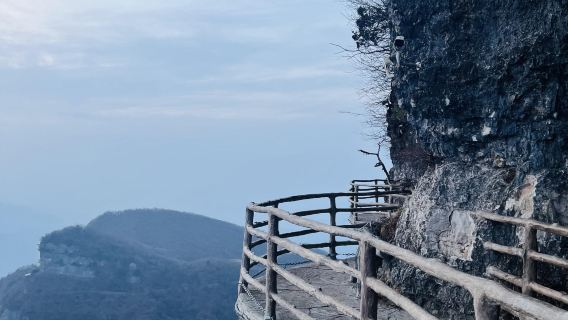
Hanzhong Longtoushan International Tourism Resort is located in Xiaonanhai Town, Nanzheng District, Hanzhong City.Longtou MountainBelongs toCangshan Mountain RangeAt an elevation of approx. 2,336m with high forest coverage, this attraction is renowned for its four wonders: sea of clouds at sunrise, colorful forests, peculiar rock formations, and rime ice scenery. It's a stunning alpine nature resort featuring magnificent mountain landscapes, beautiful surroundings, and captivating scenery. From afar, the undulating mountain ridges resemble a dragon's body, while the solitary peak towers like its head, piercing the sky and mingling with the clouds—a spectacle both magnificent and majestic. This unique terrain and mild climate create a year-round tourism experience: "admire azaleas in spring, escape the summer heat, marvel at fall foliage, and ski in winter." It stands as Qinba region's most distinctive fall foliage viewing destination and one of its largest winter sports resorts.Hanzhong · 72.6 km from Yang County
Experiences you can't miss in Yang County
Featured Day tours in Yang County
View all Day tours

Free cancellation
Instant confirmation
Book now for tomorrow
FromDKK 356.72

Free cancellation
Instant confirmation
Book now for tomorrow
FromDKK 454.41



Free things to do in Yang County


What travelers say about Yang County

闲庭漫步30October 12, 2026
5.0
The clock tower is located in the heart of the old town, at a crossroads, and can only be accessed via an underpass. Free baggage check-in is available at the entrance, which is quite convenient. Climbing the clock tower offers panoramic views of the old town, providing a pleasant visual experience.
Xi'an Bell Tower

CS@LOctober 21, 2026
4.0
Basically it is a big theme park that recreates the Tang Dynasty vibes and gorgeous era during the Tang Dynasty period. Best to go late evening and stay until all the lights up. If short on travel time actually can skip this place.
Tang Paradise

Anonymous userOctober 23, 2026
5.0
As someone who struggles to snag tickets, I was surprised to find that I managed to get one during the National Day holiday, which somewhat made up for my disappointment at Huashan. Since I was traveling alone, I was a little nervous beforehand, but things weren't as bad as I'd imagined once I actually left.
Jianmen Pass

E10***54October 7, 2026
5.0
Da Ci'en Temple is a famous temple where the Tang Dynasty monk Xuanzang served as abbot. The Big Wild Goose Pagoda, located within the temple grounds, is a landmark of Xi'an, offering panoramic views of the city. Nearby attractions include the Tang Paradise and the Tang Dynasty City Never Sleeps, where visitors can enjoy nighttime views or performances after their visit.
Big Wild Goose Pagoda

IamkaybeeOctober 13, 2026
4.0
As a historical C-drama fan, visiting The Longest Day in Chang’an Theme Block was exciting! 🏮 The traditional architecture made us feel like we had stepped back into ancient China.However, our booking experience was confusing. We weren’t told that banquet seats needed to be reserved in advance, and without a Chinese mobile number, we struggled. Thankfully, a helpful staff member managed to get us seats, although my sister and I had to sit separately.The included dress-up experience was also disappointing. The makeup was rushed, and we looked far too pale, so we removed it straight after the banquet. We had hoped to walk around in hanfu and fully immerse ourselves in the experience.Overall, we’d love to do it again, but next time, we’d skip the banquet and dress-up package. ❤️
The Longest Day in Chang'an Theme Block

sarah10yyqOctober 11, 2026
5.0
Professor Liu is exceptionally knowledgeable, and his explanations were remarkably clear and detailed. He could eloquently describe each artifact. I learned a great deal of new knowledge from his explanations and gained a new understanding of our history. I am very grateful to him for his three-hour lecture.
Xi'an Beilin Museum

天空不知道芸在哪里October 18, 2026
4.0
✅Advantages
1. Rich in history: This is the original site of the Tang Dynasty imperial palace, far exceeding the scale of the Forbidden City. Standing on the rammed earth foundation of Hanyuan Hall, one can directly experience the grand scale of "all nations paying tribute," creating a strong sense of antiquity. The museum within the park displays artifacts and miniature palace models, allowing visitors to understand the original appearance of the palace and compensating for the fact that only the earthen platform remains of the ruins.
2. User-friendly zoning and convenient transportation: A large area of the outer park is free, suitable for locals to stroll, picnic, fly kites, and take children; it is directly accessible by Metro Line 4 and is adjacent to Xi'an Railway Station, making arrival and departure very convenient.
3. Relatively relaxed atmosphere, unlike the crowds at popular tourist attractions. The lakeside of Taiye Pond is lush with vegetation, offering beautiful scenery in spring and autumn, perfect for leisurely strolls and relaxation.
⚠️Disadvantages
1. Almost no restored buildings remain; most are just rammed earth platforms and foundation mounds. 1. Without knowledge of Tang Dynasty history and without guided tours, it might just seem like a large earthen mound.
2. The park is extremely large, making walking tiring. The core paid area is largely open, with little shade in the summer sun, resulting in a huge amount of walking. Those with average stamina are advised to purchase a sightseeing electric cart; otherwise, you'll be very exhausted afterward.
3. Commercial facilities within the park are limited. There are few shops, water fountains, and limited dining options, so it's best to bring your own water and snacks.
4. It caters to polarized tastes: history buffs and those who enjoy historical ruins will love it; those seeking grand architecture and Instagram-worthy photos will find it less interesting.
Daming Palace National Heritage Park

蓝波的小窝October 15, 2026
5.0
Longtoushan is fantastic! It's great value for money, the scenic area is well-designed, the elevator and cable car ride up the mountain is a fantastic experience, the sea of clouds is spectacular, the colorful forests are picturesque, the environment is clean and hygienic (even the restrooms are cleaner than those in 5A scenic areas), there are lots of squirrels, the staff are friendly, the shuttle bus and glass walkway are free, and all visitors rave about it. Highly recommended!
Hanzhong Longtoushan International Tourism Resort


