Things to do in Yuncheng
Explore top experiences
Top 10 attractions in Yuncheng


Guanque Tower
A national AAAA-level tourist attraction and one of the top ten attractions in Shanxi Province, Guanque Tower is located on the eastern bank of the Yellow River west of Puzhou Ancient City in Yongji, Shanxi. Alongside the Yellow Crane Tower in Wuhan, Hubei; Yueyang Tower in Yueyang, Hunan; and Tengwang Pavilion in Nanchang, Jiangxi, it is renowned as one of China's four great historical and cultural towers. Originally built during the Northern Zhou Dynasty (557–571 AD) by military commander Yuwen Hu as a defensive watchtower, the tower earned its name from the storks that frequently perched on its structure. The Tang Dynasty poet Wang Zhihuan's celebrated poem "On the Stork Tower" ("The sun along the mountain bows; The Yellow River seawards flows. You will enjoy a grander sight; If you climb to a greater height.") has become an enduring masterpiece, widely known both domestically and internationally. After standing for over 700 years through the Tang and Song dynasties, the tower was destroyed during warfare in the early Yuan Dynasty (1222 AD). The reconstructed Guanque Tower follows Tang-style architecture, featuring four eaves externally with three visible tiers, while internally comprising six floors. With a total height of 73.9m, it epitomizes the grandeur of the Tang era. Ascending Guanque Tower not only offers breathtaking panoramic views but also immerses visitors in the brilliance of China's 5,000-year civilization.Yongji · 16.5 km from downtown

Yongle Palace
Yongle Palace, also known as Dachunyang Longevity Palace, was built in the Yuan Dynasty. Construction of such a magnificent palace complex with Taoist characteristics took over a century. Yongle Palace displays the typical architectural style of the Yuan Dynasty. Thick brackets intersect with each other layer by layer without much carved decoration. The architecture is spare and bright compared with the building style in the Ming and Qing Dynasties. The halls are arranged on the south-north axis. Of note, there are elaborate wall paintings on the Yongle Palace. There are many and of high artistic value, true rarities.Ruicheng · 3 km from downtown

Yuncheng Guan Gong Hometown Cultural Tourism Scenic Area
The Jiezhou Guandi Temple is located at the West Pass in Yuncheng's Jiezhou Town. The current buildings are reconstructions of buildings that would have stood here during the Qing Dynasty. The Jiezhou Guandi Temple is divided into two parts: the main temple and the Jieyi Garden. Upon entering the scenic site, visitors will first come to the Jieyi Garden. In the garden are structures such as the Jieyi Building and the Junzi Pavilion. In the main temple, the primary hall is Chongning Hall. This is where the statue of Guandi can be found. Every year, around National Day, a grand "Guandi Cultural Festival" is held featuring historical ceremonies and folk worship activities.Yuncheng · 19.4 km from downtown

Pujiu Temple·Romance of the Western Chamber
Pujiu Temple, located 12 km southwest of Yongji City in Shanxi Province on the Emei Plateau, was built during the Northern and Southern Dynasties and is a thousand-year-old ancient temple. It is a national AAAA-level tourist attraction, one of Shanxi's "Top Ten" tourist attractions, and one of the Eight Scenic Spots of Hedong. The temple gained fame worldwide thanks to the Yuan Dynasty playwright Wang Shifu's "The Romance of the Western Chamber." The story of Zhang Sheng and Yingying breaking free from feudal constraints, with the matchmaker Hongniang facilitating their love under the moonlight through letters, has become a timeless tale. For centuries, Pujiu Temple has been regarded as a sacred destination for couples seeking love, drawing visitors from far and wide. The annual Qixi Festival's Love Culture Celebration further elevates the eternal theme of love with its enchanting beauty. The temple was born from the drama, and the drama gave the temple its fame. The stupa within the temple was thus beautifully named the "Yingying Pagoda," and its remarkable frog-croaking echo effect is celebrated as one of China's four great echo architectures. Due to its unique acoustic structure, Yingying Pagoda is ranked alongside Italy's Leaning Tower of Pisa and France's Eiffel Tower as one of the "Six Wonder Pagodas of the World," truly a marvel of architectural acoustics. "While temples worldwide shun romance, only Pujiu Temple in Shanxi embraces love." May Pujiu Temple bless all lovers to unite in marriage!Yongji · 10.7 km from downtown

Guandi Temple in Sitou
The Shitou Guandi Temple is located on Beigaoling, Shitou Village, Caochuan Town, Pinglu County, Yuncheng City, Shanxi Province. Covering an area of 2,800 square meters, the temple faces south and features a three-courtyard layout. The main hall, offering hall, main hall, and Spring and Autumn Tower are located along its central axis. The main hall is a relic of the Yuan Dynasty, featuring a single-eaved hipped roof and a five-rafter roof structure. The offering hall dates from the Ming Dynasty, while the remaining buildings are mostly from the Qing Dynasty. The Spring and Autumn Tower features a two-story, cross-shaped hip roof, a three-bay ground floor with a veranda, and a gray ceramic tile roof. The protected area extends 5 meters to the east, west, and north, and 10 meters south of the mountain gate. The construction control zone extends 30 meters beyond.Pinglu · 30.3 km from downtown

Li Family Courtyard
Li Family Courtyard in Yuncheng is the private residence of Li Ziyong, a wealthy merchant in southwest of Shanxi, and it was built in the late Qing Dynasty and early period of the Warlord Era. Li Family Courtyard is a typical building reflecting the style of residential houses in the southern Shanxi province. The whole building is arranged around a quadrangle courtyard and also boasts Hui style architecture. It combines the features of two major architectural forms in south and north of China, and in terms of the art of decoration, the national culture infiltrates every corner of the building.Wanrong · 17.3 km from downtown
Wanrong Feiyun Tower Scenic Area
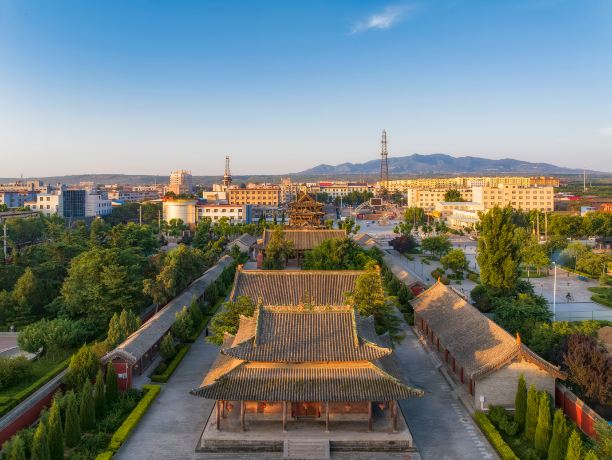
Wanrong Dongyue Temple is a national key cultural relic protection unit. It is a temple dedicated to Huang Feihu, the emperor of Dongyue. It was built in the early Tang Dynasty and has been repaired in all dynasties. The main building in the temple, the Feiyun Tower, is made of pure wood, with a light structure, overlapping bucket arches, entwined cloud belts, flying in the sky, and ingenious craftsmanship. Together with the Yingxian Wooden Tower, it is known as the South Tower and the North Tower. It is a rare flower in the field of Chinese architecture. , has a very high research and appreciation value.Wanrong · 308m from downtown

Great Ladder Cliff of The Yellow River
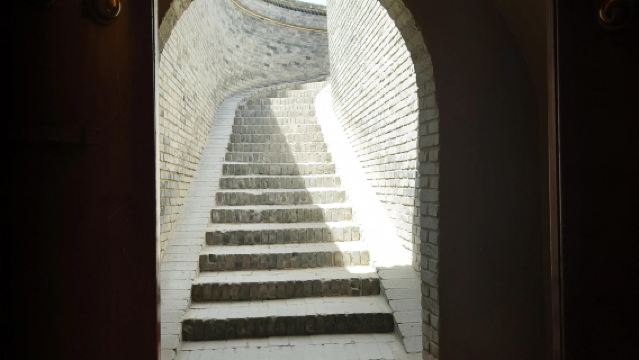
The Yellow River Ladder Cliff is located in Hejin City, Shanxi Province, between Longmen and Shimen of the Yellow River. It faces Shimen to the north, Longmen to the south, the Yellow River to the west, and Luliang to the east. The mountains and rivers are magnificent and the scenery is unique. The core landscape of the Ladder Cliff, the Ladder Cliff, is very old, dating back to the Northern Wei Dynasty, according to relevant records. Although the chisel marks on the wall have experienced wind and rain, they are still clearly visible. It is an ancient zigzag plank road artificially excavated on the edge of the cliff according to the terrain. It consists of 365 steps, with a width of four or five feet and each step is seven or eight inches high. The overall shape of the Ladder Cliff from the air is like carving 365 steps on a vertical stone. The terrain is steep, the scenery is unique, and the craftsmanship is amazing. The red past on the ladder cliff: On December 23, 1938, the Japanese army entrenched in Hejin, with the 7th and 8th regiments attached to the Tengtian Battalion as the backbone, plus puppet troops, totaling 4,000 to 5,000 people, more than 20 cannons, and the air force cooperated to attack the frontier positions of the New Eighth Division East Longmen Mountain and Yumenkou. The officers and soldiers of the New Eighth Division fought bravely and repelled the Japanese attack many times. The Japanese suffered heavy casualties, and the casualties of the officers and soldiers of the New Eighth Division's frontier positions also reached more than 70%. Among them, a reinforced platoon guarding Yunzhong Temple all died heroically. Many frontier positions were lost for a time. On the 30th, Zhu Zhenmin, deputy commander of the New Eighth Division, ordered the 23rd Regiment to cross the mountains and ridges, cross the river from Shijiatan to reinforce, and launch an attack on the Japanese army from the side of Longmen Mountain (Datizi Cliff) to recover all the positions in Longmen Mountain. This battle dealt a heavy blow to the Japanese invaders, killing and wounding more than 200 Japanese soldiers, forcing them to retreat to Hejin and Jieshan. 271 officers and soldiers from Guizhou, including the company commander of the New Eighth Division, were buried together at the foot of Longmen Mountain at the junction of Shaanxi and Shanxi (this place belongs to Hejin County, Shanxi Province). In 1987, the Hejin County Political Consultative Conference built a monument in front of the tomb. The beautiful legend on the ladder cliff: It is said that when Dayu arrived here to control the flood, he encountered an evil dragon blocking him and could not continue the construction. So he built the stone ladder to the sky of the Yellow River ladder cliff, intending to go to heaven to complain to the Jade Emperor. As a result, after the ladder was built, he found that he still could not go to heaven. Then Guanyin Bodhisattva saw it and could not bear the suffering of the people, so he enlightened Dayu to enter heaven, and then met the Jade Emperor. The Jade Emperor sent heavenly soldiers and generals to kill the evil dragon and remove the obstacles to river control. Dayu led the people to fight day and night, and soon chiseled the dragon gate, allowing the endless flood to flow into the sea. Now there is a barefoot print on the rock wall next to the Guanyin Buddha niche on the ladder cliff. Legend has it that this is what Dayu left when he entered heaven. Peach Blossom Valley Peach Blossom Valley, as the name suggests, is named after the peach blossoms that bloom all over the mountains in early spring. The valley is quiet and elegant, with lush vegetation, gurgling streams, waterfalls, and various rock formations. The scenery of each season is unique. In spring, peach blossoms bloom all over the mountains. In summer, the scenery is lush and green, with birds singing and flowers fragrant. In autumn, the intoxicating red leaves are scattered on both sides of the valley like ribbons. In winter, everything is quiet, accumulating strength and waiting for the coming year. If you are lucky, you can catch a snowfall, which is really as if it can cleanse the beauty of the soul. Mingxiu Plank Road (Glass Plank Road) Mingxiu Plank Road: "Ming" means wisdom, "Xiu" means practice, and "Mingxiu" means practice of wisdom. The plank road is made up of 108 pieces of three-layer tempered glass, which is exactly the same as the number of 108 Buddhist beads. We integrate the meaning of 108 Buddhist beads with it, and hope that everyone can be happy and at ease in this practice of life. The glass plank road is about 230 meters long and has a vertical height difference of about 150 meters. It is the best way to reach Taohua Valley. On the way, tourists can experience the Sky Walk while enjoying the Taohua Valley Waterfall.Hejin · 14.1 km from downtown
Temple of Prince Guangren
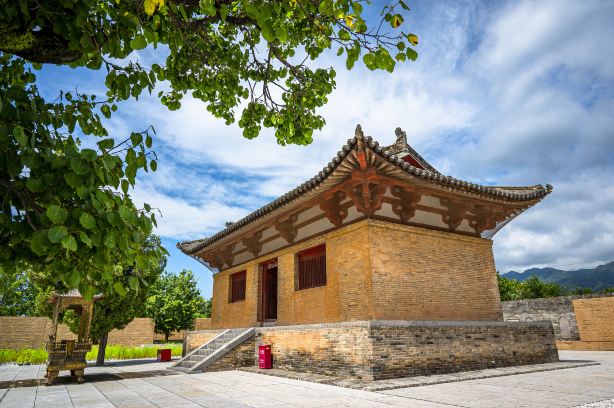
The Temple of Prince Guangren is a courtyard-style temple building located in Ruicheng County, Yuncheng City, Shanxi Province. Originally built during the Taihe era of the Tang Dynasty, this historic site serves as both a provincial and national key cultural relic protection unit. As an attraction combining religious faith, architectural artistry, and cultural experiences, the Temple of Prince Guangren draws numerous history enthusiasts and visitors who come to admire its architecture and offer prayers. Temple of Prince Guangren and the Yuan Dynasty Taoist temple about 1 li to the southeastYongle PalaceFacing each other from afar, atYongle PalaceNot far to the northwest, there isLongquan VillageIn the past, a spring called Longquan gushed from the high ground north of the village, irrigating fertile farmland, so the villagers built upon it.LongwangmiaoSacrificial rituals. The temple enshrines the Five Dragon Kings of the Five Directions. Legend says Nuwa appointed five dragons, with the Azure Dragon as their leader to govern all dragons, bestowing upon him the title Prince Guangren - hence the name Temple of Prince Guangren. The Temple of Prince Guangren faces south and covers an area of 4,560 square meters. It consists of a main hall, an opera stage, and side rooms, featuring simple construction with an elegant, rustic charm. The opera stage has three bays in width and three purlins in depth, with unadorned bracket sets on the column-top lintels. The central bracket set features a dragon head emerging from the large bracket mouth, while elephant trunks extend from both sides. The two end bays display dragon heads emerging from their bracket mouths. The main hall is the only surviving Tang Dynasty wooden structure in the Hedong region. Among the four remaining Tang Dynasty wooden buildings in China, the main hall of the Temple of Prince Guangren is one. The temple's Tang Dynasty stele holds significant reference value for studying ancient water conservancy projects that benefited the people, as well as the temple's construction period. Visitors can explore the main hall, side rooms, and courtyard at the Temple of Prince Guangren, admiring the exquisite wooden architecture and stone inscriptions. They'll learn about the legendary stories of Prince Guangren and local history while experiencing the solemnity and sacredness of this traditional temple.Ruicheng · 4 km from downtown

Yuncheng Salt Lake
Located in the south of Shanxi Province, Xiechi Lake is often called China's "Dead Sea." Visitors can go for a mud massage, swim in the lake (the high salt content makes it very easy to float), and bathe in the natural mineral springs.Yuncheng · 4.8 km from downtown
Experiences you can't miss in Yuncheng
Featured Day tours in Yuncheng
View all Day tours
Free cancellation
Instant confirmation
Book now for tomorrow
FromSAR 319.51


5.0/5
· 1 reviewInstant confirmation
FromSAR 252.09
FromSAR 775.64
Free cancellation
Instant confirmation
Book now for tomorrow
FromSAR 645.07

Featured Cultural experiences in Yuncheng
View all Cultural experiences
FromSAR 126.53
More things to do
Private Tours in Yuncheng
View More Private Tours in Yuncheng

Free things to do in Yuncheng

What travelers say about Yuncheng

M52***90October 11, 2026
5.0
I hadn't originally planned to visit the Stork Tower, as it's a reconstruction completed in 2002. However, I came across a travelogue about climbing it, and perhaps the focus for modern people isn't so much on whether it's an ancient building, but rather on Wang Zhihuan's famous line, "To see a thousand miles further, climb one more story." When you reach the top and gaze into the distance—the Yellow River, the Zhongtiao Mountains, the blue sky and white clouds overhead, the wind blowing from Fengling Ferry—don't we feel the same sentiment as Wang Zhihuan back then?
Sometimes, even a simple visit can lead to unexpected experiences. The scenic area has set up signature boards for each province, autonomous region, municipality, and region. Surprisingly, this tourist experience made the friendship between Qin and Jin (Shaanxi and Shaanxi) more tangible. The board for Shaanxi Province has already been replaced twice, as it's become too densely packed with signatures from friends from neighboring Shaanxi. The scenic area simply put up a sign at the very front of the signature corridor that reads "Qin People Gather!" It looks like it'll be full soon too.
Guanque Tower

青衫磊落踏歌行October 18, 2026
5.0
Yongle Palace was built to commemorate Lü Dongbin. The entire building is grand in scale. In the 1960s, it was moved here to make way for the construction of the Sanmenxia Reservoir. As a result, the original site was not flooded, so the combined ticket also includes a visit to the original site. The most famous is the Yuan Dynasty mural "Chaoyuan Tu" in the Wuji Hall.
Yongle Palace

爱旅游的孔雀August 10, 2026
5.0
The ancestral temple of Guan Yu, one of the 30,000 temples worldwide, is indeed magnificent and awe-inspiring. Several emperors personally inscribed plaques, making it a royal temple exuding grandeur. It's a bit far from the city center, so it's advisable to plan your time accordingly.
Yuncheng Guan Gong Hometown Cultural Tourism Scenic Area

Anonymous userOctober 7, 2026
5.0
The scenic area isn't large; it takes a little over an hour to tour the whole thing. Many parts of the area are thoughtfully designed, and the paintings and text on the walls are quite interesting. Although there were many people during the National Day holiday, it didn't feel crowded.
Pujiu Temple·Romance of the Western Chamber

迎园小区November 3, 2024
4.0
The largest in the country. It's very beautiful. It's worth a visit.
Guandi Temple in Sitou

呼莲October 4, 2026
5.0
This place is definitely worth visiting. The character, kindness, generosity, and love of Shanxi merchants can be fully experienced here.
I am deeply amazed by the harmonious blend of artistry and practicality in Chinese architecture; it fills me with immense pride.
Li Family Courtyard

西北禾木October 6, 2026
4.0
Wanrong Feiyun Tower, hailed as the No. 1 wooden tower in China, is a pinnacle of ancient Chinese wooden architecture. The entire tower is constructed entirely of wood, without a single iron nail, relying solely on mortise and tenon joints for connection – a testament to its ingenious design. While appearing to have three stories, it actually contains five, with four colossal pillars extending from the ground floor to the roof, supported by 32 auxiliary pillars forming a stable framework. Beneath the eaves are 345 sets of uniquely shaped brackets, layered like clusters of clouds, both sharing the load and possessing aesthetic appeal. Thirty-two upturned eaves gracefully extend into the air, their chimes ringing in the wind. Standing below and looking up, the orderly arrangement of the wooden components, standing firm through centuries of wind and rain, fully demonstrates the superb construction skills of ancient craftsmen, making it a must-see wooden architectural marvel in Shanxi.
Wanrong Feiyun Tower Scenic Area

M24***35October 5, 2026
4.0
Climb the ladder up, take the elevator down. Definitely don't take the elevator up and go down the stairs! Your legs will go weak! Climbing the ladder isn't as difficult as you might imagine, but you've only climbed about a third of the way; you have to keep going to reach the top. It's worth it! By the way, the prices in the scenic area are very reasonable; items at the top are only one yuan more expensive than usual, which is perfectly acceptable. Also, the scenic area's special performances are really good; the people performing so gracefully at such a height are truly admirable.
Great Ladder Cliff of The Yellow River

M37***45October 5, 2026
4.0
The Guangrenwang Temple in Ruicheng, Yuncheng, is one of the few remaining Tang Dynasty wooden structures in China and a fifth batch of National Key Cultural Relics Protection Units. The ancient temple sits atop a loess plateau, devoid of elaborate decorations; its simple yet robust brackets and walls perfectly embody the rustic and majestic spirit of Tang Dynasty architecture.
Having withstood a thousand years of wind and rain, the temple retains the original Tang Dynasty structural features in its eaves and beams. This ancient building, far removed from the hustle and bustle of the countryside, stands quietly on the plateau, a must-see for anyone exploring early wooden architecture.
A few words to say...
Temple of Prince Guangren

trveloneSeptember 29, 2026
5.0
Good place, absolutely no crowded in week day, delicious ala carte dinner. Very relaxing experience, but waiting for massage or etc was long, I skipped this experience
Yuncheng Salt Lake


