Things to do in Gujiao
Explore top experiences
Top 10 attractions in Gujiao


Jinci Temple Museum
Jinci Temple is located on the banks of the Jin River at the foot of Xuanweng Mountain, 25 km southwest of Taiyuan. It was built by later generations to commemorate Tang Shuyu, the founding feudal lord of the Jin State, and served as the ancestral temple of the Jin State. It is often said that "a visit to Taiyuan is incomplete without seeingJinci Templethe saying "a wasted trip to Taiyuan". After getting off at Jinci Temple, the first place you'll reach isJinci MuseumThis is a free park with a pleasant environment, perfect for casual strolling. After about a 10-minute walk through the park, you'll reach the main area of Jinci. Inside Jinci Museum,Jinci TempleThe "Three Treasures" (Xian Hall, Flying Bridge Across Fish Pond, and Shengmu Hall) and "Three Wonders" (Zhou-bai, Nanlao Spring Pavilion, and painted clay sculptures) are must-sees for every visitor toJinci Templeview that everyone must see. Jinci TempleThe "Three Treasures" are connected and located atJinci Templeon the central axis, allowing for a combined visit. Xian Hall is a place for offering sacrifices, with fence-like walls on all four sides, providing good ventilation and coolness. Notably, not a single iron nail was used in the beams and pillars throughout the hall. The Flying Bridge Across Fish Pond is located in front of Xian Hall and was built during the Song Dynasty. The entire view resembles a modern overpass, making it the only existing example among ancient bridges in China. One end of the "Flying Bridge" connects to Shengmu Hall, which is the earliest existing main building in Jinci Museum. The main hall is spacious, and a major highlight is its beam-and-pillar structure without internal columns. Eight wooden carved coiled dragons, appearing ready to fly, are carved on the eight corridor pillars in front of the hall, which, together with the "Flying Bridge Across Fish Pond," present a magnificent sight. Centered around the Hall of the Holy Mother, it's easy to find the "Three Wonders." The painted clay figurines are located inside the Hall of the Holy Mother, with the main statue of the Holy Mother seated majestically in a wooden shrine, dignified and resplendent, while the other 42 attendant statues stand on either side. These figurines are dressed in vibrant colors with varied expressions, including one maidservant dressed as a flower-dan (young female role in Chinese opera), her face half joyful and half sorrowful, evoking complex emotions in viewers. Master Mei Lanfang once stood before this maidservant statue for a long time, carefully studying her posture and inner emotions, and praised it highly. The Zhou Cypress, located north of the Hall of the Holy Mother, was planted during the Western Zhou Dynasty and is over 3,000 years old. The Pavilion of the Never-Aging Spring stands south of the Hall of the Holy Mother, where the source of the Jin River flows continuously year-round. In addition,Jinci TempleInside, there is also the extremely precious "Jinci Inscription" stele, personally composed and handwritten by Emperor Taizong of Tang, Li Shimin. At the southernmost part, you can find the Shifang Fengsheng Zen Temple, which is said to have originally been the villa of Yuchi Gong, a founding general of the Tang Dynasty. In the northern part of the temple complex, the Futu Courtyard houses the Sheli Shengsheng Pagoda. Climbing the pagoda offers a panoramic view.Jinci TempleThe panoramic view is clearly visible.Taiyuan · 32.1 km from Gujiao
Fenhe Park
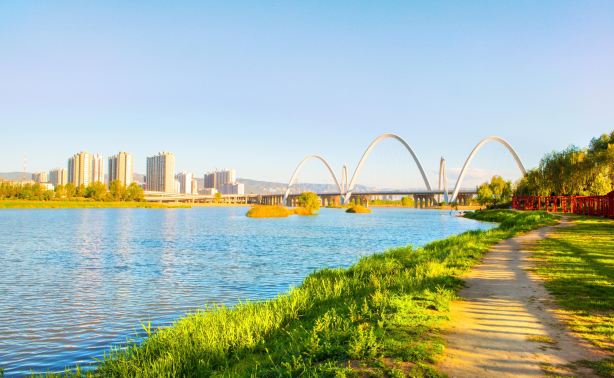
Fenhe Park is a waterfront park formed after water conservancy treatment and greening and beautification in the Taiyuan urban section of the Fenhe River, with a total length of more than 18 kilometers. The park is long and narrow, with the road on one side and the clear water of the Fen River on the other. A large number of trees are planted in the park, and green meadows are surrounded by stones, forming a green ecological promenade along the Fen River. Fenhe Park starts from the north side of Chaicun Bridge in the north and ends at the south side of Xiangyun Bridge in the south. Taiyuan people used water as ink and green as color, painted a new picture of Fenhe River, and built a waterfront garden with northern garden style and Fenhe regional cultural characteristics. Here you can enjoy the famous Fenhe River crossing at night, when the sunset is slanting, the red clouds are full of sky, the river surface is shining with gold, and the boats are accompanied by the scenery. Jinfen Ancient Rhyme is a commemorative square with the theme of commemorating Taiqi, the first ancestor of Zhifen. The statue of Fen Shentai stands high on the pedestal in the center of the square, surrounded by fountains and flower beds, which is solemn yet lively. The park is distributed along the Fen River, and there are many scenic spots. The content is simple and complex, which reflects the designer's eclectic and profound understanding of Shanxi's profound historical and cultural heritage, which is very worth visiting.Gujiao · 498m from downtown

Shanxi Museum
"Five thousand years of history can be seen in Shanxi." Located on Binhe West Road in Taiyuan, the Shanxi Museum showcases the essence of Shanxi's cultural relics. The museum consists of a main building and four corner annexes, with the main building resembling both a dipper and a ding vessel, serving as the primary venue for travelers to view the collection. The main building has four floors. The first-floor lobby features a general service desk, while the second and third floors host thematic exhibitions on history and culture. The fourth floor showcases art-themed exhibitions, which together form the permanent displays of the Shanxi Museum. After entering the first-floor lobby, proceed to the second floor via the stairs to begin the historical journey themed "Soul of Jin." The cultural and historical thematic exhibition showcases the highlights of Shanxi's five-thousand-year civilization through numerous precious artifacts, ranging from ancient human relics to the rise and fall of Shanxi merchants during the Ming and Qing dynasties over five centuries. During your visit, several exquisite artifacts are not to be missed. The bird zun, a bronze ritual vessel from the Western Zhou period, was used in the ancestral temple sacrifices of the Jin marquis. The bird zun features an exquisitely crafted design with a phoenix as its main form. On the phoenix's back rests a small bird, serving as the handle for the vessel's lid. At the tail of the phoenix, an elephant is depicted, with its long trunk perfectly balancing the phoenix's two legs to form a stable tripod base. This artifact is a representative piece among the bronze collections in the museum. In addition, you can also admire: the Houma covenant texts, which are oath documents from the Spring and Autumn period used by the ministers of the Jin state; the lacquered wooden panel paintings, a painted screen from the Northern Wei dynasty depicting colorful stories from the "Biographies of Exemplary Women"; the white marble sarcophagus, a relic from the Sui dynasty, belonging to a tomb occupant who was a member of the Central Asian Yu people, with intricate carvings both inside and outside the sarcophagus, featuring figures with deep-set eyes, high noses, and black hair, characteristic of the Mediterranean Caucasian race. In the cultural thematic exhibition, you can also learn about the origins and development of Buddhism and traditional opera in Shanxi. The fourth floor of the main hall features an art thematic exhibition area. Among them, the "Timber and earth splendor" - ancient architectural art thematic exhibition showcases Shanxi's status as a province rich in cultural relics and ancient structures. "For above-ground relics, look to Shanxi" - Shanxi is renowned as the "treasure trove of ancient Chinese architecture," boasting over half of China's above-ground ancient structures with comprehensive categories, especially in the quantity of religious buildings. If you're a fan of ancient architecture, this is a must-visit. The Shanxi Museum also hosts temporary exhibitions periodically. At the first-floor lobby service desk, services such as hiring on-site guides (Chinese and English) and renting audio guides are available. The main building also houses a restaurant and a tea house for visitors.Taiyuan · 31.5 km from Gujiao

Mengshan Grand Buddha
The Mengshan Giant Buddha is also known as the Giant Buddha of the Western Mountains. It was built in the Northern Qi Dynasty during the reign of the Tianbao Emperor, making for over a thousand years of history. The Mengshan Giant Buddha was originally carved into the cliff face to the rear of Mengshan's Kaihua Temple. During the later years of the Yuan Dynasty, the Mengshan Giant Buddha was damaged. It was rediscovered in 1980 but, at the time, the head of the Buddha was missing. A new head has since been carved for the giant Buddha. The Mengshan Buddha is incredibly majestic. From the bottom of his legs to his neck is about 30 meters. Based on the proportions of the human body, it is assumed that the original statue (including the missing head) would have been 46 meters tall.Taiyuan · 27.3 km from Gujiao

Taiyuan Botanical Garden
Taiyuan Botanical Garden is located at the foot of Taishan Mountain in Jinyuan District and collects more than 3,000 species of plants. Visitors can stand on the cantilever at the main entrance and overlook the whole botanical garden.Taiyuan · 31.2 km from Gujiao

Taiyuan Ancient County
The ancient county seat of Taiyuan is located in Jinyuan District, covering an area of about 0.8 square kilometers. There are many relics of historical buildings in the city, the pattern of cross streets is clear, and the texture of streets and alleys is perfect. It follows the ancient architectural pattern of Jinyang ancient city "Phoenix Flying in the City", just like a phoenix with its head north and tail south. It has the reputation of "Phoenix City" since ancient times. It is the continuation of the 2500-year-old Jinyang ancient city. There are 79 existing cultural relics buildings in the city, and 49 historical buildings listed for protection by the Taiyuan Municipal Government. Among them, the Confucian Temple is listed as a national key cultural relics protection unit.Taiyuan · 33.8 km from Gujiao

Tianlongshan Caves
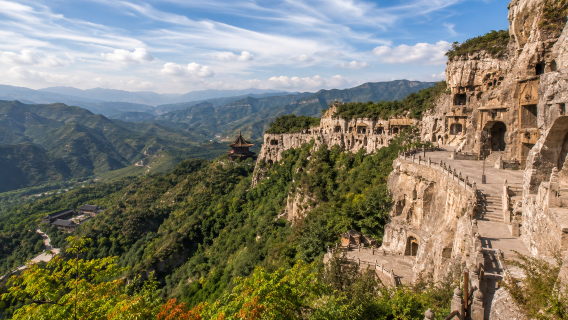
The Tianlong Mountain Grottoes are located on the mountainside of Tianlong Mountain, 40 kilometers southwest of Taiyuan City. Tianlong Mountain was formerly known as Fangshan Mountain. After the Tianlong Temple was built at the foot of the mountain in the Northern Qi Dynasty, the mountain was called Tianlong Mountain. It used to be the summer palace of Gao Huan, the father of the Northern Qi Emperor Gao Yang. Tianlong Mountain has beautiful scenery, surrounded by undulating mountains, lush pines and cypresses, rippling springs in Longwang Stone Cave on the top of the mountain, and clear streams in front of the mountain. The Tianlongshan Grottoes are distributed on the cliff waist of the east and west peaks of Tianlong Mountain. There are 24 caves excavated in the Eastern Wei, Northern Qi, Sui and Tang Dynasties, eight caves in the east peak, thirteen caves in the west peak, and three caves in the north of the mountain. There are more than 1,500 statues in the coexisting grottoes, and 1,144 relief sculptures, caisson wells and portraits. The Tianlongshan Grottoes are characterized by their mature, full, succinct and meticulous expression of emotions, which are close to the life of laborers.Taiyuan · 26.3 km from Gujiao

The Coal Museum of China
The Chinese Coal Museum is located in Taiyuan City on the west bank of Fenhe Park. Every day our lives are affected by coal. Do you know where coal comes from, how it is formed, or how it is excavated from deep beneath the surface of the earth's crust? A visit to the Chinese Coal Museum will help answer some of these questions along with many other questions you never knew you had. One of the most interesting features of the museum is the Coal Palace. The Coal Palace is a is an underground facility built to replicate a real mine at a scale that is true to life. You can put on a miner's suit and hat and go down an elevator and passageways similar to ones coal miners use to work. This experience provides a new understanding of the hardship and dangers miners face every day while working.Taiyuan · 31.4 km from Gujiao

Taiyuan Shanxi Merchants Museum
Taiyuan Shanxi Merchants Museum (former site of the Military Governor's Office) is located at 101 Fudong Street in Taiyuan, covering a total area of approximately 100,000 square meters with a building area of about 30,000 square meters and exhibition halls spanning roughly 18,000 square meters. Historical records indicate this site was originally the Temple of Duke Wen of Jin (Chong'er), later serving as Marshal Pan Mei's residence during the early Northern Song Dynasty, followed by provincial administrative offices. During the Jin Dynasty, it functioned as the Hedong Circuit headquarters, transformed into a provincial secretariat in the Yuan Dynasty, became the Shanxi Governor's Office in the Ming and Qing dynasties, and after the Xinhai Revolution...Shanxi Taiyuan Shanxi Merchants MuseumIt served as the Shanxi Provincial Government and Taiyuan Pacification Office. After the liberation of Taiyuan on April 24, 1949, it became the headquarters of the Taiyuan Military Control Commission. In September of the same year, following the establishment of the Shanxi Provincial Committee and Provincial People's Government, it became their office location. In the winter of 1989, the Provincial Committee relocated, and in September 2017, the Provincial People's Government moved out. The original site was then developed into the Taiyuan Shanxi Merchants Museum. In October 2019, the former Governor's Mansion was designated as part of the eighth batch of National Key Cultural Relics Protection Units by the State Council. On December 28, 2020, the Taiyuan Shanxi Merchants Museum officially opened to the public. The Taiyuan Shanxi Merchants Museum is a cultural and historical museum established on the site of the former Governor's Mansion, integrating ancient architecture, garden views, and exhibition spaces. Its permanent exhibition "The Global Shanxi Merchants" begins with the important directives from the Party Secretary during his inspection of Shanxi. Through five thematic sections—the profound foundations of the merchants' rise, their glorious dominance in domestic commerce, their miraculous financial networks spanning the world, the arduous journey of the Ten Thousand Mile Tea Road, and their patriotic spirit of benefiting society—the exhibition offers a comprehensive, multi-dimensional portrayal of Shanxi merchants during the Ming and Qing dynasties. It strives to convey historical depth, cultural richness, the value of artifacts, the authenticity of historical materials, and innovative presentation techniques.Taiyuan · 34.1 km from Gujiao

Donghu Vinegar Garden
Explore Donghu Vinegar Garden and discover the history of vinegar brewing in Shanxi. As a national AAAA-level tourist attraction, a national industrial tourism demonstration base, and a provincial research and practice education demonstration base for primary and secondary schools, Donghu Vinegar Garden covers a total construction area of approximately 16,667 square meters. Rooted in Shanxi's long-standing Yellow River farming culture, it preserves and innovates the history of the "Meiheju" vinegar workshop founded during the Hongwu period of the Ming Dynasty, the national intangible cultural heritage "Meiheju" aged vinegar brewing technique, and Shanxi's vinegar history and culture. Based on the ancient brewing process of "steaming, fermenting, smoking, filtering, and aging," it truly embodies "inheriting traditional craftsmanship and realizing a health-oriented philosophy." Since its opening in 2000, Donghu Vinegar Garden has launched distinctive "intangible cultural heritage" vinegar culture study tours, offered Shanxi aged vinegar DIY courses, added "intangible cultural heritage" vinegar-making experience programs, and developed traditional Shanxi vinegar-themed banquets. It has welcomed over 5 million visitors from home and abroad, with annual visits by minors exceeding 30,000, making it a highlight for promoting traditional Chinese agricultural culture and vinegar culture in China's condiment industry. The garden features twelve specialized exhibition halls including "Donghu Meiheju Development History Museum," "Vinegar Therapy Garden," "Vinegar Museum," "Vinegar Cellar," and "Craft Brewing Workshop," each displaying agricultural tools and vinegar-making equipment from different historical periods. Donghu Vinegar Garden showcases the unique charm of "National Intangible Cultural Heritage - Traditional Vinegar Brewing Techniques" to visitors from around the world through displays of ancient and modern utensils, vinegar product exhibitions, and hands-on experiences of intangible cultural heritage vinegar-making techniques. It opens a time tunnel for people to understand Shanxi's vinegar culture, deeply experience the intangible heritage vinegar-making process, and recognize the health benefits of Shanxi aged vinegar. Visitors can not only explore the profound history of Shanxi vinegar culture, breathe in the rich aroma of Donghu vinegar, enjoy a "Donghu vinegar sauna," and taste authentic Donghu aged vinegar, but also deeply engage with the national intangible cultural heritage of traditional vinegar brewing techniques. Visitors can also sample various vinegar-infused specialties like vinegar-soaked beans and vinegar snacks, as well as traditional Shanxi vinegar banquets, gaining a deeper understanding of Shanxi aged vinegar. Over its 20+ years of operation, Donghu Vinegar Garden has earned honors such as the "Certificate of Origin Registration," "National Silver Quality Award," and inclusion in China's "Intangible Cultural Heritage" protection list. It is highly revered by domestic and international biology experts as the "Living Fossil of Chinese Grain Vinegar Brewing" and the "Finest Vinegar in China." Praised by Europeans and Americans as the "Secret of China" and by Japanese merchants as the "Chinese Mystique," it has evolved into an immersive vinegar experience center integrating production, tourism, dining, and research, becoming a cultural landmark of Shanxi with distinct ethnic charm.Taiyuan · 37 km from Gujiao
Experiences you can't miss in Gujiao
Featured Day tours in Gujiao
View all Day tours
5.0/5
· 1 reviewFree cancellation
Instant confirmation
Book now for tomorrow
FromUS$69.99
Free cancellation
Instant confirmation
Book now for today
FromUS$136.23

FromUS$170.29
Free cancellation
Instant confirmation
Book now for tomorrow
FromUS$76.58
Free cancellation
Book now for tomorrow
FromUS$233.29

Free cancellation
Instant confirmation
Book now for tomorrow
FromUS$136.23
Free cancellation
Instant confirmation
Book now for tomorrow
FromUS$81.67
Free cancellation
Instant confirmation
Book now for tomorrow
FromUS$54.84
Featured Cultural experiences in Gujiao
View all Cultural experiences
Free cancellation
Instant confirmation
Book now for tomorrow
FromUS$16.49

5.0/5
· 1 reviewFree cancellation
Book now for tomorrow
FromUS$6.00
FromUS$16.49
Free cancellation
Book now for today
FromUS$40.31
Free cancellation
Book now for tomorrow
FromUS$16.49
Free cancellation
Instant confirmation
Book now for tomorrow
FromUS$40.87
Free cancellation
Instant confirmation
Book now for tomorrow
FromUS$158.18
Free things to do in Gujiao


What travelers say about Gujiao

E35***98October 23, 2026
4.0
✅ New Record: Jinci Temple is quite far from downtown Taiyuan. There's no direct shuttle bus to the scenic area; it involves over 30 bus stops and takes more than an hour. Jinci Park is a later addition. You only enter the actual Jinci Museum after passing through the park. Jinci has three unique features that are well worth seeing.
Jinci Temple Museum

好孩子是哪里人April 29, 2025
5.0
汾河作为山西省最重要的河流,穿过整个山西省,汾河平原的缔造者,在太原这一段,两岸都进行了修缮,无论是白天还是夜晚,漫步在河边,想象着千万年来河水静静地流淌。
Fenhe Park

Anonymous userOctober 7, 2026
5.0
The tour guide was attentive and incredibly friendly, covering everything he needed to, and explaining things in considerable detail. With so many people during the National Day holiday, his experience helped us squeeze in every possible moment, and surprisingly, the trip wasn't crowded at all. The Yungang Buddha and the VR tour of Wutai Mountain were definitely worthwhile, and the Yanmen Pass Great Wall and Wang Family Courtyard were also very enjoyable. The driver was fantastic, incredibly experienced, and knew many shortcuts to Xiaoxitian, taking us directly to the scenic area entrance and saving us a lot of walking. The small group size meant it wasn't crowded, and the hotel arrangements were quite reasonable. The Yingxian Wooden Pagoda, the Yanmen Sunset, and the Wang Family Brick Carvings were all breathtakingly beautiful. The local tour guide was completely transparent and honest. I highly recommend this Shanxi tour; if you want to see ancient architecture but are afraid of doing research, book this tour without hesitation.
Shanxi Museum

davidsnowOctober 8, 2026
5.0
Breathtaking view, amazing hike to the top, unreal experience and genuine atmosphere. Highly recommend
Mengshan Grand Buddha

Hello3369October 24, 2026
5.0
Taiyuan Botanical Garden, nestled at the foot of Mount Tai, is adorned with three dewdrops falling on the shore of Haowen Lake: one representing the rainforest, one the desert, and one a sea of flowers. By day, it's a verdant wonderland; by night, a galaxy has fallen.
Around 7 PM, the 64-meter-high Time Elevator illuminates with starlight, and the Milky Way seems to flow down the slope into the lake—Taiyuan's most sci-fi-like night.
Springtime brings cherry blossoms, plum trees, and peonies; summer offers respite from the heat in the greenhouses; autumn offers strolls among ginkgo and pine trees; winter paints the snow-covered dome of the sky—this place doesn't necessarily need a reason; it's simply one of the few places in the city where you can slow down.
Taiyuan Botanical Garden

楚云霁月August 21, 2026
4.0
The old town was rather deserted. The art exhibition was quite nice, though a bit over the top. But the park at the exit was absolutely gorgeous. Winding paths led to secluded spots, and unexpected beauty unfolded.
Taiyuan Ancient County

M51***71June 20, 2026
5.0
The scenery is absolutely stunning. And transportation is incredibly convenient. After taking bus 804 or 856 to the last stop, it's less than a ten-minute walk to the bus stop for the Tianlongshan Grottoes (Sightseeing Route 1), which costs four yuan one way and can be paid with NFC. Seeing such a beautiful sky from the popular bridge was truly breathtaking.
Tianlongshan Caves

一根老葱October 16, 2026
5.0
Coal, once the most important energy source, remains indispensable. The Coal Museum preserves the rich history, outstanding contributions, and hard-won achievements of coal. It's worth a visit to learn about and appreciate it!
The Coal Museum of China

🚲小电驴登儿 🚓October 10, 2026
5.0
The Shanxi Merchants Museum is located within the old Governor's Mansion; its red walls and green tiles are very photogenic. The exhibitions mainly focus on the history of Shanxi merchants and their banks. The courtyard is exquisite, quiet, and not crowded. It's a pleasant place to stroll around; about two hours is sufficient.
Taiyuan Shanxi Merchants Museum

酷姐驾到September 28, 2026
4.0
The vinegar-making experience presented so far is too simplistic and crude. I hope it can be further optimized to include more scientific knowledge and engaging elements. Could you explain how the fumigation method was discovered, the detailed principles behind each process, the corresponding chemical reactions, and the role of microorganisms? And how does this compare to industrial vinegar-making processes?
Donghu Vinegar Garden


