Things to do in Lin County
Explore top experiences
Top 10 attractions in Lin County


Qikou Ancient Town
Qikou Ancient Town, located 50 kilometers south of Linxian County, Shanxi Province, is a famous historical and cultural town in China. Xiwan Village in the town is a famous historical and cultural village in China. Moraine (sound qi) mouth is located in the middle of the Shanxi-Shaanxi Gorge of the Yellow River, 48 kilometers south of the county seat, and adjacent to the ancient town of Mengmen in the south. The Yellow River comes from the north, the Qiushui River comes from the east, the Crouching Tiger Mountain is across the north of the town, the Black Dragon Temple stands on the east of the river, the mountains are surrounded by the water, the yin and yang meet, the momentum of the mountains, and the majesty of the river, condensed into "The Yellow River roars with tigers, The magnificent picture of Longyin Moraine Mouth.Lin County · 38.5 km from downtown

Qikou National Scenic Area
Qikou National Scenic Area gets its name from Datong Qi. "Qi" refers to dangerous shoals of sand and stone in shallow water. As the Yellow River flows through here, the river channel narrows, making it difficult for boats and rafts to pass, forcing them to dock, unload cargo, and switch to land transport. With its water-land transfer wharf, Qikou rose to prominence during the Qianlong reign of the Qing dynasty and became a major commercial hub in the north for the next two hundred years. Qikou Ancient Town is the main part of the scenic area. The five-li long street runs along the mountain and river, and the stone-paved street surface, along with Ming and Qing dynasty commercial establishments and old shops, preserves the traditional streetscape. Heilong Temple is built against Wohu Mountain. From there, you can overlook the Yellow River, the mouth of the Qiushui River, and the full view of the ancient town. The temple's opera stage also has a unique acoustic effect. Xiwan Village preserves extensive Ming and Qing dynasty residential courtyards, while Lijiashan Village is characterized by cave dwellings built into the mountainside in stacked tiers. Traditional dwellings are also preserved in the Zhaizishan area. Along the Yellow River canyon, you can also admire natural water-eroded reliefs. The views of rock walls formed by the long-term action of river water, wind, and rain stretch out, showcasing the unique natural landscape of the Yellow River canyon.Lin County · 31.1 km from downtown
Lijiashan Village
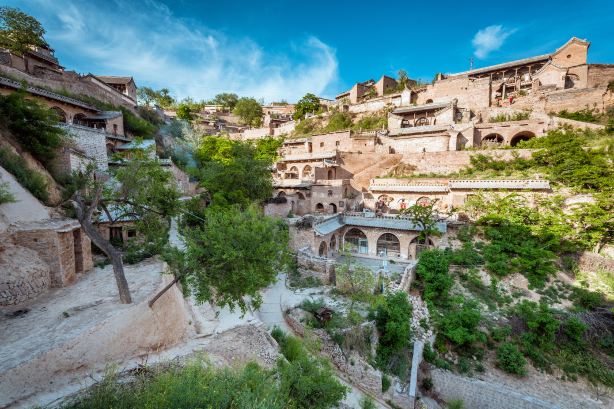
Lijiashan Village is an ancient cave-dwelling village hidden in a loess mountain hollow south of Qikou Ancient Town, surrounded by mountains on three sides and near the Yellow River and the Qiushui River. During the Ming and Qing dynasties, Qikou developed into a commercial port thanks to Yellow River water transport, and merchants surnamed Li who did business there settled their families in this hollow, gradually forming a clan village. The painter Wu Guanzhong visited the village twice for inspiration and listed it as one of the three great discoveries of his life. The village spreads out in layers along the mountain terrain, with Ming and Qing dynasty cave-dwelling courtyards stacked from the foot of the mountain to the ridge along the steep slope, forming a multi-dimensional village with staggered layers. The upper courtyards often sit on the roofs of the lower cave dwellings, and stone paths connect the homes. Walking through them, you can see the layout where the cave dwellings are intertwined with the mountain. Courtyards of wealthy families from that era are still preserved on the east and west slopes, with exquisite details such as brick carvings, stone carvings, and upturned eaves. Some of the cave dwellings in the village are still inhabited today, where traditional dwellings and daily life are intertwined.Lin County · 40.5 km from downtown

Xiwan Village
Xiwan Village is about one kilometer away from Qikou Town. It is built by the river. The ancient houses in the village are scattered on the hillside by the river, with distinct layers. The ancient houses are exquisite and beautiful, and the workmanship is exquisite. It is famous for its unique residential buildings. This complete residential building complex covers an area of more than 30,000 square meters. It is backed by the mountain and faces the water, sheltered from the wind and facing the sun. It rises with the trend, like waves, with a strong sense of layering. There are seven alleys in the village, two horizontal and five vertical, which evenly connect the courtyards. There are more than 40 courtyards that are well preserved. The courtyards are connected and the households are connected. The walls of the buildings are eclectic and varied in style. Different terrains follow the procedures and are staggered. They are very harmonious with the surrounding environment. The various facilities for anti-theft, fire prevention, drainage, and flood discharge are very exquisitely configured. Every brick, stone, and wood here is filled with a strong traditional cultural atmosphere. Various carvings are ingeniously conceived and delicately portrayed. Xiwan Village was rated as a "National Famous Historical and Cultural Village".Lin County · 37.4 km from downtown

Yellow River Art Gallery
The Yellow River Gallery, also known as the Yellow River Baili Water Erosion Relief, is located in the Moraine section of the Shanxi-Shaanxi Yellow River Grand Canyon. It is a precious natural heritage. It was formed in the Triassic period. Formed natural cliff relief.Lin County · 32.6 km from downtown

Black Dragon Temple
The Black Dragon Temple is located in Wohu Mountain, Qikou Town, at the entrance of the Qiushui River at the southern end of Linxian County. According to the record of the addition of the Bell and Drum Tower Stele in the 21st year of Emperor Qianlong's reign in the Qing Dynasty: the temple was founded in the Ming Dynasty. During the Yongzheng period, a music building was added. During the Daoguang years, the revision hall and the east and west ear hall were rebuilt. The scale of the temple is magnificent and obvious. The overall momentum of the Black Dragon Temple is magnificent, with a total area of about 4,800 square meters. It belongs to the ancient building complex of Qikou, and is the sixth batch of national key cultural relics protection units.Lin County · 38.3 km from downtown

Qikou Yellow River Gallery Water Erosion Relief Scenic Area
Lin County · 34.6 km from downtown

Jinci Temple Museum
Jinci Temple is located on the banks of the Jin River at the foot of Xuanweng Mountain, 25 km southwest of Taiyuan. It was built by later generations to commemorate Tang Shuyu, the founding feudal lord of the Jin State, and served as the ancestral temple of the Jin State. It is often said that "a visit to Taiyuan is incomplete without seeingJinci Templethe saying "a wasted trip to Taiyuan". After getting off at Jinci Temple, the first place you'll reach isJinci MuseumThis is a free park with a pleasant environment, perfect for casual strolling. After about a 10-minute walk through the park, you'll reach the main area of Jinci. Inside Jinci Museum,Jinci TempleThe "Three Treasures" (Xian Hall, Flying Bridge Across Fish Pond, and Shengmu Hall) and "Three Wonders" (Zhou-bai, Nanlao Spring Pavilion, and painted clay sculptures) are must-sees for every visitor toJinci Templeview that everyone must see. Jinci TempleThe "Three Treasures" are connected and located atJinci Templeon the central axis, allowing for a combined visit. Xian Hall is a place for offering sacrifices, with fence-like walls on all four sides, providing good ventilation and coolness. Notably, not a single iron nail was used in the beams and pillars throughout the hall. The Flying Bridge Across Fish Pond is located in front of Xian Hall and was built during the Song Dynasty. The entire view resembles a modern overpass, making it the only existing example among ancient bridges in China. One end of the "Flying Bridge" connects to Shengmu Hall, which is the earliest existing main building in Jinci Museum. The main hall is spacious, and a major highlight is its beam-and-pillar structure without internal columns. Eight wooden carved coiled dragons, appearing ready to fly, are carved on the eight corridor pillars in front of the hall, which, together with the "Flying Bridge Across Fish Pond," present a magnificent sight. Centered around the Hall of the Holy Mother, it's easy to find the "Three Wonders." The painted clay figurines are located inside the Hall of the Holy Mother, with the main statue of the Holy Mother seated majestically in a wooden shrine, dignified and resplendent, while the other 42 attendant statues stand on either side. These figurines are dressed in vibrant colors with varied expressions, including one maidservant dressed as a flower-dan (young female role in Chinese opera), her face half joyful and half sorrowful, evoking complex emotions in viewers. Master Mei Lanfang once stood before this maidservant statue for a long time, carefully studying her posture and inner emotions, and praised it highly. The Zhou Cypress, located north of the Hall of the Holy Mother, was planted during the Western Zhou Dynasty and is over 3,000 years old. The Pavilion of the Never-Aging Spring stands south of the Hall of the Holy Mother, where the source of the Jin River flows continuously year-round. In addition,Jinci TempleInside, there is also the extremely precious "Jinci Inscription" stele, personally composed and handwritten by Emperor Taizong of Tang, Li Shimin. At the southernmost part, you can find the Shifang Fengsheng Zen Temple, which is said to have originally been the villa of Yuchi Gong, a founding general of the Tang Dynasty. In the northern part of the temple complex, the Futu Courtyard houses the Sheli Shengsheng Pagoda. Climbing the pagoda offers a panoramic view.Jinci TempleThe panoramic view is clearly visible.China · Taiyuan
Yingxian Wooden Pagoda
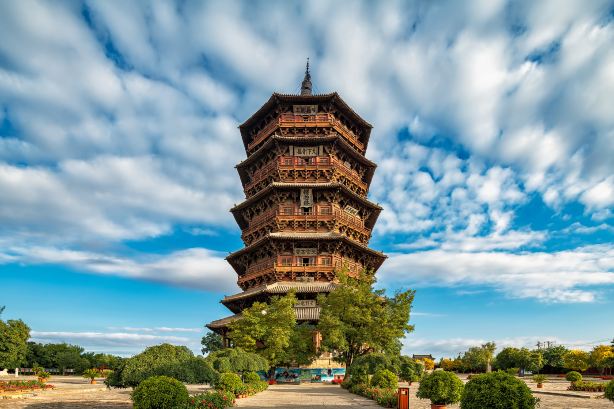
The full name of Yingxian Wooden Tower is Sakyamuni Pagoda of Fogong Temple. It is in the Fogong Temple in the northwest of Yingxian County. The octagonal wooden pagoda has five stories. Except for the high-end stone foundation of the first floor, the rest of the pagoda is made of wood using the traditional craftsmanship of Sunmao. Each layer of the wooden tower is equipped with wind chimes for a pleasant sound when the wind blows.China · Ying County

The Hukou Waterfall Scenic Area
The Hukou Waterfall is a famous waterfall on the Yellow River. The roiling water of the Yellow River roars downward here with great power. The Hukou Waterfall area is divided by the Yellow River. On the west side is Yichuan County, Shaanxi, and on the east side is Ji County, Shanxi. The waterfall is also divided into the Hukou Waterfall (the part of the falls in Shaanxi) and the Shanxi Hukou Waterfall (the part of the falls in Shanxi). Separate tickets are sold for each area. The Shanxi section of the Hukou Waterfall is located 45 kilometers west of the seat of Ji County in Linfen City, Shanxi.China · Ji County
Experiences you can't miss in Lin County
Featured Travel photography in Lin County
View all Travel photography
FromPKR 4,606.61


FromPKR 92,131.94

FromPKR 58,964.45

FromPKR 46,065.98

FromPKR 4,606.61


FromPKR 55,279.17
Free things to do in Lin County
Qikou Ancient Town
Lin County · 38.5 km from downtownQikou National Scenic Area
Lin County · 31.1 km from downtownLijiashan Village
Lin County · 40.5 km from downtownXiwan Village
Lin County · 37.4 km from downtownYellow River Art Gallery
Lin County · 32.6 km from downtown
Shanxi Museum
China · Taiyuan
Xinzhou Ancient City
China · Xinzhou
Taiyuan Ancient County
China · Taiyuan
Donghu Vinegar Garden
China · Taiyuan
What travelers say about Lin County

320***35August 31, 2026
5.0
Definitely worth seeing! With over thirty actors, every movement and every line was incredibly professional and dedicated – not at all perfunctory! A fantastic live performance! The stage is movable, and the scenery and stage design were meticulously crafted! Thumbs up! 👍 Everything was very well-conceived, and the content was incredibly rich! I learned so much more about the history of Qikou!
Qikou Ancient Town

滇国剑客October 1, 2021
5.0
Qikou is a place with early human activities. People here have created a long history and excellent culture. Therefore, Qikou Scenic Area occupies an important place in the hearts of tourists.
Qikou National Scenic Area

骑着蜗牛赶绿灯July 27, 2026
5.0
This is a unique ancient village in Shanxi, featuring loess cave dwellings. With its distinctive topography, expansive views, and pristine, untouched commercial environment, it's free to visit, offering exceptional value. Quiet and less crowded, it boasts stunning photo opportunities and a relaxed pace suitable for all ages. A visit of 1.5-2 hours is recommended, making it a must-see hidden gem on the Lüliang self-driving loop.
Lijiashan Village

petitedragonApril 13, 2026
5.0
Xiwang Village is located on the banks of the Qiushui River.
The village is nestled against the mountains and faces the water, with seven stone-paved streets (two horizontal and five vertical) connecting the courtyards, forming a castle-like, enclosed village with layered, interconnected courtyards and households.
For ¥2 per person, we visited one of the families. The elderly lady was very hospitable, giving a detailed introduction to her ancestral home. The stone carvings on the roof beams were exquisite, and she even offered to take photos for us.
Xiwan Village

西溪老翁April 9, 2021
5.0
The Yellow River Gallery, also known as the Yellow River Hundred Miles Water Erosion Relief, is located in the Qikou section of the Yellow River Grand Canyon in Shanxi and Shaanxi. It is a precious natural heritage. It was formed in the Triassic period. It is a natural cliff relief formed by the combination of groundwater dissolution and river erosion on the thick sandstone of the Triassic system.
The Yellow River Gallery has a strong sense of art, like calligraphy, architecture, people, or birds and animals. Different people may see different artistic conceptions from different angles. It makes people marvel at the uncanny craftsmanship of nature.
Yellow River Art Gallery

Annie长翅膀的喵July 5, 2026
5.0
The Black Dragon Temple, perched majestically on the mountainside of Wohu Mountain, is a landmark ancient temple in Qikou Ancient Town. Originally built in the Ming Dynasty, it has been renovated and remains standing to this day.
The temple is built against the mountain, its stone foundations imposing, its halls arranged in a harmonious and orderly fashion, and its glazed tile roofs exuding ancient charm. The plaque above the mountain gate is vigorous and simple, and the stage cleverly incorporates acoustic design, allowing the sound of opera performances to travel across the Yellow River to the other side—a truly ingenious architectural feature.
This place was once a place of prayer for blessings for merchants and boatmen on the Yellow River, embodying their hopes for peace and prosperity. Climbing to the top of the temple and gazing into the distance, one can see the Yellow River surging mightily, the ancient town's houses standing in neat rows, and the mountains, water, and ancient buildings reflecting each other, showcasing the magnificent and timeless charm of this ancient Yellow River town.
Black Dragon Temple

M26***27October 22, 2026
5.0
We went in early August on a road trip. We stayed in the parking lot the night before, otherwise, the traffic would have been terrible during peak season. It has a strong historical feel, giving you a sense of traveling back a thousand years. The kids weren't particularly interested. It was too crowded during peak season, so the experience wasn't great. If there are fewer people, I would definitely recommend it.
Jinci Temple Museum

Anonymous userOctober 21, 2026
5.0
Buying on the go is very convenient.
I'd been wanting to see the wooden pagoda for a long time, and this visit was truly breathtaking. The entire scenic area revolves around the wooden pagoda; you can enter from the first floor, and even then, it took almost two hours to see it.
Yingxian Wooden Pagoda

陈呱呱🍭October 22, 2026
5.0
I only went to the Shanxi entrance; I don't know if I can enter through the Shaanxi entrance. Seeing the Yellow River, the Mother River, was still very impressive; seeing it in person is definitely a great experience. There were also performances.
The Hukou Waterfall Scenic Area


