Things to do in Ningjin
Explore top experiences
Top 10 attractions in Ningjin


Zhaozhou Bridge
Zhaozhou Bridge, also known as Anji Bridge, is locally called the Great Stone Bridge. Built between the late Kaihuang period and early Daye period of the Sui Dynasty (595–605 AD), it has a history of over 1,400 years. Designed and constructed by Sui Dynasty craftsman Li Chun, it was bestowed the name "Anji" by Emperor Zhezong during his northern inspection tour in the Northern Song Dynasty. The Zhaozhou Bridge is a large single-span open-spandrel stone arch bridge with a segmental arch. The main arch consists of 28 parallel arch rings arranged longitudinally. The bridge has a total length of 64.4m, a deck width of 9m, and a width of 9.6m at the springing lines on both sides. The main arch, constructed with 28 parallel arch rings, has a clear span of 37.02m and a rise (vertical distance from the crown to the springing line) of 7.23m. The two smaller arches near the abutments at each end of the main arch have clear spans of 3.81m, while the two smaller arches closer to the center of the bridge have spans of 2.85m. Zhaozhou Bridge is an ancient stone arch bridge renowned for its exceptional scientific sophistication and artistic beauty. It holds a significant position in the history of world architecture and has been celebrated since ancient times as a "marvel of the world." In 1961, it was designated by the State Council as one of China's first batch of major national cultural heritage sites. In September 1991, the American Society of Civil Engineers selected it as the 12th "International Historic Civil Engineering Landmark," commemorating the honor with a plaque and monument.Zhao County · 17.5 km from Ningjin

The Palace Museum
The Forbidden City, also known as the Imperial Palace, was the imperial palace of the Ming and Qing dynasties, and is also the symbol of ancient China. When you are in the majestic and orderly high walls and deep courtyards, you can truly feel its former glory. ▲The long history has left behind large-scale precious buildings and countless cultural relics, which have also become the main attraction of visiting the Forbidden City today. ▲Classic attractions: The Forbidden City Corner Tower is a polygonal building with a convex plane on all four sides. It is located in Dongcheng District, Beijing. The roof has three layers. The upper layer is a hip roof with vertical and horizontal intersections. It is composed of a gable roof with flowing water on two slopes and a hip roof with four slopes. Because there are nine main ridges on this roof, it is called the Nine-ridge Hall. ▲Sundials are divided into two types according to their installation principle: equatorial and horizontal. The sundial installed using the equatorial principle is called an equatorial sundial. The key points of its production are that it must have a time plate, a latitude arc and a gnomon. When operating, the time plate must be parallel to the equatorial plane of the earth, the gnomon must be in the same direction as the earth's axis, and the shadow cast by the gnomon on the gnomon is the desired time. ▲The Treasure House is located in the Ningshou Palace area. It has a rich collection of treasures, including Buddhist supplies, ornaments, daily utensils, and treasures for appreciation. Among them, the red coral lion about 14 cm high, the Dongzhu court beads about 130 cm long, and the gold "Fengtianzhibao" seal are all rare treasures. ▲The Clock and Watch Museum is located in the Fengxian Hall in the palace. Most of the clocks on display are British products, but there are also clocks from other countries such as France and Switzerland. In addition to the timing function, these clocks are decorated with figures, birds, beasts, flowers, etc., which can also make various different movements. They are very delicately made. Among them, the copper-plated gilded writing clock, the copper-plated gilded enamel gourd-top fishing and woodcutting farming clock, and the copper-plated gilded rotating flower running man rhinoceros carrying clock are very rare.China · Beijing

Universal Beijing Resort
Beijing Universal Studios is a highly anticipated theme park destination, including Universal Theme Park, Beijing Universal CityWalk, and two resort hotels. It features brand new selected Attraction and includes popular entertainment facilities and attractions from Universal Theme Parks around the world. ▲Universal Studios Beijing: Blending Chinese cultural elements to create a unique experience, it has seven theme Attraction, 37 rides and entertainment facilities and landmark attractions, 24 performances, 80 Dining and 30 retail stores. ▲Minion Land: It is a colorful world full of joy! At this moment, these naughty Minions are walking around the streets, ports and city centers, having fun all over the world without restraint! At the same time, Gru is also recruiting soldiers for the Minions Army, so hurry up and sign up at Gru's house! ▲The Wizarding World of Harry Potter™: Here you can leave the ordinary world behind and experience the wonderful rides and endless magical adventures, which will lead you step by step into a thrilling and interesting magical world! ▲Transformers Metrobase: This is a Cybertron-style base, which is transformed by Transformers the size of a city. If you are ready to become an agent, then accept Optimus Prime's recruitment, join the Beijing Nest Force, fight side by side with the Autobots, and fight against the Decepticons to protect the earth! ▲Kung Fu Panda Land of Awesomeness: This is an ancient place like a paradise, and also a legendary place that combines the beauty of nature and craftsmanship. Come here to explore your own Kung Fu! There's also Jurassic World Isla Nublar, Hollywood, and Waterworld waiting for you to explore! ▲The Universal Studios Grand Hotel The Universal Studios Grand Hotel is located at the entrance of Universal Studios Beijing and offers Hollywood-themed accommodation and the privilege of Early Park Admission via the Universal Studios Beijing VIP Experience entrance; NUO Resort Hotel is a 5-minute walk from the entrance. Guests can enjoy a well-equipped fitness center, indoor swimming pool, and spa center (NUO SPA). Guests can also enjoy Early Park Admission via the Universal Studios Beijing VIP Experience entrance. Both hotels combine themed features with high-end facilities to create an immersive vacation experience.China · Beijing

National Museum of China
The National Museum of China is an institution that, on behalf of the country, collects, studies, displays and interprets representative material evidence that fully reflects China's fine traditional culture and advanced socialist culture. It is a national palace of history, culture and art and a cultural living room. The National Museum of China currently has more than 1.4 million collections, covering ancient cultural relics, modern and contemporary cultural relics, rare books and ancient books, and artworks. Among them, there are 815,000 pieces (sets) of ancient cultural relics, 340,000 pieces (sets) of modern and contemporary cultural relics, more than 240,000 pieces (volumes) of rare books and ancient books, and a total of nearly 6,000 first-class cultural relics. In recent years, especially since the 19th National Congress of the Communist Party of China, the National Museum of China has increased its efforts to collect representative material evidence reflecting contemporary advanced culture, and publicly collected cultural relics collections from the society, collecting an average of about 50 sets of ancient cultural relics and more than 1,000 sets of modern and contemporary cultural relics, physical objects and artworks each year. The exhibitions of the National Museum of China include three series: basic exhibitions, special exhibitions, and temporary exhibitions, forming a three-dimensional exhibition system covering theme exhibitions, basic exhibitions, special exhibitions, and temporary exhibitions. Among them, "Ancient China", "Road to Rejuvenation" and "Road to Rejuvenation in the New Era" are the basic exhibitions of the National Museum, and are also important positions for promoting Chinese traditional culture, advanced socialist culture, and cultivating and practicing the core socialist values. The special exhibitions are mainly based on the collection of cultural relics, including more than ten special exhibitions such as ancient Chinese bronzes, Buddhist statues, jades, porcelains, modern classic works of art, and African wood carvings. Temporary exhibitions include two categories: self-planned exhibitions and introduced exchange exhibitions, covering historical culture, fine cultural relics, archaeological discoveries, classic works of art, regional culture, international exchanges and other aspects, with an average of more than 40 exhibitions held each year. The National Museum of China has rich research resources, a solid research foundation and strong research capabilities, and is the industry leader in the development of the domestic museum industry. Since 2018, in accordance with the principle of "not seeking to collect but to exhibit, open cooperation, mutual benefit and win-win", we have established strategic cooperative relations with many cultural and museum institutions, institutes, universities and colleges at home and abroad, jointly carried out academic research, held high-quality cultural relics exhibitions, convened seminars, launched postdoctoral research workstations, and took the lead in establishing two international organizations, the BRICS Museum Alliance and the Silk Road Museum Alliance, striving to play a greater role and make greater contributions in promoting the core socialist values, enhancing cultural confidence, promoting exchanges and mutual learning between Chinese and foreign civilizations, and building a socialist cultural power.China · Beijing

Bailin Temple
It is a famous Buddhist temple in China, an important town of northern Buddhism, and the seat of Zhaozhou Ancestral Court. It houses Hebei Buddhist Academy and Hebei Zen Research Institute. The current abbot is Zen Master Minghai, and there are more than 160 resident monks. It is located in the southeast corner of Zhaoxian County, Hebei Province (called Zhaozhou in ancient times), facing the first bridge in the world - Zhaozhou Bridge. The main hall of the whole temple, Puguang Hall, covers an area of 435 square meters. Inside the hall is a 3-meter-high, 10-ton, seated statue of Sakyamuni and other statues of gods and Buddhas carved out of marble. Puguang Temple is connected to the mountain gate by a stone road about 7 meters wide and 100 meters long. There are six pairs of imitation Tang stone lamp buildings on both sides of the road, with nearly 10,000 square meters of lawn, more than 300 newly planted cypress trees and more than a dozen trees. The thousand-year-old ancient cypresses that have experienced the vicissitudes of life complement each other. As soon as you enter the mountain gate, you step into the pure Buddha land, which is in sharp contrast with the mundane world outside the mountain gate.Zhao County · 18.6 km from Ningjin

Mount Taishan
Crowned as "The King of the Five Sacred Mountains", Mount Tai has been one of China's most famous mountain peaks since ancient times. A large and impressive rock mass covering 25,000 ha and rising to 1,545 m above the surrounding plateau, Mount Taishan is considered one of the most beautiful scenic spots in China and was an important cradle of oriental East Asian culture since the earliest times. The mountain was an important object of the cult worship of mountains even before 219 BCE, when the Qin Emperor paid tribute to the mountain to inform the gods of his success in unifying all of China. Watching the sunrise and catching the spectacular sea of clouds are common activities that visitors engage in. You are also encouraged to explore the ancient sites, engravings, and religious temples to understand the role of Mount Tai in China's long history.China · Tai'an

Jinci Temple Museum
Jinci Temple is located on the banks of the Jin River at the foot of Xuanweng Mountain, 25 km southwest of Taiyuan. It was built by later generations to commemorate Tang Shuyu, the founding feudal lord of the Jin State, and served as the ancestral temple of the Jin State. It is often said that "a visit to Taiyuan is incomplete without seeingJinci Templethe saying "a wasted trip to Taiyuan". After getting off at Jinci Temple, the first place you'll reach isJinci MuseumThis is a free park with a pleasant environment, perfect for casual strolling. After about a 10-minute walk through the park, you'll reach the main area of Jinci. Inside Jinci Museum,Jinci TempleThe "Three Treasures" (Xian Hall, Flying Bridge Across Fish Pond, and Shengmu Hall) and "Three Wonders" (Zhou-bai, Nanlao Spring Pavilion, and painted clay sculptures) are must-sees for every visitor toJinci Templeview that everyone must see. Jinci TempleThe "Three Treasures" are connected and located atJinci Templeon the central axis, allowing for a combined visit. Xian Hall is a place for offering sacrifices, with fence-like walls on all four sides, providing good ventilation and coolness. Notably, not a single iron nail was used in the beams and pillars throughout the hall. The Flying Bridge Across Fish Pond is located in front of Xian Hall and was built during the Song Dynasty. The entire view resembles a modern overpass, making it the only existing example among ancient bridges in China. One end of the "Flying Bridge" connects to Shengmu Hall, which is the earliest existing main building in Jinci Museum. The main hall is spacious, and a major highlight is its beam-and-pillar structure without internal columns. Eight wooden carved coiled dragons, appearing ready to fly, are carved on the eight corridor pillars in front of the hall, which, together with the "Flying Bridge Across Fish Pond," present a magnificent sight. Centered around the Hall of the Holy Mother, it's easy to find the "Three Wonders." The painted clay figurines are located inside the Hall of the Holy Mother, with the main statue of the Holy Mother seated majestically in a wooden shrine, dignified and resplendent, while the other 42 attendant statues stand on either side. These figurines are dressed in vibrant colors with varied expressions, including one maidservant dressed as a flower-dan (young female role in Chinese opera), her face half joyful and half sorrowful, evoking complex emotions in viewers. Master Mei Lanfang once stood before this maidservant statue for a long time, carefully studying her posture and inner emotions, and praised it highly. The Zhou Cypress, located north of the Hall of the Holy Mother, was planted during the Western Zhou Dynasty and is over 3,000 years old. The Pavilion of the Never-Aging Spring stands south of the Hall of the Holy Mother, where the source of the Jin River flows continuously year-round. In addition,Jinci TempleInside, there is also the extremely precious "Jinci Inscription" stele, personally composed and handwritten by Emperor Taizong of Tang, Li Shimin. At the southernmost part, you can find the Shifang Fengsheng Zen Temple, which is said to have originally been the villa of Yuchi Gong, a founding general of the Tang Dynasty. In the northern part of the temple complex, the Futu Courtyard houses the Sheli Shengsheng Pagoda. Climbing the pagoda offers a panoramic view.Jinci TempleThe panoramic view is clearly visible.China · Taiyuan

Prince Kung's Palace Museum
Prince Kung's Palace Museum is located by the Shichahai lakeside and stands as one of the best-preserved princely mansions from the Qing dynasty in Beijing. It originally served as the residence of Heshen, a powerful official during Emperor Qianlong's reign. After Heshen's downfall, the property was granted to Prince Qing Yonglin, and later to Prince Gong Yixin during the Xianfeng era, hence the name "Prince Kung's Palace." This mansion witnessed the entire decline of the Qing dynasty, earning the saying "One Prince Kung's Palace, half the history of the Qing dynasty." The complex features a mansion in the front and a garden at the rear, both laid out along central, eastern, and western axes with meticulous order and grandeur. The mansion consists of multiple siheyuan courtyards connected along a central axis: The central Yinan Hall, roofed with green glazed tiles, follows the specifications of a prince's main hall. On the eastern route, the two-courtyard complex of Ledao Hall and Duofu Pavilion once served as the residence of Heshen's son Fengshen Yinde and Princess Hexiao of the Gulun rank, with Ledao Hall later becoming Prince Gong's living quarters. The western route features delicate refinement, with Xijin Study standing out particularly – its partitions are entirely made of exquisitely carved nanmu wood, modeled after the Ning Shou Palace in the Forbidden City. This extravagant construction later became one of Heshen's listed crimes. At the mansion's end stands a two-story elongated building commonly called "Ninety-nine and a half rooms," its rear wall punctuated by a row of variously shaped decorative windows. Legend claims this was the treasure vault and marks the boundary between mansion and garden. The garden, named Cuijin Garden, was reconstructed by Prince Gong's commissioned artisans, blending the charm of Jiangnan landscapes with northern architectural layouts. Its three marvels are the Western-style gate carved from white marble, the stele inscribed with the character "Fu" (blessing) by Emperor Kangxi, and the grand all-wood theater. Hidden in the Secret Cloud Cave within rockeries, the "Fu" stele conceals wishes for numerous descendants, abundant harvests, talent, longevity, and blessings in its strokes—easily missed if one isn't attentive. The theater, an enclosed wooden structure, reportedly projects vocals throughout without amplification. Bat motifs dominate the garden's "blessing" theme: the Bat Pool, Bat Hall, and painted beams interplay harmoniously. From the Moon-Inviting Platform, visitors overlook the entire garden, while the Winding Stream Pavilion preserves the refined legacy of ancient floating wine cup poetry. When touring, you may first follow the central axis to see the mansion, then pass through the western gate to enter and appreciate the garden in detail. There are usually more travelers visiting during holidays, so it's advisable to start early and allow enough time to slowly savor the history and details of this princely mansion.China · Beijing
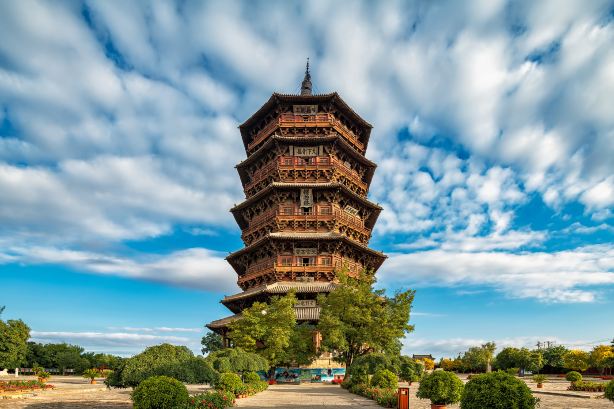
Yingxian Wooden Pagoda
The full name of Yingxian Wooden Tower is Sakyamuni Pagoda of Fogong Temple. It is in the Fogong Temple in the northwest of Yingxian County. The octagonal wooden pagoda has five stories. Except for the high-end stone foundation of the first floor, the rest of the pagoda is made of wood using the traditional craftsmanship of Sunmao. Each layer of the wooden tower is equipped with wind chimes for a pleasant sound when the wind blows.China · Ying County

Temple of Heaven
The Temple of Heaven is a unique altar for emperors of the Ming and Qing dynasties. Here, people worship the heavens, ask for rain, and pray for a better harvest. It is a famous ancient building in China. The Temple of Heaven is divided into two parts: the Inner Altar and the Outer Altar. Well-known structures such as the Hall of Prayer for Good Harvest and the Echo Wall are located in the Inner Altar. While visiting the Temple of Heaven, tourists get to experience the grand praying ceremony of ancient emperors and observe the ingenious designs such as the Echo Wall and the Triple Sound Stones. The wisdom of the ancient craftsmen will not fail to impress you.China · Beijing
Experiences you can't miss in Ningjin
Featured Day tours in Ningjin
View all Day tours
Free cancellation
Instant confirmation
Book now for tomorrow
FromQAR 140.75
Free cancellation
Instant confirmation
Book now for tomorrow
FromQAR 260.12

FromQAR 326.63

FromQAR 869.21

FromQAR 620.87
Free things to do in Ningjin
Zhaozhou Bridge
Zhao County · 17.5 km from NingjinNational Museum of China
China · BeijingBailin Temple
Zhao County · 18.6 km from Ningjin
Hebei Museum
Shijiazhuang · 58.3 km from Ningjin
Zhengding Ancient City
Zhengding · 65.7 km from Ningjin
Daming Lake Scenic Area
China · Jinan
Shanxi Museum
China · Taiyuan
Xinzhou Ancient City
China · Xinzhou
What travelers say about Ningjin

难 得糊 涂September 19, 2026
5.0
The Zhaozhou Bridge Scenic Area, also known as Anji Bridge, was built over 1400 years ago under the supervision of the Sui Dynasty craftsman Li Chun. It is the world's oldest and best-preserved open-spandrel stone arch bridge, often referred to as the "Number One Bridge Under Heaven." It is a 4A-level scenic area and a national key cultural relics protection unit.
The Zhaozhou Bridge itself spans the Xiao River, featuring a single-arch design with four smaller arches added to the shoulders—a groundbreaking innovation in bridge construction. This not only reduced the bridge's weight but also helped divert floodwaters during the rainy season. The bridge's bluestone railings are carved with lifelike dragons and mythical beasts. Currently, climbing the bridge is prohibited, but visitors can admire and photograph it up close from the banks.
The Ancient Bridge Exhibition Hall introduces the bridge's construction principles and historical evolution, showcasing old photographs and models to help visitors understand the engineering wisdom of the ancients.
The Li Chun Statue stands at the entrance of the scenic area, commemorating the designer of this famous bridge.
The riverside gardens along the Xiao River offer excellent views of the bridge's reflection in the water.
Zhaozhou Bridge

AdamarbbOctober 26, 2026
4.0
This place was worth visiting the temple was insane and made feel like in a movie. Although there were a lot of tourist it did not feel overwhelming or busy. I would recommend it for couples, family and even solo travellers for sure.
The Palace Museum

ShereshOctober 25, 2026
5.0
We had an amazing time. Hopefully, we can go back another again😊
Universal Beijing Resort

E43***44October 13, 2026
5.0
张洋导游讲解的非常好!All visitors should book the national Museum of China trip. It is not easy to book on your own, book through Trip.com and have a guide to share the history with you..
National Museum of China

吹你一脸灰October 10, 2025
4.0
Berlin Zen Temple is located at No. 23, Shita East Road, Zhaozhou Town, Zhao County, Shijiazhuang City, Hebei Province. It was first built during the Jian'an period of the Eastern Han Dynasty (196-220 AD). It was called "Guanyin Temple" in ancient times, "Yong'an Temple" in the Southern Song Dynasty, "Berlin Zen Temple" in the Jin Dynasty, and "Berlin Zen Temple" since the Yuan Dynasty. The existing temple buildings (except the Berlin Temple Pagoda) were built in 1992, covering an area of more than 90 acres. It is an important ancestral temple in the history of Chinese Zen Buddhism [2].
Bailin Temple

爱运动的川儿October 26, 2026
5.0
[Celebrating] Climbing Mount Tai, a journey through all four seasons! ⛰️ Initially sunny, then a sudden downpour, heavy rain covering the mountain, thick fog shrouding the peaks.
On the way down, I was surprised to find a clear sky and a sea of clouds surging.
All the twists and turns transformed into a magnificent vista before my eyes, and my heart felt instantly lighter and more open. ✨
Mount Taishan

xxf0711October 25, 2026
5.0
A taxi only goes to the entrance of Jinci Park. You can walk into the Jinci Museum or take a 10-yuan round-trip sightseeing bus. It's worth a visit! Due to limited energy, I only visited the main attractions. I had lunch at the market outside Jinci Park, which was quite good.
Jinci Temple Museum

库鲁兹游轮老炮儿October 25, 2026
5.0
Five stars! This guided tour of Prince Gong's Mansion was the biggest surprise of my Beijing trip. The guide was incredibly knowledgeable, covering everything from the construction of the mansion by Heshen, the history of Prince Qing and Prince Gong Yixin, to the architectural ingenuity and feng shui significance of Xijinzhai, the Houzhaolou, the Fuzi Stele in Miyun Cave, and the Grand Theater. The explanations were clear, concise, and packed with valuable information. His vivid and engaging style captivated both young and old. The pace was relaxed and comfortable throughout, avoiding any rushing. He thoughtfully provided information on key points to visit, tips to avoid common pitfalls, and patiently answered every question. There were no forced purchases. After the tour, I truly understood the meaning of "One Prince Gong's Mansion, half of the Qing Dynasty's history." When visiting Prince Gong's Mansion, be sure to hire this guide to avoid a superficial experience and deeply immerse yourself in the historical heritage of the mansion.
Prince Kung's Palace Museum

chow111October 25, 2026
5.0
Highly recommended! This 970-year-old wooden pagoda, built entirely of wood without nails, has stood majestically for centuries, a true marvel. It's easily accessible by direct shuttle bus from Datong Ancient City and Datong South Railway Station.
Yingxian Wooden Pagoda

HotchocOctober 25, 2026
5.0
It wasn’t very crowded at 9am. The buildings were beautiful. Make time for strolling in the peaceful parks in between. We spotted 2 squirrels and a cat.
Temple of Heaven


