Things to do in Yiliang
Explore top experiences
Top 10 attractions in Yiliang


The Huanglian River Scenic Area
The Huanglian River Scenic Area is located in the Daguan County of Zhaotong City. With waterfall views as its main attraction, it presents natural wonders such as caves, rain forests, and rare animals and plants, as well as cultural exhibits such as ancient tombs, prehistoric relics, and ethnic customs. A great getaway destination, it is a multipurpose sightseeing district for tourism, vacation, rock climbing, scientific expeditions, and other recreational activities.Daguan · 16.8 km from Yiliang
Xiaocaoba Ecological Tourist Area
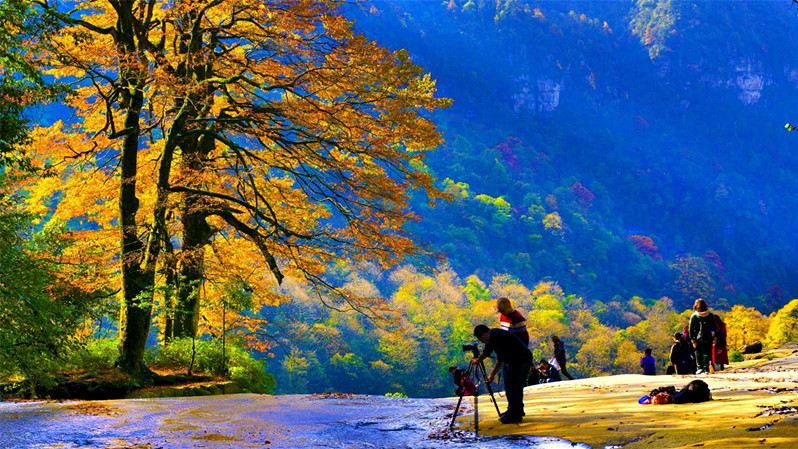
Xiaocaoba Ecological Tourist Area is located within theChaotianma area of the Wumeng Mountain Nature Reservein Yunnan Province. It is situated in the northeast of Yiliang County, 32 km from the county seat, and covers an area of 163 square kilometers. It spans two counties and four townships—Yiliang County, Yanjin County,Xiaocaoba Township, Lianghe Township, Longhai Township, and Miaoba Township—with a forest coverage rate of 78.6%. This is a masterpiece of nature, integrating primitive forests, rivers, unique peaks, waterfalls, and other landscapes with the ethnic customs of the Miao and Yi people. It is renowned for being majestic, unique, perilous, serene, beautiful, and rustic. Xiaocaoba Ecological Tourist Area is famous for five major features. First, it is the world's origin of Gastrodia elata (tianma). Due to the convergence of warm and humid air currents, the scenic area has formed special climatic conditions that have nurtured the world-renowned Xiaocaoba Gastrodia elata. Second, it features rich and unique attractions. Over 600 attractions, offering fun, sightseeing, scientific exploration, and leisure, are scattered across 13 rivers of various sizes, such as the Camel Drinking from the Spring, Milky Way Waterfall, Huanhe Rock, andHeavenly Book. Third, it has a wide variety of precious flora and fauna. There are over 1,200 recorded species of higher plants and 96 species of wild vertebrates. Among them are 29 national rare and endangered protected plants, such as the dove tree and Tetracentron sinense; 10 national precious tree species, such as linden and Taxus chinensis var. mairei; and 5 provincial key protected plants. 96 species of vertebrates have been discovered in the scenic area, including 16 national key protected wild animals such as black bears, macaques, and Lady Amherst's pheasants. It is particularly worth mentioning that the dove tree, a nationally protected plant, has reached a scale of 10,000 mu of contiguous forest in the scenic area. Fourth, the scenery in the scenic area is charming throughout the four seasons. It is a great place to enjoy flowers in spring, waterfalls in summer, red leaves in the fall, and snow in winter. It can be called a "fairyland on earth" and is a "paradise" for photography enthusiasts. Fifth, it has unique historical and folk culture.Xiaocaobastill preserves legendary tales and allusions, such as Zhuge Liang's expedition to the south, the construction of the Seven-Star Camp, the submission of the Yi leader General Jihuo, the "Two Horses Facing the Sky," and the British missionary and Gastrodia elata. The traditional folk culture of the Miao and Yi people is mysterious and fascinating. Xiaocaoba Ecological Tourist Area possesses unique natural advantages and historical origins.Xiaocaobablack Gastrodia elata is of excellent quality, with a gastrodin content of up to 1.13%, which is far higher than that of Gastrodia elata from Hanzhong, Shaanxi, and Enshi, Hubei. It is a representative of Zhaotong Gastrodia elata and, even more so, a representative of Yunnan Gastrodia elata.Yiliang · 31.8 km from downtown

Huangguoshu Scenic Area
The Huangguoshu Scenic Area is located in Anshun, Guizhou, centered around the Huangguoshu Waterfall. Surrounded by deep gorges, dense vegetation, and dotted with limestone caves and stone forests, it is a typical karst landscape area. The waterfall's name originates from the locally abundant "Huangguoshu" (Ficus virens). Ming Dynasty traveler Xu Xiake visited and documented this site, contributing to its fame. The scenic area primarily consists of three main sections: the Great Waterfall, Tianxing Bridge, and Doupotang. Most travelers follow the sequence of Doupotang, Tianxing Bridge, and finally the Great Waterfall, saving the most spectacular view for last. The grand waterfall has a drop of nearly 80 m and a width of over 100 m. The Baishui River plunges from the cliff top into Rhinoceros Pool, creating a vast mist. Multiple viewing platforms around it allow visitors to experience its grandeur, wonder, steepness, and beauty from different angles—above, below, front, back, left, and right. A particularly unique experience lies behind the waterfall: a 100 m long Water Curtain Cave runs horizontally through its midsection, featuring cave windows and halls. Reaching through a window, one can touch the cascading water. The cave served as the filming location for the Water Curtain Cave in the 1986 TV series Journey to the West. Due to the heavy humidity inside, bringing a raincoat in advance is recommended. Tianxing Bridge is renowned for its harmonious blend of rocks, water, trees, and caves—where rocks rise from the water, caves hide within rocks, and trees stand beside caves. The stepping stones along the path are engraved with dates, allowing travelers to find their own "birthday stone." The attraction is divided into upper and lower sections. Many travelers turn back after completing the upper section, missing the Silver Chain Waterfall in the lower part—where water cascades like silver chains into a funnel-shaped pool, the highlight of Tianxing Bridge. The Doupotang waterfall is located approx. 1 km upstream from the grand waterfall. With a width of over 100 m at its crest, the water spreads out smoothly like a beaded curtain. During the high-water season, its deep roar earns it the nickname "roaring waterfall." The scene of the four pilgrims leading their horse across the river in the 1986 TV series Journey to the West was filmed here. In summer and fall, the waterfalls are full and powerful, while in winter and spring, the flow becomes gentler, offering different viewing experiences. Nearby, visitors can also enjoy local snacks like sticky rice, love tofu, and Anshun spring rolls.China · Zhenning

Mount Emei
Mount Emei is one of the four famous mountains of Chinese Buddhism, and it is also the temple of Samantabhadra Bodhisattva. There are numerous Buddhist monasteries in the mountains that combine to give this place a holy and serene atmosphere. The scenery in the mountains are beautiful. The four seasons each have their own characteristics. If you are lucky, you can see the sunrise and sea of clouds. Do note that the monkeys in Mount Emei are notoriously naughty. They are not afraid of people, and even take the initiative to ask tourists for food.China · Emeishan City

Sanhaidong
The Shanhai Cave Attraction is based on the Classic of Mountains and Seas and is built around the main story line of "Searching for the Secret Realm of Mountains and Seas and Tracing the Origin". The cave uses sound, light, electricity and other technological means to perfectly present more than 40 dream scenes such as Nuwa mending the sky, Chiyou's battlefield, birds paying homage to the phoenix, and Yu killing Xiangliu, allowing you to be immersed in the scene and enjoy a visual feast.Daguan · 30.3 km from Yiliang
Leshan Giant Buddha
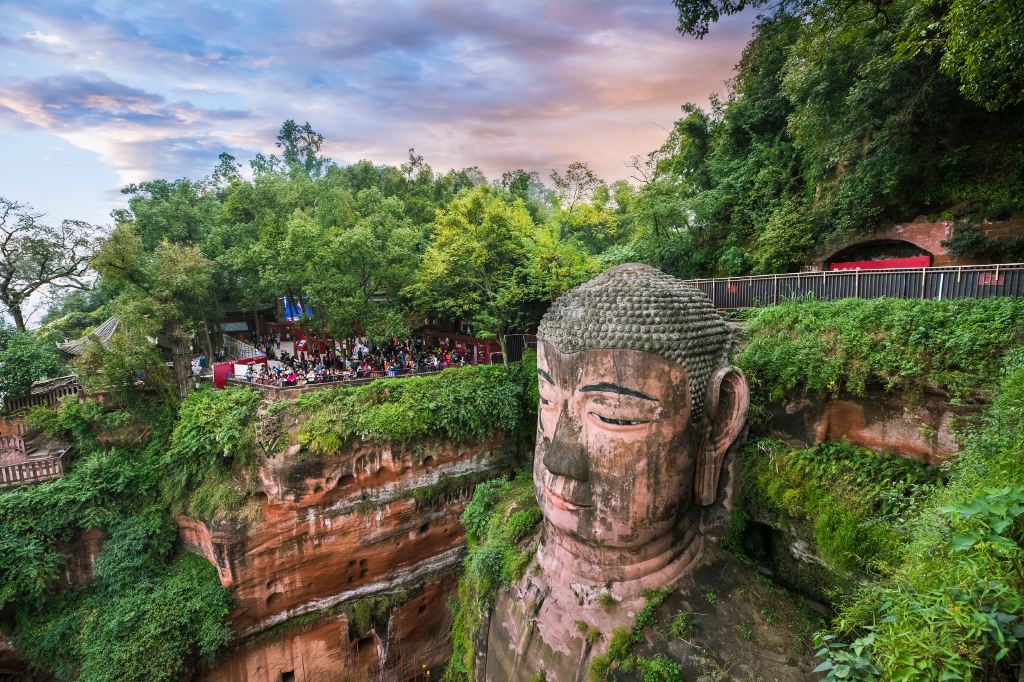
The Leshan Giant Buddha, also known as the Lingyun Giant Buddha, is situated on the cliff of Qiluan Peak on Lingyun Mountain at the confluence of the Min River, Qingyi River, and Dadu River in Leshan, Sichuan. It is a colossal seated stone statue of Maitreya carved during the Tang Dynasty, standing approx. 70 m tall, with a single instep spacious enough to accommodate over a hundred people. Legend has it that the turbulent waters at the confluence once frequently capsized passing boats. To calm the currents, the monk Haitong of Lingyun Temple initiated the carving of the Buddha. Over several generations, craftsmen continued the construction, which took approx. ninety years to complete. On the cliff to the right of the Buddha, an inscription from the Tang Dynasty titled "Jiazhou Lingyun Temple Great Maitreya Stone Statue" remains to this day, revealing its original name—the Great Maitreya Stone Statue of Jiazhou Lingyun Temple. The common route to visit the giant Buddha is to first arrive at Lingyun Temple beside the Buddha's head, then descend along the winding Jiuzhaigou plank road built against the cliff. View the Buddha's spiral hair buns and robe folds up close, and reach the platform at the Buddha's feet to look up at the full figure. Only then can one truly appreciate the grandeur of "a mountain being a Buddha, and a Buddha being a mountain." Lingyun Temple has continuous incense offerings, and many travelers also join their palms here to pray for blessings. For a different perspective, take a boat cruise or view from the riverside of Leshan ancient city: the continuous mountain outlines of Wuyou Mountain, Lingyun Mountain, and Guicheng Mountain resemble a giant reclining Buddha facing upward, with the grand Buddha seated precisely at its chest—creating the marvel of "Buddha within Buddha." The river view also captures the grand Buddha's full profile alongside the scenery of three rivers, making it especially effortless for travelers with limited stamina or those seeking panoramic shots.China · Leshan

Zhijin Cave Scenic Area
Zhijin Cave Scenic Area is a magnificent and uniquely shaped treasure trove of cave resources discovered in China. The cave is filled with various formations such as stalagmites, stone pillars, stone buds, and flagstones, creating a mesmerizing array of karst views. Since the entire attraction features a one-way walking route, visitors must complete the full journey upon entering. After exiting, they can take electric bikes back to the entrance. In the cave, you can admire various rock formations such as stalagmites, stone pillars, stone sprouts, and flagstones, creating diverse karst views. The cave passages crisscross in twists and turns, with stone peaks scattered throughout. The myriad of breathtaking scenes leaves visitors marveling at nature's craftsmanship.China · Zhijin

Yelang Valley
Huaxi Yelang Valley is located in a small canyon at the foot of the Cape Mountain in Huaxi University City, Gui'an New District. The opposite Cape Mountain is said to have been the residence of Queen Yelang's successor to Jinzhusi. To this day, the ruins of the ancient Yelang Tun Fort are still preserved on the top of the mountain, and Yelang Valley is also named after it. The stone buildings, pottery art, sculptures and other characteristic buildings in Yelang Valley are mysterious and full of strong artistic atmosphere, which are worth seeing.China · Guiyang

Maling River Canyon
Maling River is located in Xingyi City, a strategic point for Yunnan, Guangxi and Guizhou. It is 334 kilometers northeast of Guiyang and 321 kilometers west of Kunming. It originates from Baiguoling in the Wumeng Mountains. The upper reaches are called Qingshui River, and the middle reaches are called Maling River because of Mabie Dazhai and Malingzhai on both sides. Maling River has a slightly sad title - "the beautiful scar on the earth", which vividly describes the magnificence and steepness of Maling River. Maling River is more than 70 kilometers long, cutting a narrow and deep ground canyon in the plain. This structure is extremely rare in the world and is known as "the first seam in the world". The majestic and beautiful Maliang River Canyon National Scenic Spot is known as the "River of Thousands of Waterfalls" and "The Crack in the Sky and Earth". In 1993, the Maliang River "Five Rings Rafting Company" was established, pioneering rafting in the southwest. In April 1998, the International Canoe Rafting Competition was successfully held, and it became the Guizhou Province Canoeing Training Base and the National Olympic Whitewater Sports Base.China · Xingyi

Qingyan Ancient Town
Qingyan Ancient Town is located in Huaxi District, the southern suburb of Guiyang, and is known as one of Guizhou's four ancient towns alongside Zhenyuan, Bing'an, and Longli. Established during the Ming Dynasty as a military stronghold, the town preserves numerous well-maintained ancient buildings from the Ming and Qing periods. The filming of the movie "The Missing Gun" brought Qingyan Ancient Town to wider recognition. The ancient town's architecture follows the natural mountain contours, with its city walls built from massive stones on cliffs. It features four city gates at the east, west, south, and north. The exquisite stone and wood carvings in the town's buildings are a major highlight. The south gate of the ancient town, Dingguang gate, is the most magnificent among the four main gates. Historically, it served as the first gateway guarding the southern entrance to Guiyang. The towering gate tower and city walls built with massive stones, along with the winding flagstone path outside the town and surrounding farmland, create a spectacular landscape. Many promotional photos of Qingyan ancient town are taken here. Entering the ancient town through Dingguang gate, the first sight is the Zhaolilun centenarian memorial archway. Built by imperial decree during Emperor Daoguang's reign in the Qing dynasty, this archway features an unusual design - the stone lions carved on its four pillars are upside down compared to conventional ones, creating a peculiar sight. Walking along the ancient stone-paved post road, you'll find shops on both sides selling local specialties. Unique snacks like braised pig's feet, grilled tofu, and rose candy offer distinctive flavors worth trying when you need a break from exploring. The ancient post road winding from the south gate to the north gate serves as both the central axis and main street of the ancient town. Divided by the ancient cultural square at the town center, the northern section is called North Street while the southern section is named South Street. Intersecting with the main street are East Street to the east and West Street to the west. Following East Street eastward leads to Wenchang Pavilion at No. 143, a brick-and-wood structure built during the Wanli era of the Ming Dynasty. This octagonal pavilion with multiple eaves was constructed against the mountain slope and served as a gathering place for scholars to study, socialize, and worship the Wenchang deity - visitors may also pay their respects if interested. Heading west along the main street, you'll reach various distinctive religious buildings in Qingyan Ancient Town, including Yingxiang Temple, Ciyun Temple, Wanshou Palace, and the Catholic Church, all exquisitely crafted and perfect for photography. Between South Street and West Street lies a quiet alley called Back Street. This stone-paved lane is one of the most characteristic features of Qingyan Ancient Town, with its bluish-black flagstones polished smooth by centuries of use, reflecting light like mirrors to create a profound sense of tranquility. The narrow, serene path follows the mountain's contours, flanked by layered slate walls, making it an ideal photography spot. The streets and alleys in Qingyan ancient town are deep and winding, but there are signposts on the main street and at every important intersection. Moreover, most lanes can loop back to the main street, so you don't need to worry about getting lost while exploring the ancient town.China · Guiyang
More things to do
Private Tours in Yiliang
View More Private Tours in Yiliang


Free things to do in Yiliang

Zhaotong Ancient City
Zhaotong · 45.8 km from Yiliang
Baili Azalea Scenic Area
China · Dafang
Qianling Mountain Park
China · Guiyang
Taoyuan River Scenic Spot
China · Xiuwen
Guizhou Provincial Museum
China · Guiyang
Meihua Mountain Tourism Scenic Area
China · Liupanshui
Jiaxiu Pavilion
China · Guiyang
Lushan Scenic Area
China · Xichang
What travelers say about Yiliang

M29***22June 21, 2026
5.0
It doesn't require much physical exertion, and you can reach all the checkpoints. The scenery is beautiful, with many waterfalls of various shapes and sizes. The air is incredibly rich in oxygen ions. You can take a water slide down the mountain. The price is reasonable, and it's just a few minutes to the parking lot at the scenic area entrance.
The Huanglian River Scenic Area

MorningAugust 7, 2023
4.0
Original ecology, especially suitable for summer vacation, low consumption. I don't recommend it if you are looking for novelty. If a large family comes to stay for a few days, it will be very comfortable. There are no entertainment facilities at night. The family can go out for a walk and come back to play mahjong. The scenic area is especially suitable for hiking.
Xiaocaoba Ecological Tourist Area

139***82October 21, 2026
5.0
I've visited Huangguoshu Waterfall Scenic Area three times over 30 years. It's considered one of the most beautiful waterfalls in Asia, and the town of Huangguoshu is also quite well-developed. Although the water flow was lower this year, it was still incredibly magnificent, powerful, and thunderous. This time, I had the opportunity to fully appreciate the unique features of the waterfalls in all three sections. If the main waterfall is the head of the family, powerful and imposing, then the upstream Doupotang Waterfall is the steady son, refined and elegant, while the downstream Yinlian Waterfall is the emerald green jade, endlessly captivating and always brimming with charm!
Huangguoshu Scenic Area

M17***37October 23, 2026
4.0
I set off from Baoguo Temple Service Center at 7:00 AM, took a 2-hour bus ride to Leidongping, and then hiked to the Golden Summit. I didn't take the cable car; it took about an hour to reach the summit. It was foggy that day, so I couldn't see the Buddha statues clearly. I started my descent around 1:00 PM. I saw a few monkeys in the distance. After getting off the cable car, I took another bus to Wannian Temple. The bus pass allows for two hops on and off. When I arrived at Wannian Temple, I saw the Wuliang Hall, which is even older than the Golden Summit. I took the last bus down the mountain at 6:00 PM.
Mount Emei

帝国统帅66October 4, 2025
4.0
Shanhai Cave, located in Shanggaoqiao Township, Daguan County, Zhaotong City, Yunnan Province, was formerly known as Qinglong Cave. It is a karst cave formed by an underground river and stalactites. The cave's towering cliffs and golden stalactites create a unique karst landscape. It is a comprehensive tourist attraction integrating natural scenery, historical culture, and leisure and entertainment.
Sanhaidong

_TI***d1October 24, 2026
5.0
We where happily surprised with the landscape and nature surrounding the giant statue itself. The wait for the statue can be immensely long, but we seemed to have luck with the crowds. The steps down are very steep but very beautiful to walk on.
Leshan Giant Buddha

Anonymous userOctober 21, 2026
5.0
A fantastic attraction! We visited the Grand Canyon in the morning and Zhijin Cave in the afternoon, perfectly avoiding the crowds. We strolled around the cave, stopping frequently, and hired a professional guided tour, which lasted about two hours. I highly recommend hiring one, otherwise you'll just be wandering around aimlessly and miss a lot of exciting content. Also, be aware that the cave has outhouses; those who know, know. I advise everyone to use the restroom before entering the cave.
Zhijin Cave Scenic Area
Anonymous userOctober 15, 2026
4.0
The oddly shaped stones were quite interesting. There weren't many people during the Chinese New Year, so the experience was good. However, many small shops were closed, and transportation wasn't very convenient. It was rather quiet due to the holiday.
Yelang Valley

jiaoxiaozhuOctober 20, 2026
5.0
This card is absolutely fantastic! It includes a double ticket for three of Xingyi's most classic attractions, free parking, and is more than half the price of buying individual tickets! Plus, you can enter simply by scanning the code without any reservation – so convenient! Unfortunately, we didn't have enough time to visit Wanfeng Lake.
Maling River Canyon

E18***41October 19, 2026
5.0
Not far from Guiyang, this ancient town offers a tranquil escape from the hustle and bustle of the city. The "Defend Qingyan" activity immerses you in the atmosphere of the revolutionary war. While the main street is teeming with tourists, a stroll into the side alleys allows for a quieter appreciation of the century-old buildings. The pig's trotters in the food street are a specialty and definitely worth trying.
Qingyan Ancient Town


