Things to do in Zhongxiang
Explore top experiences
Top 10 attractions in Zhongxiang


Zhangjiajie National Forest Park
Zhangjiajie National Forest Park is where Zhangjiajie tourism originates. "Everyone knows Zhangjiajie, but who recognizes Wulingyuan?" Many visitors are confused about the relationship between Zhangjiajie and Wulingyuan. Generally, Zhangjiajie refers to both Zhangjiajie City and the Zhangjiajie attraction. The Zhangjiajie attraction specifically means Zhangjiajie National Forest Park, which—together with Tianzi Mountain, Suoxi Valley, and Yangjiajie—forms the Wulingyuan scenic area. Since Zhangjiajie National Forest Park was developed earlier and gained greater fame, even Zhangjiajie City was renamed after it. As a result, people commonly use "Zhangjiajie National Forest Park" or "Zhangjiajie attraction" to refer to the Wulingyuan scenic area. "Three thousand spectacular peaks and eight hundred beautiful waters." The three thousand spectacular peaks, in particular, are world-renowned. Wulingyuan's mountains stand apart from famous peaks around the world. Across its 398-square-kilometer area, over 3,000 densely packed sandstone pillars rise dramatically, with 243 exceeding 1,000 meters in height. When sea of clouds roll in, these pillars appear to float without foundation, soaring straight into the sky. Alongside North America's redwood forests and Greenland's glaciers, they form one of Earth's four great geological wonders. Located at low altitudes in the subtropical zone, Wulingyuan thrives with lush forests and abundant water sources, supporting numerous endangered plant and animal species. Each pillar teems with life. The natural pillars, bridges, canyons, waterfalls, streams, pools, caves, and dense broadleaf forests often shroud in mist and clouds, enhancing their breathtaking beauty. This unique landscape creates a spectacular scene described as "majestic mountains, elegant waters, peculiar peaks, secluded gorges, and exquisite caves," earning its reputation as "an enlarged bonsai and a miniature fairyland." On December 14, 1992, the UNESCO World Heritage Committee unanimously voted to include Wulingyuan on the World Heritage List, filling China's gap of having no World Natural Heritage sites. Its recognized outstanding universal value lies in its exceptionally rare quartz sandstone peak forest landform, which possesses extremely high aesthetic value. UNESCO states: "Wulingyuan's scenery can be compared to several national parks and monuments in the United States, such as the Grand Canyon, as well as the sandstone peaks of Western Australia's Purnululu region. However, due to Wulingyuan's lower elevation and subtropical location, it boasts lush forests, abundant water sources, and numerous towering peaks that display more vertical profiles than the heritage sites in the U.S. and Australia." The visually stunning Pandora planet in the globally popular 2009 movie "Avatar" captivated countless viewers, with its floating mountains inspired by Wulingyuan. Additionally, Wulingyuan served as the filming location for Chinese literary classics like "Dream of the Red Chamber" and "Journey to the West," as well as movies such as "Zhong Kui: Snow Girl and the Dark Crystal" and "Monster Hunt." In 2010, Wulingyuan's unique landform was officially named the "Zhangjiajie landform," becoming a globally recognized term and one of the few landform types in the world named after a specific region. Attraction highlights Yuanjiajie: Step into Pandora from Avatar Yuanjiajie served as the filming location for the "Hallelujah Mountains" in the movie Avatar. Here, you can explore the magical world of floating peaks scattered like stars across the landscape. If you're lucky enough to visit during a light rain or just after the rain clears, you'll witness the breathtaking scenery of mist-shrouded, layered mountain peaks. Mihun Terrace is the ideal vantage point, offering panoramic views of hundreds of towering stone peaks that create a majestic atmosphere. You can also see the renowned "World's First Bridge," a natural wonder spanning two mountains with a vertical drop of 357 meters. Tianzi Mountain: Where the Emperor's Return Makes Other Mountains Pale in Comparison Exploring Tianzi Mountain, you'll encounter extraordinary geological formations and peculiar peaks like the Imperial Writing Brush, Fairy Presenting Flowers, Commander's Platform, Sky-High Farmland, and Immortal Bridge. Don't focus too much on how closely these natural shapes resemble their names - the true charm lies in the mountain's "primordial natural beauty." The misty atmosphere after rainfall creates an ethereal fairyland experience, while winter transforms the landscape into an even more enchanting silver wonderland. Huangshi Village: Reach the summit for breathtaking mountain views "Without ascending Huangshi Village, your trip to Zhangjiajie is incomplete." Huangshi Village is a scenic viewpoint within Zhangjiajie National Forest Park, surrounded by sheer cliffs and lush greenery, with its summit often shrouded in mist. Reaching the top of Huangshi Village offers panoramic views that let you experience the majestic feeling of "seeing all other mountains appear small." Yangjiajie: Thrills Amidst the Peaks Yangjiajie is primarily known for its pristine natural beauty, featuring towering mountains and narrow paths that make it famous for its "perilous" reputation, beloved by backpackers and adventurers. Within the attraction, Black Dragon Village is one of Zhangjiajie's most magical spots. Once inhabited by bandits from western Hunan, it was later renamed after the TV series "The Suppression of Bandits in Black Dragon Mountain." The village is built along the mountainside, with only one path leading up and down—requiring visitors to use both hands and feet to climb to the summit. Suoxi Valley: Nature's Ink Wash Masterpiece Suoxi Valley, also known as Suoxi, gets its name from the rope-like shape of its winding streams. Unlike the more rugged areas of the forest park, this mist-shrouded valley features crystal-clear streams that flow year-round, surrounded by graceful peaks at every turn. The Ten Mile Gallery stands as the crown jewel of Suoxi Valley—a 5km-long canyon filled with fragrant wildflowers and extraordinary rock formations. Walking through this landscape feels like stepping into a living Chinese landscape painting. Golden Whip Stream: Filming Location of "Journey to the West" Golden Whip Stream Canyon is the earliest developed area in the attraction, where a crystal-clear stream flows through the valley flanked by towering peaks and lush greenery. This location served as one of the filming sites for the classic TV series "Journey to the West," allowing fans to visit iconic scenes like the Water Curtain Cave and the Mountain-Splitting Rescue.China · Zhangjiajie

The Three Gorges Dam Tourism Area
The Three Gorges Dam Tourism Area is located in the Xiling Gorge section of the Yangtze River in Yichang, Hubei. It is a scenic attraction built around the Three Gorges hydro project, covering over ten square kilometers. Currently, it offers travelers three viewing spots: Tanzi Ridge, the 185 viewing platform, and the river closure memorial park. The dam crest itself is not open to travelers, so visits primarily revolve around these three attractions. Tanzi Ridge is the highest accessible point in the dam area, named for its jar-shaped summit viewing platform resembling an overturned jar. It also served as the survey site for the dam's initial location selection. From the ridge top, visitors can overlook the Three Gorges Project in its entirety—the dam, power station, and twin five-level ship locks are all visible. The five lock chambers cascade down the mountainside, earning the nickname "Fourth Gorge of the Yangtze." The park displays engineering artifacts like ancient riverbed stones, river closure rocks, and foundation stones from the dam site, complemented by model exhibits that help visitors intuitively understand the origins and development of this mega-project. The 185 observation platform is located on the left bank of the dam. It gets its name from sharing the same elevation of 185 m as the dam crest. Standing on the platform feels like being atop the dam: on one side, the dam and vertical ship lift are within close reach, offering a chance to witness ships "riding the elevator" over the dam; on the other side lies the vast, tranquil reservoir upstream. The stark contrast between the stillness above and the dynamism below the dam is striking. The closure memorial park is situated on the right bank downstream of the dam, preserving artifacts like tetrahedral closure stones and large loading machinery used during the construction. It's an ideal spot to view the dam's full frontal grandeur. During flood seasons when the dam releases water, torrents rush out from the deep outlets, creating towering mist and thunderous echoes that reverberate through the valley—a truly awe-inspiring spectacle. The three attractions are far apart, and the scenic area provides shuttle buses for transportation. It is recommended to reserve half a day to visit them in order.China · Yichang

Yellow Crane Tower
Yellow Crane Tower is a landmark building of Wuhan. It is located on the bank of the Yangtze River and above Snake Hill in Wuchang. Many celebrities have written famous poems about the tower. Yellow Crane Tower was built during the Three Kingdoms period, but it was destroyed many times. What we see now is the reconstructed version built in 1985. When you climb the Yellow Crane Tower, you can see the spectacular view of the Yangtze River and Wuhan's three districts.China · Wuhan
Laojun Mountain Scenic Spot
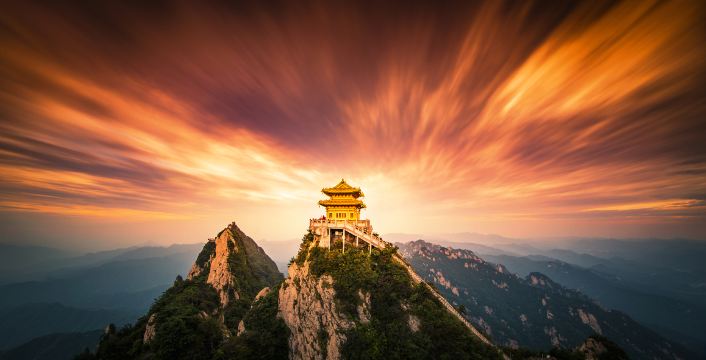
It is said that Laojun Attraction is the place where Li Er (Laozi), the founder of Taoism, practiced in seclusion. During the Northern Wei Dynasty, a temple was built in the mountain to commemorate it. Later, it was named "the famous mountain in the world" and has always been popular. The mountain is lush with trees and picturesque, and mountain springs can be seen everywhere. In the golden autumn, this is the best choice for viewing red leaves in the Souvenir areas. After the rain, Laojun Mountain is surrounded by clouds and mist in each peak, like a fairyland in the sky. The Attraction area is huge and is mainly divided into the main Laojun Mountain Attraction in the center, the Dream Valley Attraction in the west, and the Zhaigou Attraction Area in the east. Generally, tourists will spend a day to visit the main Laojun Mountain Attraction, which is also the most developed area of the entire Attraction. If you go to the top of the mountain, you will also have the opportunity to see the beautiful sea of clouds, sunrise, and sunset. The main Attraction of Laojun Mountain includes Zhongtianmen, Jinding, Laojun Temple, Nantianmen, Yuhuangding and Mazongling. Since its construction in the Northern Wei Dynasty, Laojun Temple has been the center of worship for pilgrims from the Central Plains; the Taoist temple on Yuhuangding enshrines the Jade Emperor and is also a good place to view the scenery in the mountain; Jinding and Mazongling are good places to watch the sunrise and the sea of clouds. Recommended itinerary: Day Trips Most tourists choose to spend a day to visit the main Attraction of Laojun Mountain. Lingguan Hall - the statue of Laojun at the foot of the mountain - Lincu Hall - Zhongtianmen - tree-lined trail - Lying Yunsong - Bodhisattva Hall - Laojun Temple, Jinding - Yuhuangding, and then return along the original route. Tourists can choose to walk the whole way or take a "walk + cable car" tour of Laojun Mountain according to their own conditions. There is the Zhongling Cableway of the Attraction between the Lingguan Temple at the foot of the mountain and the Zhongtian Gate on the mountainside. Take the Zhongling Cableway and then walk from Zhongtian Gate to the top of the mountain, Yuhuang Peak. The road from Zhongtian Gate to the top of the mountain is not very steep and can usually be completed in about an hour. Two-day tour If you have enough time, you can spend two days to visit Laojun Mountain. The general route is: D1: Visit the main Attraction of Laojun Mountain and stay in the mountain that night. D2: From the top of Laojun Mountain, choose to go down the mountain to the Dream Valley in the west or the Zhaigou Attraction in the east, and arrive at the west gate and east gate of the Attraction respectively. In the main Attraction of Laojun Mountain, you can stay near Zhongtianmen on the mountainside and Laojun Temple on the top of the mountain. There are hotels near Zhongtianmen with better accommodation conditions, while the accommodation conditions Souvenir Laojun Temple are relatively poor. If you plan to go to the top of the mountain to watch the sunrise the next morning, you can stay Souvenir Laojun Temple. Compared with the Zhaigou Attraction in the east, the mountain roads in Dream Chasing Valley are smoother, and tourists can choose one of them to go down the mountain according to their preferences. There are many places in the Attraction that can provide Dining services for tourists, but the signboards on some sections of the road in the Attraction are not yet very complete, so tourists need to pay more attention when visiting.China · Luanchuan

Hubei Provincial Museum
The Hubei Museum is composed of three antique buildings, including a comprehensive exhibition hall, a Chu Culture Hall, and a bell museum. The layout reflects the ancient Chu architectural concept of "One Hall" and "Multiple Stations". The Hubei Museum boasts four treasures: the Zeng Houyi Chime Bells unearthed in the Tomb of Marquis Yi of Zeng; the exquisite workmanship of the cold weapon era, the King of Yue's Sword of Goujian, the 1 million year-old Xunxian Man Skull Fossil, and the White and Blue Porcelain Plum Vase.China · Wuhan

Qingchuan Pavilion
Qingchuan Pavilion is located on Hanyang's Tortoise Mountain and faces the Yangtze River, across the river from the Yellow Crane Tower. Qingchuan Pavilion was built in the Ming Dynasty and was named after the Tang Dynasty poet Cui Wei. The pavilion as it exists today was rebuilt in the 1980s according to historical photos. The scenic area consists of three main buildings: Qingchuan Pavilion, Wuhan Dayu's Palace, and Tiemenguan. There are also a number of other attractions such as various stone tablets and monuments, decorated archways, and cloisters, all rich in classical Chinese charm. It is very pleasant to climb up to the pavilion, feel the wind from the river, and enjoy the view of the river. The classical architecture and the greenery here complement each other perfectly, and the beautiful scenery has caused this to become a popular spot for wedding pictures in Wuhan.China · Wuhan
Wudang Mountains
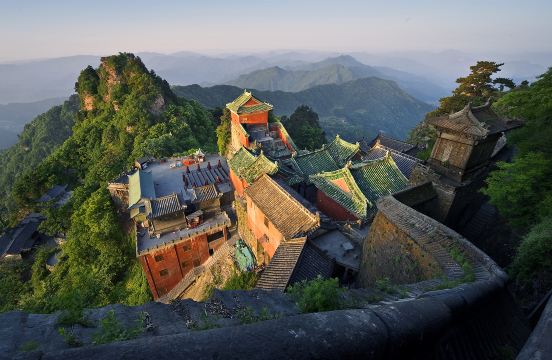
The Wudang Mountains are located in Shiyan, northwestern Hubei province. Its main peak, Tianzhu Peak, stands at an elevation of over 1,600 m. Legend has it that Emperor Zhenwu cultivated and ascended to immortality here, while Taoist Zhang Sanfeng further synthesized the essence of martial arts during the late Yuan and early Ming dynasties, making this the birthplace of Wudang martial arts. During the Yongle era of the Ming dynasty, the imperial court launched the monumental project of "constructing the Forbidden City in the north and building the Wudang Mountains in the south." The mountain temples were built according to royal standards, with their layout unfolding layer by layer following the mythological narrative of Zhenwu's spiritual cultivation. The palaces blend harmoniously with the peaks, cliffs, and streams, creating an ethereal and mystical atmosphere befitting a sacred mountain. The attractions unfold along the mountain terrain from the base to the summit, connecting key areas like Taizi Slope, Zixiao Palace, Nanyan Palace, and Taihe Palace. At Taizi Slope, the undulating Nine-bend Yellow River Wall follows the mountain contours, while Wuyun Tower's "one pillar supporting twelve beams" remains an architectural marvel. Zixiao Palace, a well-preserved imperial Taoist temple, features the stately Zixiao Hall with its double-eaved, nine-ridged roof. Nanyan Palace clings dramatically to a cliff face, offering vertiginous views of the valley below. Ascending the stone-paved ancient path to Tianzhu Peak's summit reveals the gilded bronze Golden Hall—the architectural masterpiece of the entire complex. As the birthplace of Wudang martial arts, this place attracts enthusiasts from home and abroad who come to seek masters and practice martial arts. The Taizi Slope on the mountain and the Xuantian Yuxu Palace at the foot serve as daily training grounds for practitioners. If you happen to encounter Taoist priests or students demonstrating Wudang boxing techniques, take a moment to quietly observe and appreciate the centuries-old martial arts heritage. A two-day visit is recommended: On the first day, enter from the mountain gate to visit Taizi slope and Zixiao palace, then stay overnight near Wuyaling. On the second morning, first visit Nanyan palace, then ascend to the golden summit before hiking down or taking the cableway at Qiongtai. After exiting the mountain gate, you may also visit Xuantian Yuxu palace. The attraction's shuttle buses connect all major core attractions, allowing flexible combinations of hiking and riding. Most dining and lodging options are concentrated around Nanyan, convenient for rest during the climb. From late October to November each year, when the forests are ablaze with color and red leaves cover the mountains, it's the perfect time to enjoy the fall scenery in the mountains.China · Danjiangkou

Yue Yang Tower
"Be the first to worry about the world's worries and the last to enjoy its pleasures"—this line from Fan Zhongyan's Northern Song dynasty essay "Yueyang Tower chronicle" made Yue Yang Tower by Dongting Lake a household name. The main tower, Yueyang Tower, is said to have evolved from a naval review tower built by Lu Su of Eastern Wu during the Three Kingdoms period. Alongside Yellow Crane Tower in Hubei and Tengwang Pavilion in Jiangxi, it is hailed as one of the three great towers of southern China. Poets like Li Bai, Du Fu, Meng Haoran, and Bai Juyi once climbed it to compose verses. From the top floor, leaning on the railings, you can take in the vast expanse of Dongting Lake stretching hundreds of miles, with Junshan Island visible across the waters—where timeless verses and the lake's beauty converge in this moment. The tower itself is an architectural treasure: its three-story, triple-eave structure is built entirely of wood with mortise-and-tenon joints—no iron nails used—and four golden nanmu pillars run straight from the ground to the rooftop. The helmet-shaped roof, called "helmet crown," is supported by layered ruyi bracket sets, a rare design among surviving ancient towers in China. Inside, carved Qing-dynasty panels of "Yueyang Tower chronicle" are preserved—pause to admire them when ascending. The small attractions within the attraction each have their own highlights: near the gate, the "Five-dynasty towers" use bronze miniature models to recreate Yueyang Tower's different architectural styles from the Tang, Song, Yuan, Ming, and Qing dynasties, showcasing a millennium of changes at a glance. On the lakeshore in front of the main tower, ancient iron artifacts resembling shackles and weighing several tons are displayed—their casting era and purpose remain debated, forming a long-standing historical mystery. Additionally, there are the Shuanggong Shrine commemorating Fan Zhongyan and Teng Zijing, the stele corridor engraved with poems about the tower from various dynasties, and the Xiaoqiao Tomb—said to belong to the wife of Three Kingdoms general Zhou Yu—waiting to be explored. If you wish to extend your itinerary, you may also take a boat tour of Dongting Lake and visit Junshan Island on the opposite shore. The nearby Bianhe Street, a cobblestone-paved antique-style street, is lined with local snack stalls and souvenir shops, making it convenient to explore along with the nearby Baling Square.China · Yueyang

White Emperor City Qutang Gorge Scenic Spot
White Emperor City Qutang Gorge Scenic Spot is located by the river in Fengjie County, Chongqing, at the western entrance of the Yangtze River's Three Gorges. It consists of two parts: White Emperor City and Qutang Gorge. A historic island city surrounded by water meets a majestic and precipitous gorge gateway, where natural landscapes, Three Kingdoms relics, and millennia of poetry converge. When cruising through the Three Gorges, the gorge's panoramic scroll often begins unfolding here. White Emperor City, originally named White Emperor City Qutang Gorge Scenic Spot, was built by Gongsun Shu in the late Western Han Dynasty as a fortified city, where he proclaimed himself the "White Emperor," a name that has endured to this day. During the Three Kingdoms period, Liu Bei retreated here after his failed eastern campaign and entrusted his son to Zhuge Liang on his deathbed. The colorful sculptures in the Entrusting the Orphan Hall at the White Emperor Temple recreate this historical episode. Interestingly, while the temple's name remains unchanged, it now enshrines Liu Bei and Zhuge Liang, who were honored during the Ming Dynasty. The Mingliang Hall, Wuhou Shrine, and Star-Gazing Pavilion are built along the mountainside, while the eastern and western stele forests display inscriptions from various dynasties, worth a slow-paced appreciation. The site is also renowned as the "City of Poetry": Li Bai, pardoned and returning east, penned the timeless line "Leaving at dawn the White Emperor crowned with cloud"; Du Fu, residing in Kuizhou for nearly two years, left behind over 400 poems; and Liu Yuxi composed "Bamboo Branch Songs" while serving as the governor of Kuizhou. After the Three Gorges Reservoir was filled, the rising river level turned White Emperor Mountain into an isolated island in the high gorge's flat lake, accessible only via a long covered bridge. The Qutang Gorge stretches approx. 8 km in total. Though not the longest among the Three Gorges, it is renowned for its majestic and precipitous scenery. The gorge entrance, called Kuimen or Qutang Pass, features the sheer cliffs of Chijia Mountain and Baiyan Mountain standing opposite each other, abruptly narrowing the river. Here, the Yangtze forces its way through the pass, which has served as the vital waterway to and from Sichuan since ancient times. It also appears on the back of the fifth series CNY 10 banknote. While sailing through the gorge, visitors can spot the hanging coffins at Wind Box Gorge high on the cliffs, the orderly arranged Meng Liang's Ladder holes on Baiyan Mountain's precipice, and numerous cliff inscriptions. When visiting, consider first walking across the covered bridge to the island to explore the Tuogu Hall, stele forest, and Star Observation Pavilion, then head to the Kuimen viewing platform behind Baidi Temple—directly facing Kuimen, it offers the same perspective as depicted on the back of the CNY 10 banknote. Matching a bill with the actual view for photos has become a classic activity. To truly experience the canyon's narrowness and the river's rush, take a boat through Qutang Gorge—looking back at the cliffs from the water is far more awe-inspiring than viewing from the shore.China · Fengjie County

Zhangjiajie Grand Canyon
Zhangjiajie Grand Canyon, located in Cili County, Zhangjiajie City, boasts lush vegetation and fresh air, with cascading waterfalls and babbling brooks everywhere, creating a natural oxygen bar. Beyond admiring the stunning natural scenery, the highlight of this attraction is the glass bridge—Zhangjiajie Grand Canyon Glass Bridge. Standing on the bridge offers a breathtaking view of the canyon floor 400m below, providing an exhilarating challenge for your nerves. Both downtown Zhangjiajie and Wulingyuan Attraction offer direct buses to the Grand Canyon, taking approximately 20–30 minutes. Upon entering the attraction, the first sight that greets you is the glass bridge spanning the canyon. The middle section features fully transparent panels, perfect for photo enthusiasts to lie down and snap away. Continue forward through Shenquan Gorge and the Ladder Plank Walkway until you reach One-Line Sky, where you can get up close with the sheer canyon walls. Proceed further down via the slideway to the mountain base, then board a cruise to exit the attraction.China · Cili
Experiences you can't miss in Zhongxiang
Featured Day tours in Zhongxiang
View all Day tours



Free things to do in Zhongxiang


What travelers say about Zhongxiang

limonzOctober 25, 2026
5.0
This is absolutely the most wondrous natural wonder in the world. As you walk along please read all the signages of earths natural wonders and how it came about. We feel we are high above the clouds. Misty and surreal.. a must visit
Zhangjiajie National Forest Park

E11***95October 8, 2026
5.0
The tour takes approximately 3.5 hours. From the visitor transfer center, take a sightseeing bus to Tanziling. After descending Tanziling, proceed to the 185 Park, where you can take an electric cart or walk. From the 185 Park, take a sightseeing bus to the Interception Memorial Park. Finally, take a sightseeing bus to the Miniature Landscape Park (the park's exit), concluding the tour.
The Three Gorges Dam Tourism Area

_M1***81October 24, 2026
5.0
The Yellow Crane Tower is a must-see attraction in Wuhan, located in Wuchang District. It has several entrances, but the current site is not the original location of the tower. The main attraction is the cultural atmosphere and the beautiful poems left by the ancients. You can go up the tower by elevator, but there's a separate fee. A leisurely stroll through the area can easily take two or three hours; if you just want to see the tower and leave, it will be much faster.
Yellow Crane Tower

D59***26October 25, 2026
4.0
It's worth a visit. The weather forecast for the first day was sunny, so we started hiking in the afternoon. The higher we went, the more disappointed we became – very foggy. We walked around the whole area and couldn't even see the Golden Summit. The forecast for the second day was sunny again, so we set off again. Today, we finally saw a bit of the sun on the mountain. Fog rolled in around 4 pm, so we couldn't see the sunset, but it was still worth the hike. The cable car is convenient for going up and down.
Laojun Mountain Scenic Spot

大土豆一颗October 4, 2026
5.0
The exhibited artifacts were quite good; I've also been to joint exhibitions organized by museums like the Hunan Provincial Museum. The Kremlin artifacts here are well-prepared and thoughtfully designed. However, the souvenir and merchandise section was rather boring. I was thinking of buying a pendant or something, but that saved me some money.
Hubei Provincial Museum

沅大王September 30, 2026
5.0
The scenic area is filled with the fragrance of osmanthus blossoms. From the top, you can enjoy panoramic views of the Yangtze River Bridge and the Yellow Crane Tower. At the very top, watching the ships on the Yangtze and the cars and trains on the bridge, with the breeze blowing, is very pleasant, and it's not too crowded. The scenic area isn't large; a leisurely hour is about right to appreciate the scenery.
Qingchuan Pavilion and Guishan Scenic Area are directly connected by the Iron Gate Pass, which leads to the West Gate of Guishan. Climbing the mountain and enjoying the breeze and osmanthus fragrance is a wonderful experience.
Qingchuan Pavilion

139***86October 24, 2026
5.0
The overall environment of Wudang Mountain Scenic Area is excellent. The area is very clean and well-managed, deserving of the 5A rating. The weather wasn't great this time; it was foggy. I'll definitely come back again next time.
Wudang Mountains

道士不好惹October 19, 2026
5.0
Yueyang Tower, located on Dongting North Road in Yueyanglou District, Yueyang City, Hunan Province, sits atop the western city wall of the ancient city of Yueyang, close to the shore of Dongting Lake. Overlooking Dongting Lake and facing Junshan Mountain, it was built atop the ancient Yueyang Gate and is considered one of the "Four Great Towers of Ancient China," along with the Yellow Crane Tower, Tengwang Pavilion, and Penglai Pavilion. Yueyang Tower, along with the Yellow Crane Tower in Wuhan, Hubei Province, and the Tengwang Pavilion in Nanchang, Jiangxi Province, are known as the Three Great Towers of Jiangnan.
Yue Yang Tower

_We***51October 10, 2026
5.0
It's great in every way. The only starting point for the Three Gorges Summit hike is Baidi City, and the scenery is beautiful. Food and drinks on the mountain cost 10 yuan per serving. There are many steep uphill sections, and the hike is about 10 kilometers and takes about 6 hours. After the hike, there are local private cars available for 30 yuan per person to take you down the mountain from the high-speed rail station or other places.
White Emperor City Qutang Gorge Scenic Spot

_TI***kqOctober 25, 2026
4.0
Unfortunately, it was extremely foggy, so we couldn't enjoy any of the views from the glass bridge.
Zhangjiajie Grand Canyon


