Things to do in Ruili
Explore top experiences
Top 10 attractions in Ruili


One Village, Two Countries
One Village, Two Countries is located in the southwest of Ruili City. The famed China-Myanmar Border Post No. 71 has been erected within the village boundary and the border zig-zags its way through the village. It is a typical border area. Visitors can experience the folk traditions of Myanmar, while enjoying a ride on the village swing, swaying back and forth between the two countries. There is also a water well in the village, in which people on both sides use in harmony.Ruili · 9.3 km from downtown

Moli Tropical Rainforest Scenic Area
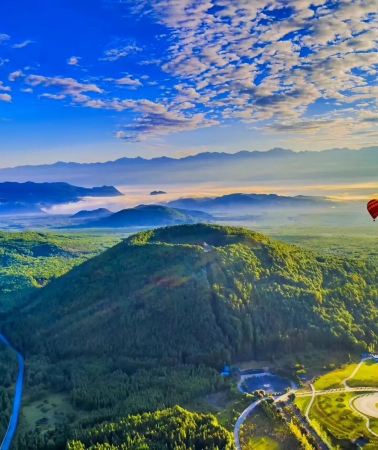
The Moli Tropical Rainforest Scenic Area is located in northeastern Ruili City. In the local Dai language, "Moli" means “beautiful waterfall.” The Moli Rainforest is famous for its rich natural landscape and being a Buddhist holy place. Near the hot spring pool, there is a gold-colored Dai-style pagoda, or stupa, that houses a meteorite. There is a giant "footprint" embedded at an incline in the ground at the rock wall, with the toes of the foot clearly visible. In Southeast Asian Buddhism, this is a very famous footprint of the Buddha. Not far from the towering pagoda stands the Big Buddha Temple. At each and every Buddhist festival, there is a constant flow of pilgrims coming here to pray for blessings.Ruili · 16.7 km from downtown

Jiegao Port
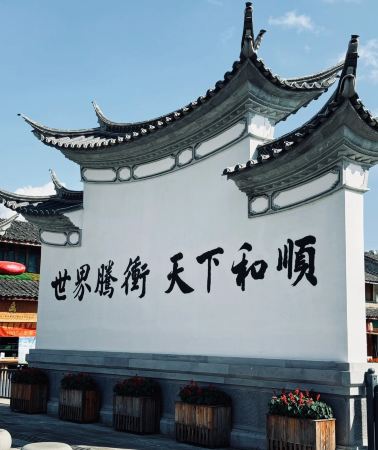
Jiegao Port is located on the east bank of the Ruili River, facing the Ruili city area across the river. It borders Muse, Myanmar, on the east, south, and north, serving as a busy land route for people and goods on the China-Myanmar border. "Jiegao" means "old city" in the Dai language and is said to have been the site of the ancient Mengmao city. Because it is surrounded by Myanmar on three sides and faces the river on one, it long functioned as an exclave. In the past, access relied entirely on ferries until the Jiegao Bridge was completed and opened to traffic in 1989, truly connecting the two sides. In 2005, a 600 m long, 4-lane bridge was opened, further easing traffic pressure. Jiegao Port implements a special inside the border, outside the customs management system: while located within the national border, the customs supervision line is set on the cross-river bridge, which gives this area a particularly strong atmosphere of border trade. The impressive national gate architecture and the straight, wide National Gate Avenue are the face of Jiegao.The nearby China-Myanmar Street is even more interesting. This street spans both countries; the Chinese side is called China-Myanmar Friendship Street, and the Myanmar side is called White Elephant Street,the boundary marker stands by the street, and standing in the middle of the street, you can see the streetscapes of two different countries on either side.Ruili · 5.4 km from downtown

Mangling One-Tree Forest
On the edge of the rainforest southwest of Ruili, a century-old banyan tree has woven a hidden ecological theater with its aerial roots. This forest community, naturally propagated from a single banyan, spans nearly four acres under its umbrella-like canopy. The aerial roots cascade like curtains, rooting into pillars upon reaching the ground, creating a multi-layered green corridor known as the Mangling Single-Tree Forest. Step into the forest as the morning mist lingers, where the scent of damp foliage drifts beneath a canopy of tangled vines. Sunlight filters through the leaves, casting dappled patterns on the interlaced "tree walls" of buttress roots, revealing squirrels darting along branches with wild fruits. Local Dai seniors often sit on the gnarled roots weaving bamboo crafts, occasionally sharing in their native tongue the legend of "Pahan Xiu" (tree spirits) guarding the village. If you stand quietly, you might hear the soft pecking of yellow-rumped sunbirds feasting on figs or the faint snap of an aerial root taking hold in the soil. In the afternoon, follow the wooden boardwalk deep into the shaded forest to discover a miniature ecosystem of ferns and orchids hidden beneath natural arches formed by aerial roots. During the rainy season, staghorn ferns clinging to branches unfurl new leaves, resembling a flock of suspended green butterflies. Locals set up bamboo tables in forest clearings, offering energy-boosting treats like water-splashing rice cakes wrapped in banana leaves and spicy pickled papaya for explorers to enjoy. As the setting sun gilds the aerial roots, the entire banyan grove transforms into a maze of light and shadow. Flocks of birds returning to their nests skim the treetops, startling a few banyan leaves that drift down onto the small altars dedicated to tree spirits among the woods—here you'll find no grand landscaping projects, yet every hanging aerial root writes primitive verses of rainforest life.Ruili · 11.2 km from downtown

Ruili Zongfo Temple
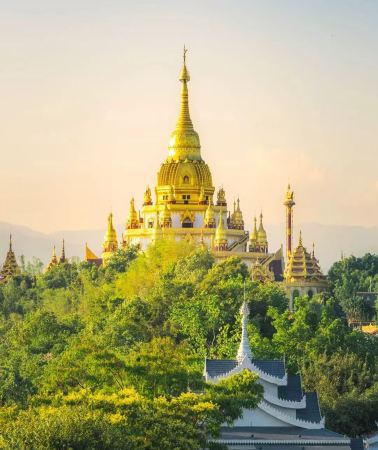
Ruili Zongfo Temple is located on the hillside of Guanghehan on the north bank of theRuili River, facing Muse, Myanmar, across the river. It is a Theravada Buddhist temple, known in the Dai language as "Wa Ba Jie." Today, it serves as a place for local believers to worship and pray, as well as a Buddhist study center for monks to study scriptures, and it also houses the Dehong Branch of the Yunnan Buddhist College. The temple's architecture blends traditional Dai styles with the styles of Buddhist temples in Southeast Asia, such as those in Myanmar and Thailand: the main hall with its triple-eave hip-and-gable roof is covered with a golden roof, while the red-painted and gold-traced stone pillars, intricately carved window lattices, and wooden brackets are full of exotic charm. The golden pagoda on the hilltop shines brightly in the sunlight. Inside the temple, there is a giant hollow Buddha statue 7.9m high, composed of hollowed-out elements such as the Dharma wheel, lotus flowers, and golden Buddhas. At sunset on a clear day, the afterglow passes through the hollow parts and shines on the Buddha, presenting a spectacular scene of "heaven and Buddha as one." Standing on the hilltop viewing platform, you can look out over the Ruili urban area on one side and Muse, Myanmar, on the other side of the river, truly experiencing the border scenery of "one basin, two countries." The temple is also adjacent to theDai King Palace, which you can visit along the way.Ruili · 6.1 km from downtown

Dai King Palace
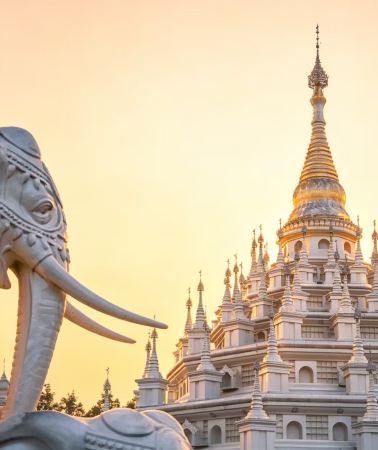
Dai King Palace is located on Guanghehan Mountain in the suburbs of Ruili. It was once the site of the third-generation palace of the Si Dynasty of the Luchuan Kingdom during the Ming Dynasty, and the current palace and pagoda were rebuilt on the original site after 2010. The golden main hall and the Great Golden Pagoda are the park's iconic buildings: the main hall's outer corridor is supported by golden stone pillars covered in intricate carvings, where solemn red and dazzling gold intertwine to create a sense of royal grandeur; the main tower and surrounding towers of the Great Golden Pagoda gleam with golden light, surrounded by sculptures of auspicious beasts, and a reclining Buddha is enshrined inside the pagoda, with daylight streaming in from the skylight, creating a serene and spacious atmosphere. The view here is expansive. Standing at the high point of the park, you can overlook the winding Ruili River and Muse, Myanmar, on the opposite bank. The pillars and white railings of the corridor are popular photo spots, and walking around the park, you can also find traces of historical sites such as the Face-Washing Well, Elephant-Washing Pool, and Drill Ground.Ruili · 6.1 km from downtown

Ruili Ancient City
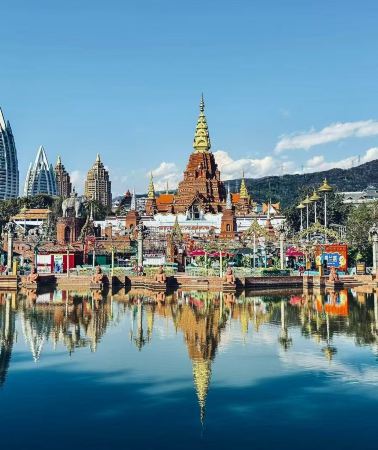
Ruili Ancient City is located in Ruili City, Dehong Dai and Jingpo Autonomous Prefecture, Yunnan Province. It is an important landmark for Ruili's history and culture, and a cultural tourism attraction on the southwest border of China with rich ethnic customs and border characteristics. Leveraging Ruili's long history and unique geographical advantages, it integrates modern tourism elements while preserving local cultural characteristics. It centrally showcases the traditional culture, architectural styles, and border humanities of ethnic minorities such as the Dai and Jingpo people, attracting many tourists for sightseeing and cultural experiences. The streets here are neat and well-organized, featuring buildings with ethnic characteristics, cultural exhibition spaces, handicraft shops, food streets, and leisure squares. Visitors can taste local delicacies such as Dai-style barbecue, sapei, bamboo rice, and paoluda, purchase jade, mahogany handicrafts, ethnic clothing, and Southeast Asian specialty goods, and experience the unique charm of the integration of border trade and multiculturalism. When the lights come on at night, it also hosts ethnic song and dance performances, intangible cultural heritage displays, festival activities, and a specialty night market, creating a lively and regionally distinctive tourism atmosphere.Ruili · 4.5 km from downtown

Wanding Boundary Cultural Park
Wanding Boundary Cultural Park is a national AA-level tourist attraction and one of the top ten attractions in Dehong. Located on National Defense Street in Wanding Town, Ruili City, Dehong Prefecture, Yunnan Province, it offers convenient transportation and serves as the core tourist area of Wanding Town, a provincial-level characteristic town in Yunnan. It is 500 m from Wanding Bridge, 1 km from the Nanyang Chinese Mechanics Memorial Hall, 20 km from Ruili (a 15-minute drive), and 75.5 km from Mangshi Airport (a 50-minute drive). The attraction covers a total construction area of 52,000 square meters, with an investment of 260 million yuan, and officially opened to the public in March 2010. Wanding Boundary Cultural Park, located at the intersection of the Burma Road and the Stilwell Road within China, is an attraction that mainly includes the China-Myanmar Friendship Memorial (a national key cultural relics protection unit), the Chinese Expeditionary Force Anti-Japanese War Memorial, the former Wanding Branch of the Central Bank of the Republic of China (the last branch established during the Republic of China period), the Coin Museum, the former International Mail Exchange Bureau, the Stamp Museum, and the China-Myanmar Ethnic Folk Museum, among other attractions, with a collection of over 100,000 items. It has become a comprehensive attraction integrating cultural tourism, sightseeing and shopping, leisure and entertainment, and dining and stay, embodying the unique border culture of China and Myanmar.Ruili · 23.2 km from downtown

Wanding Bridge
Ruili · 23.1 km from downtown

Bianzhai Hansha Tourism Scenic Area
Bianzhai Hansha Tourism Scenic Area boasts beautiful pastoral scenery and rich ethnic customs. When you arrive, you can see bamboo houses nestled among phoenix-tail bamboos and banyan tree groves, with the entire village surrounded by fields. Graceful Dai girls in traditional ethnic attire, carrying colorful Dai umbrellas, laugh and chat as they walk through the village. The sounds of wooden fish and chanting from the temple carry far, and the wind blows through the chimes on thepagoda, creating a clear, tinkling sound. Here, you can experience the grand Dai festival—the Water-Splashing Festival—at theWater-Splashing Square.Ruili · 6.8 km from downtown
More things to do
Private Tours in Ruili
View More Private Tours in Ruili


Group Tours in Ruili
View More Group Tours in Ruili
Free things to do in Ruili
Jiegao Port
Ruili · 5.4 km from downtownRuili Zongfo Temple
Ruili · 6.1 km from downtownWanding Bridge
Ruili · 23.1 km from downtownBianzhai Hansha Tourism Scenic Area
Ruili · 6.8 km from downtown
No. 71 Boundary Marker
Ruili · 9.5 km from downtown
Ruili River
Ruili · 4.1 km from downtown
Wanding Town
Ruili · 22.3 km from downtown
Zhongmian Street
Ruili · 5.8 km from downtown
Nongmo Lake Park
Ruili · 2.6 km from downtown
Jiegao Port - Ends of the Earth
Ruili · 6.2 km from downtown
What travelers say about Ruili

环球旅行家~木子October 15, 2026
5.0
This is considered a relatively unique local attraction. The barbed wire fence inside the scenic area separates it from Myanmar, and many Burmese people do business on the other side.
Ruili doesn't have many other attractions, but the "One Country, Two Villages" scenic area is quite large and features regular song and dance performances, making it worth a visit.
One Village, Two Countries

137***55August 16, 2026
4.0
It's alright. There's a waterfall at the top, the air humidity is quite high, and there are many tropical plants. Some of the trees are very tall, but it's not exactly unique or fun.
Moli Tropical Rainforest Scenic Area

大 牛August 28, 2026
5.0
It was free to enter. I walked. The Jiegao Bridge is very long, and Jiegao is right on the other side of the river, which is quite interesting because most national borders are defined by rivers, but Jiegao is like an exclave. The border gate also has a distinctive ethnic style. Climbing to the rooftop next to it, you can see the buildings on the other side, which are all quite similar.
Jiegao Port

喜欢猫的虎January 17, 2021
5.0
This tree is next to Mangling Village (next to National Highway 320). From a distance, it looks like a green forest. If you look closely, you can find that this forest is actually just a banyan tree. Ruili people call it the Welcoming Banyan Tree.
This Welcoming Banyan Tree is not very big. It ranks fifth in Dehong Prefecture, but it has a unique tree shape and changes its posture from left to right, front to back, so it is favored by many film and television experts. For example, more than ten films and TV series such as "Border Village Fire", "Peacock Princess", "Traveler with Handcuffs", and "Journey to the West" have been filmed here. The famous movie star Wang Xiaotang has played on the swing on this tree, and Liu Xiaoqing lingered in the forest.
Mangling One-Tree Forest

弘扬师兄July 27, 2025
4.0
Ruili General Buddhist Temple and Dai Palace are located next to Panbeng Village in Mengmao Town, Ruili City, Yunnan Province, on a high slope 8 kilometers away from Ruili City. The two attractions are adjacent to each other.
For those who come to Ruili in autumn and winter, especially those who have faith, this is a good place with pleasant scenery, quiet and peaceful. It is a good idea to stay for a while or to camp the RV here. Don't underestimate this place. The General Buddhist Temple has a host and monks, and a group of young monks are being cultivated in the temple; the General Buddhist Temple is very popular, and there are endless tourists visiting. From time to time, there are tour groups visiting this temple. The hollow Buddha statue is a great place to take pictures of the sunset; the building is grand and magnificent, splendid, and the infrastructure is complete.
The Dai Palace is about 20 meters away from the General Buddhist Temple and covers an area of about 533 acres. The buildings include the Dai Palace, the Great Pagoda, the dining area, the palace ruins, the wash well ruins, the wash elephant pool ruins, the training ground ruins, etc.
I don't know why the Dai Palace's facilities are not as good as those of the main Buddhist temple. There are no monks, no incense, no tour groups, only sporadic individual tourists. The reason may be that the infrastructure needs to be improved, the staffing is not in place, etc. However, this is also a good place to take pictures of the sunset.
Ruili Zongfo Temple

pekingwangJanuary 3, 2021
5.0
The Dai Palace is all Thai-style architecture. You can pretend to be in Thailand. I can't go abroad, but coming here is like going abroad. It's still Thailand without tourists [snickering], with more quietness and less noise.
Dai King Palace

秋风知我意~May 17, 2025
4.0
瑞丽古城虽是商业化新建的文旅综合体,但这里吃、住、闲都很丰富,有休闲度假的温泉酒店,有流连忘返的咖啡酒馆,还有味道正宗、环境优美的餐饮商家。不论你是外地游客还是本地居民,还是很值得来走走逛逛玩玩的。
Ruili Ancient City

Anonymous userNovember 16, 2025
4.0
I focused on the Expeditionary Force Memorial Hall, which showcases the arduous history of the Chinese Expeditionary Force's resistance against Japan through artifacts, enhancing my understanding of history. Due to time constraints, I only had time to briefly visit the stamp and coin exhibitions later on. If I had more time, I could have viewed them more thoroughly and gained a lot of knowledge.
Wanding Boundary Cultural Park

牛奶海June 10, 2020
4.0
Wanding Bridge is a boundary river bridge on the China-Myanmar border, located in Wanding Town, Ruili City, Yunnan Province. The old bridge of Wanding Bridge is no longer open to traffic. It is used as a project for visiting the China-Myanmar border, allowing tourists to take photos as a souvenir.
Wanding Bridge

格格October 27, 2019
5.0
Bianzhai Hansha is in Ruili. After taking photos at the Ruili National Gate, I went straight to Bianzhai Hansha. At first, I didn't know what Hansha meant and thought it was a tourist attraction. When I got there, I found out that it was for eating. Haha. It turns out that Hansha means golden resting place in Dai language. No wonder we came here to eat. There are mango trees and jackfruits everywhere. It's really interesting.
Bianzhai Hansha Tourism Scenic Area


