Things to do in Sunan
Explore top experiences
Top 10 attractions in Sunan


Mati Grottoes Tourism Area
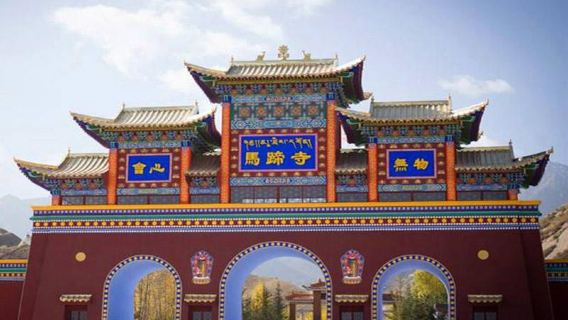
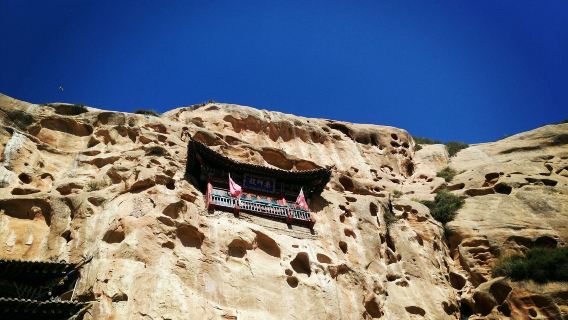
The Mati Grottoes Tourism Area is located at the foot of the Qilian Mountains in Sunan Yugur Autonomous County, Zhangye. This grotto temple complex was first built during the Northern Liang period of the Sixteen Kingdoms and continued to be carved for over a thousand years. It was renamed Puguang Temple during the Yongle era of the Ming Dynasty and was historically renowned alongside the Mogao Caves in Dunhuang and the Yulin Caves in Guazhou as a major center of Buddhist art along the Hexi Corridor. The grotto complex consists of Shengguo Temple, Puguang Temple, the Thousand Buddha Caves, Jinta Temple, and the Upper, Middle, and Lower Guanyin Caves, with over 70 surviving cave niches. Early on, Han Buddhism flourished here, while Tibetan Buddhism gradually rose after the Yuan Dynasty. The coexistence of Han-style halls and Tibetan Buddhist temples on the same mountain is a distinctive feature that sets this grotto complex apart from most others. Legend has it that a heavenly horse left its hoofprint here, giving the mountain and temple their names. The deep hoofprint can still be seen on a bluestone slab in the Mati Hall today. The "Thirty-three heavens" grotto is the iconic view here: over 20 caves across seven tiers are carved into the steep red sandstone cliff in a pagoda-like formation, with halls and pavilions suspended layer by layer. All passageways are hewn into the rock—some so narrow and steep that only one person can pass at a time, requiring visitors to climb on hands and knees along zigzagging stone steps and wooden ladders. From the upper caves, one can overlook the river valley and grasslands at the foot of the Qilian Mountains. The grand Tibetan Buddha Hall, also called the Standing Buddha Hall, extends over 30 m deep, with niches densely lining its encircling corridor, most housing statues from the Yuan Dynasty. The Thousand Buddha Cave, an earlier-excavated section of the complex, preserves intact stone sculptures of one Buddha flanked by two disciples, while nearby cliffs feature extensive relief carvings of stone pagoda forests. The attraction stretches several km deep, with the main route connecting several areas including the "Thirty-three heavens" grottoes, King Gesar's hall and the Thousand Buddha caves, which are some distance apart. Taking the shuttle bus within the attraction will save energy, and walking through the main grotto areas generally takes approx. three hrs. King Gesar's hall features statues depicting the heroic tales of the Tibetan epic figure King Gesar, which can be viewed along the way. It's worth noting that many of the early statues and murals in the grottoes have suffered damage over time, and some of what we see today are later restorations. Rather than fixating on the original millennium-old artworks, it's better to focus on the experience of climbing the cliffside grottoes themselves, along with the Qilian snow-capped mountains, pastoral grasslands and rich Yugur ethnic culture.Sunan · 79.8 km from downtown

Binggou Danxia
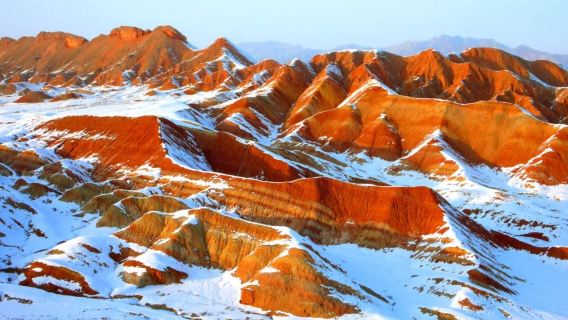
Binggou Danxia Scenic Area is located in the Zhangnan Sunan Yugu Autonomous County. It is a natural scenic spot dominated by the red palace-type Danxia landform. Compared with the Zhangye Danxia landform scenic spot (also known as the colorful Danxia) not far away, Danxia's color is relatively simple and has little change, but the main feature of the scenic spot is that the shape of the Danxia landform is very unique here. The style of the style is very large. Moreover, due to the late development here, there are fewer tourists than the colorful Danxia, and you can have a quiet view.Sunan · 30.5 km from downtown

Bars Snow Mountain
Sunan Bars Snow Mountain Ecological Tourism Attraction is located in Xichahe Village, Dahe Township, Sunan Yugu Autonomous County, Zhangye City, Gansu Province, in the middle of the northern foot of Qilian Mountain. Bars means "tall, majestic, and sacred" in Yugu language. There are six snow-capped mountains distributed from east to west in the Attraction, among which the main peak, Bars Snow Mountain, with an altitude of 5,118 meters, is a sacred mountain in the hearts of the Yugu people. The Attraction is mainly composed of snow-capped mountains, glacial relics, rivers, lakes and alpine grasslands. The ancient ethnic minority Yugu people live at the foot of the mountain. Its scenery maintains the purity of the nearly extinct nature. Because of its unique landform and cultural landscape, rich glacial relics and original natural scenery, it is known as the "Qilian Mountain Secret", "the dazzling pearl of the Silk Road", and "the paradise of outdoor sports". It is a paradise for ice and snow experience and hiking photography enthusiasts, and it is also a good mountain for primary snow mountain climbing training. The Attraction area not only has magnificent glacial geological relics, magnificent and sacred snow-capped mountains, but also has vast grasslands, colorful forests and the blue and transparent Snow Mountain Lake. It has the naturalness, novelty, rarity and beauty of geological relics and ecosystems, presenting the natural beauty of "majestic, strange, beautiful, secluded and vast". Almost all the beautiful scenery of the plateau is gathered here. The Attraction is an eco-tourism Attraction mainly integrating snow mountain viewing, ecological experience, natural education, scientific research and popular science. Its resource endowment and ice and snow landscape value are not inferior to Yulong Snow Mountain in Yunnan and Yading in Daocheng, Sichuan. CCTV's "Home in the Distance" in 2012 and CCTV's "Golden Route" in 2015 conducted special filming and publicity for the Attraction, further improving the popularity of the Bars Snow Mountain Attraction.Sunan · 25.3 km from downtown

Zhangye Alien Valley Scenic Area
The Alien Valley Interstellar Theme Geopark is located in Dahe Township, Baiyin Mongolian Township and Kangle Township Souvenir Kangbaiji Town, Sunan Yugur Autonomous County, Zhangye City, Gansu Province. It is an important part of Zhangye National Geopark. The Souvenir is rich in glaciers, snow-capped mountains, forests, grasslands, Danxia, hills, Gobi, deserts, wetlands and many other landforms. The park includes four Attraction: Mars Valley, Mercury Valley, Jupiter Valley, and the Great Leap Forward in Steel. There are protruding peaks, steep mountains, steep canyons, steep cliffs, jagged rock pillars, and strange rocks. The terrain is magnificent and vast, and the colors are gorgeous and colorful. Many landforms are very rare in the country. They are rare, unique, and unrepeatable high-quality tourism resources. It is a complex tourist Attraction that can bring tourists multiple enjoyments. The Alien Valley Interstellar Theme Geological Park has become a shining pearl on the Silk Road with its unique endowments.Sunan · 30.3 km from downtown

Qilian Mountains
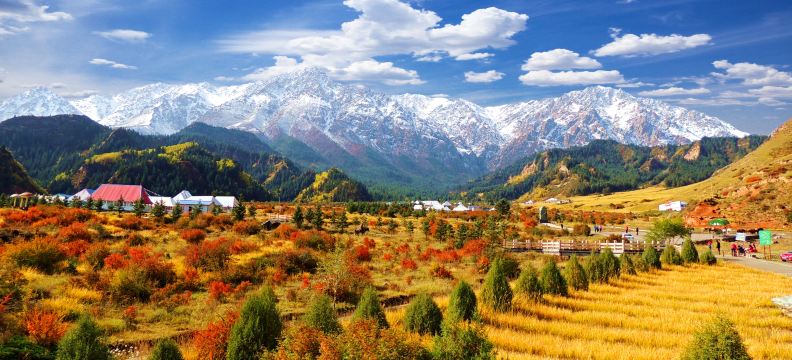
The Qilian Mountains are a massive mountain system stretching for nearly 1,000 km: multiple parallel ridges and valleys alternate, extending from northwest to southeast. Many peaks have an altitude of over 5,000 m, and the main peak,Tuanjie Peak, stands at 5,808 m. The summits are covered in snow year-round, with thousands of glaciers developing there. Ancient texts record that the Xiongnu people called the sky "Qilian," which is how the mountain got the name "Tianshan" (Heavenly Mountain). The Tianshan mentioned in Li Bai's poem, "The bright moon rises above the Tianshan, amidst the vast sea of clouds," refers precisely to this place. Meltwater from ice and snow converges into inland rivers such as theShiyang River, Hei River, and Shule River, nourishing a series of oases in the Gobi Desert to the north, including Wuwei, Zhangye, Jiuquan, and Jiayuguan, which enabled the Silk Road to connect. The southern side of the mountain range blocks moist air currents, nurturing lush pastures in the areas of Menyuan and Qilian County, andQinghai Lakelies quietly in the intermontane basin of this mountain system. Grasslands, coniferous forests, and canyons are distributed across the mountains, which also serve as a habitat for wild animals such as snow leopards and red deer. The area around Zhangye on the northern slope is the ancestral home of the Yugur people, where open foothills, forests, canyons, and snow-capped peaks meet. Taking a self-drive tour along mountain pass roads such asBiandukou, enjoying the alternating scenery of snow-capped mountains and grasslands, and experiencing nomadic culture in the Yugur pastoral areas are the core experiences that have long been popular here. The mountainous area has a high altitude and a large temperature difference between day and night, and the accessible parts of the mountain are scattered across various scenic spots in Gansu and Qinghai provinces.Sunan · >100 km from downtown

Sanshisan Tian Grottoes
Matisi TempleThe Thirty-Three Days Grottoes, with their grand scale and complete collection of statues, attract numerous visitors. The grottoes consist of seven levels with 21 caves, neatly arranged on a cliff over 100 meters high. Each level is connected by tunnels carved inside the rock walls in a zigzag pattern, with winding corridors and stone steps.Sunan · 80 km from downtown

Zhangye UNESCO Global Geopark
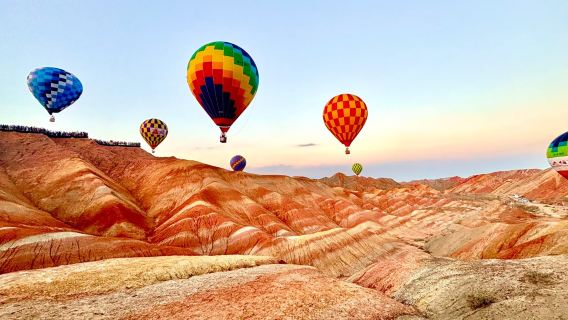
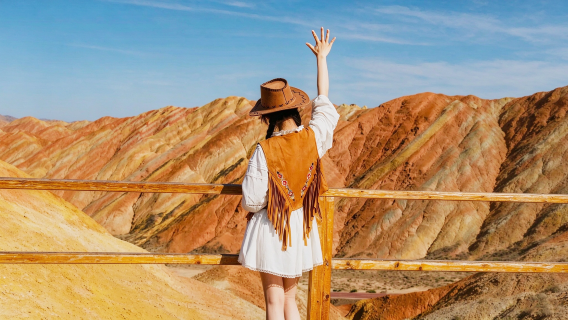
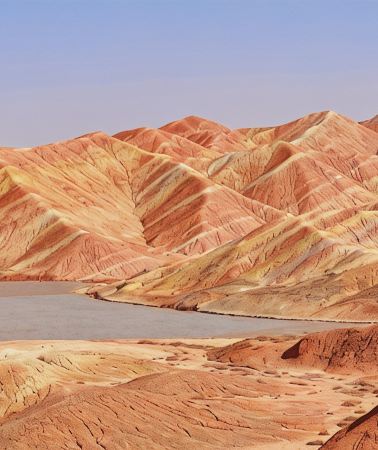
Zhangye Danxia National Geopark is located in Zhangye, Gansu Province, China. It is famous for its unique landforms and rich geological features. The Danxia landforms in the park were formed millions of years ago. They are made of red sandstone and conglomerate after long-term weathering and erosion, presenting a colorful natural landscape. The hills and rock formations here show gorgeous color changes under the sunlight, which is breathtaking. The park is not only an important place for geological research, but also a paradise for photography enthusiasts, attracting many tourists to explore and appreciate. Whether it is the soft light in the early morning or the setting sun in the evening, Zhangye Danxia shows a charming natural charm.Sunan · 42.7 km from downtown

Matisi Grottoes
Matisi Grottoes, located in Sunan County, Zhangye City, Gansu Province, is a Buddhist grotto complex with a long history and rich cultural heritage. The grottoes are built into the mountainside in a terraced layout and are named after the main cave, which resembles a horse's hoof. First established during the Northern Liang period, they have undergone continuous renovation and expansion throughout various dynasties, blending Buddhist artistic styles from the Northern Dynasties, Sui and Tang dynasties, and the Western Xia period. The grottoes preserve exquisite murals and Buddhist sculptures, with themes covering classic Buddhist stories, bodhisattva figures, and historical figures, showcasing the superb carving and painting skills of ancient artisans. The entire grotto complex cleverly utilizes the mountain terrain, creating a unique layout that combines architecture with the natural landscape, reflecting both the solemnity of religious belief and aesthetic appeal. Matisi Grottoes are not only an important relic of Buddhist art but also provide valuable data for the study of ancient religion, architecture, and social history in Northwest China.Sunan · 80 km from downtown

Thousand Buddha Grottoes
The Horse-Tied Temple is located in the Sunan Yugur Autonomous County of Gansu Province (the Yugur people are a minority ethnic group unique to Zhangye, Gansu Province); 65 kilometers north of the urban area of Zhangye City, it is a tourist area integrating grotto art, Qilian Mountain scenery and Yugur customs. The grottoes consist of seven parts: Shengguo Temple, Puguang Temple, Thousand Buddha Caves, Jinta Temple, Upper, Middle and Lower Guanyin Caves, with a total of more than 70 caves and niches, which were first built in the Northern Liang Dynasty. The Horse-Tied Temple is named after the legendary celestial horse that left a horseshoe print when drinking water here. The legendary horseshoe prints are now preserved in the Horse-Tied Hall of Puguang Temple and have become the treasure of the temple.Sunan · 79.6 km from downtown

Kangle Grassland
Kangle Grassland is located in Zhangye City, Gansu Province, with an average altitude of approx. 3,000 m and a total area of 2.68 million mu. It is known as the "Grassland in the Sky" and is a natural pasture with beautiful scenery. It is renowned for its diverse landforms, combining glaciers and snow-capped mountains, primeval forests, alpine meadows, deep canyons, and Danxia landforms, which is rare among grassland scenic areas in China. From the observation deck, you can take in the boundless meadows, grazing cattle and sheep, and towering snow-capped mountains. The area is rich in ethnic customs. Visitors can taste authentic butter tea and hand-grabbed mutton, and admire colorful ethnic costumes. Summer and fall are the best times to visit. In midsummer, the average temperature is only around 20°C, making it a great summer retreat; in the fall, the meadows turn golden and the forests are painted in vibrant colors, offering a magnificent autumn landscape that allows you to relax your body and mind amidst the snow-capped mountains and grassland.Sunan · 29.5 km from downtown
Experiences you can't miss in Sunan
Featured Day tours in Sunan
View all Day tours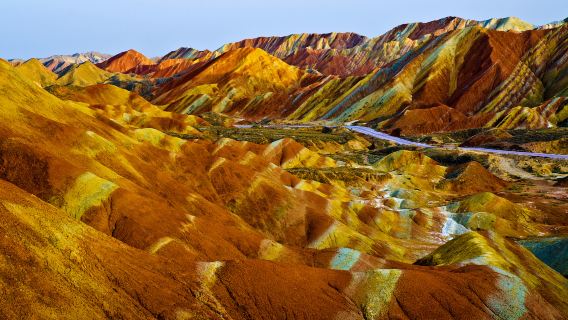
4.7/5
· 9 reviews· 78 bookedFree cancellation
Instant confirmation
Book now for tomorrow
From€63.44
Free cancellation
Instant confirmation
Book now for tomorrow
From€37.73

Free cancellation
Instant confirmation
From€19.95
From€22.63

Free cancellation
Instant confirmation
Book now for tomorrow
From€74.54

Free cancellation
Instant confirmation
Book now for tomorrow
From€69.98
Free cancellation
Instant confirmation
From€32.00

Instant confirmation
Book now for tomorrow
From€95.84
Featured Outdoor experiences in Sunan
View all Outdoor experiences
Instant confirmation
Book now for tomorrow
From€96.68

From€253.73
Free cancellation
Instant confirmation
Book now for tomorrow
From€76.06
Free cancellation
Instant confirmation
Book now for tomorrow
From€69.98
More things to do
Private Tours in Sunan
View More Private Tours in Sunan

Free things to do in Sunan
What travelers say about Sunan

唐风一宋雨October 20, 2026
4.0
Mati Temple, located at the northern foot of the Qilian Mountains in Sunan Yugur Autonomous County, is a national key cultural relics protection unit. It is a group of grottoes integrating Han and Tibetan Buddhism with Yugur and Tibetan folk customs, initially carved during the Northern Liang Dynasty and flourishing during the Sui and Tang Dynasties.
It's only an hour's drive from Zhangye city, and the road is relatively easy to drive. Unfortunately, apart from the Jinta Temple, which is mostly closed to the public, the grottoes and niches in the Thirty-Three Heavens North Temple Grottoes and Thousand Buddha Caves are mostly empty. Most of the Buddha statues and murals are gone. Besides multiple layers of historical damage, the main destruction occurred during the Cultural Revolution, when the vast majority of ancient Buddha statues were smashed and murals were removed. Jinta Temple, due to its remote location and sparse population, miraculously preserved its Northern Dynasties painted apsara sculptures, becoming a treasure of the Mati Temple grottoes.
Most of the Buddha statues seen now are reconstructions from the 1980s and 1990s. Many niches have not yet been re-sculpted, so they appear empty. It is not recommended to visit if you only want to see Buddha statues and murals.
Mati Grottoes Tourism Area

118***98October 15, 2026
5.0
A very satisfying trip! The half-day tour of Binggou Danxia was just over 40 yuan per person for transportation, including door-to-door pick-up and drop-off – excellent value for money. Especially our driver, Mr. Zhao, was incredibly warm, attentive, and considerate – very professional, punctual, and responsible. Highly recommended!
Binggou Danxia

来和我一起旅行October 6, 2025
5.0
On the third day of the National Day trip, the journey from Zhangye to Jiuquan was long, so we arranged to go to the snow mountain first. It is indeed not famous, but the scenery is nice, and you may see marmots, but we didn’t see any. It was cold and windy, so you needed to wear a thin down jacket and gloves. There were plank roads all the way, but the altitude was 3900-4000m. This was the day with the fewest steps on the trip. We walked more than 8,000 meters and had not yet reached the end. I flew a drone, and it may not have been halfway, but I still felt very tired. It took 2 hours, plus the round trip bus ride was about 3 hours. There were not many people in the scenic area, so there was no need to queue.
Bars Snow Mountain

130***58August 25, 2026
5.0
What's confusing about this scenic area is that the navigation leads to the visitor center on the map, but after asking a staff member, I learned that I had to go up to the second floor to exchange for tickets, get a navigation address and a pass, and then drive more than ten kilometers to actually reach the scenic area. Make sure you don't lose your pass; you'll need to check it before entering. Also, it might be inconvenient if you're not driving. During the summer, which is probably peak season, I didn't see any buses for individual tourists; it was all private cars. The scenery inside the scenic area is definitely worth seeing, and the fact that drones can fly is a great feature 👍
Zhangye Alien Valley Scenic Area

背包客小马February 26, 2025
5.0
Qilian Mountains in Gansu attracts tourists with its magnificent natural scenery and rich cultural heritage. Qilian Mountain Ski Resort has become a popular attraction where tourists can experience skiing, snowmobiling and other activities. In addition, a herd of white-lipped deer, a national first-class protected animal, was discovered in the Qilian Mountains Nature Reserve, and the ecological protection results were remarkable.
It is worth a visit. The Qilian Mountain Grassland is known as one of the six most beautiful grasslands in China 🤟
Qilian Mountains
134***96September 26, 2026
5.0
As the essence of Mati Temple, almost all the Buddha statues in the grottoes are modern replicas, but the seven-story, twenty-one grottoes embedded in the steep red sandstone wall are a wonder!
Sanshisan Tian Grottoes
M29***28July 19, 2026
4.0
It's truly beautiful and perfect for taking photos!
However, because the entire scenic area consists of several viewing platforms, and the only way to get between them is by sightseeing bus, tourists tend to congregate at these platforms, making it extremely crowded. This is especially true during the most beautiful sunset hours, when the area is packed with people, making even taking a photo a luxury.
Zhangye UNESCO Global Geopark

150***89August 28, 2024
5.0
The last part of the journey up to the Medicine Master Hall is very interesting. It is basically vertical. You need to use your hands and feet to go up. Go back the same way. The room can accommodate about ten people. You have to be patient when going up and down. Wait until everyone comes down before going up again.
Thousand Buddha Grottoes

234***58October 4, 2026
1.0
This so-called tourist attraction is a complete rip-off. As tourists from Chengdu, having hiked over various free mountains like Zheduo Mountain and Jiajin Mountain, and seen countless free grasslands like Hongyuan and Ruoergai, why would anyone pay 90 yuan per person to come here? I wouldn't have come at all if it weren't for bringing my dog. Turns out the entire grassland is fenced off and completely off-limits. Avoid this place!
Kangle Grassland


