Things to do in Ejin Banner
Explore top experiences
Top 10 attractions in Ejin Banner


Ejina Populus Euphratica Tourist Area
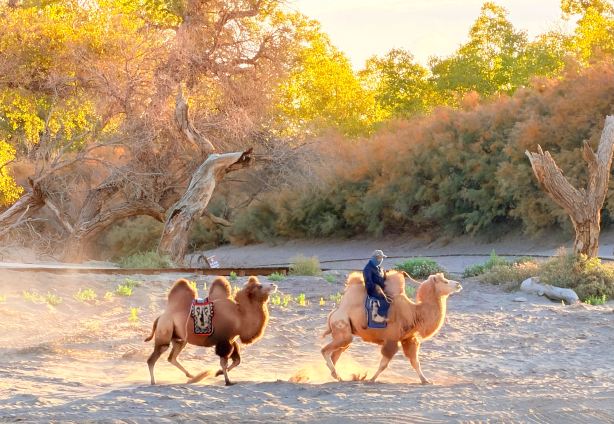
Known for the movie "Hero," Ejina Populus Euphratica Forest Tourist Area boasts unique scenery in the autumn and people come from other regions across China to enjoy its autumn splendor. Those who visit Ejina appreciate the desert's scenery. A desert poplar festival is held here around the National Day holidays, during which hundreds of thousands of tourists come to admire the dazzling golden desert poplar forest and the vast desert itself.Ejin Banner · 10.3 km from downtown

Hei Cheng-Ruoshui River Populus Euphratica Scenic Spot
Hei Cheng-Ruoshui River Populus Euphratica Scenic Spot, one of Ejin Banner's two major populus scenic areas, is located 18 km southwest of Dalaihubu Town in Ejin Banner, Alxa, Inner Mongolia (at the 98 km mark of Jiu-Hang Road), covering 35 square kilometers. Centered around the concept of "one ticket for four signature views of Ejin," it offers a full-day aesthetic feast from sunrise to sunset. The attraction brilliantly combines "one city, one river, and two populus forests" – featuring Hei Cheng Experience Park, Ruoshui River, Ruoshui Populus, and the Light-Shadow Populus·Peculiar Tree Forest – blending magnificent natural wonders with profound cultural heritage to showcase its unique charm. The Ruoshui Poplar Scenic Area (Most Charming Poplar Forest): Over 20,000 acres of pristine desert poplars stretch along the upper reaches of the Ruoshui River, forming four distinct forest zones—the Oil Painting Forest, Rainbow Forest, Phoenix Forest (desert poplars), and Sky Mirror Forest. Here, the desert, sacred waters, and wild poplars blend naturally, embodying both the timeless sentiment of "Though there are thousands of rivers, I take only one sip" and the infinite grace of "The poplar's myriad charms are lost in the Ruoshui's embrace." Light and Shadow Populus Euphratica·Strange Forest (Photographer's Paradise) View Area: This place carries the poignant legend of General Hei and his soldiers who turned into trees after dying in battle to guard their homeland. The vast expanse of withered Populus euphratica trees with bizarre shapes, sculpted by the magic of light and shadow, has become a sacred destination that photographers yearn to visit for creative inspiration. Heicheng Experience Park·Millennium Time-Travel View Area: Reviving the ancient city's splendor along the historical thread of "built by water and thriving with water." The northwestern city wall half-buried in yellow sand whispers tales of the vast desert, while the shimmering waves of Baota Lake and bustling market streets within the city walls seem to open a portal to the Western Xia era, recreating the Silk Road prosperity witnessed by Marco Polo himself. Ruoshui River·Shuangjin Holy Land Scenic Area: This poplar forest attraction along the main channel of Ruoshui River spans an average width of over 600 meters. It serves as both a tranquil spot to admire the sunrise over Ruoshui and a magnificent stage showcasing the poetic grandeur of "the setting sun over the endless river." Within a single day, visitors can experience the breathtaking spectacle of "witnessing the glorious sunrise at dawn and admiring the sunset over the vast river at dusk." Detailed guide to the four stunning views Ejina Populus Euphratica Crown - Ruoshui Populus Euphratica Scenic Area Exquisite view 1: Ruoshui Poplar Forest The Populus Euphratica trees and the Ruoshui River stand side by side, painting a magnificent desert landscape together. The resilience of the Populus Euphratica and the gentleness of the Ruoshui weave together breathtaking scenes that speak of nature's wonder and grandeur. Across this vast desert, they compose a hymn to life, leaving every visitor in awe of nature's power and majesty. Ruo Shui Poplar Forest · Oil Painting Scenery Like an artist using heaven and earth as a canvas, splashing golden oil paint to outline a natural oil painting of autumn poplars—this is truly the gem among poplar landscapes. The thousand-year-old "Mother of Poplars" takes deep root in fertile soil, growing alongside tens of thousands of young poplars around forty years old, together weaving this intoxicating oil-painting forest. Stepping into the grove feels like wandering into a gilded dream, where every frame before your eyes is a vivid and dynamic "oil painting," quietly flowing with the vibrant colors and vitality the poplars have accumulated over time. Ruo Shui Populus Euphratica Forest · Colorful Forest By the Ruoshui River, thousand-year-old Populus Euphratica trees thrive alongside tamarisk and achnatherum, weaving a vibrant natural tapestry across the Gobi Desert. The purple-red tamarisk burns like sunset clouds, the golden Populus Euphratica spreads like brocade, and the silvery achnatherum sparkles like stars—these three hues intertwine to create a strikingly layered, multicolored three-dimensional landscape. As seasons change, the colors subtly shift with time, constantly renewing the view. This place draws its soul from the millennia-old Populus Euphratica weathered by time, while 300- to 400-year-old mature trees form its backbone, powerfully showcasing life's resilience and vitality through the ages. Ruoshui Populus Euphratica · Phoenix Forest (Desert Populus Euphratica) Here, the desert and poplar trees create a breathtaking encounter—in the Phoenix Forest, the cycle of life and death of the poplars intertwines with the vast expanse of the desert, resembling a phoenix rising from the flames, narrating a legendary rebirth amidst the sea of sand. The forest holds dual surprises of nature and culture: Sun-Moon Lake mirrors the sky's radiance and drifting clouds, while the Desert Sky Ladder reaches toward the heavens—both serving as perfect vantage points to capture the grandeur of sunrise and the splendor of sunset. The stargazing campsite lets you dream beneath the Milky Way, and sunset coffee sessions invite leisurely sips amid twilight hues, creating an understated luxury experience no traveler should miss. Every moment spent here is infused with the romance and wilderness charm of desert poplars. Ruo Shui Populus Euphratica · Tianjing Forest The tranquil blue water lies as still as a maiden, spreading like a mirror across the landscape, capturing the golden hues of the poplar trees along the shore and the crystal clarity of the sky above. The interplay of light and shadow creates a naturally formed "mirror of the sky." Scenic spots like the "Love Island" by the lakeside echo the ancient legend of "Though there are thousands of rivers, I only take a sip from one," infusing every ray of light with tenderness and every gaze with a heartbeat. No visit to Ejina is complete without seeing the Populus euphratica forest! Exquisite View ②: Populus Euphratica in Light and Shadow - The Strange Forest (Photography Paradise)/Populus Euphratica in Light and Shadow - The Strange Forest (Photography Paradise)/The Strange Forest (Populus Euphratica in Light and Shadow - Photography Paradise) The millennium-old Dead Forest is a stunning interpretation of the essence of life, showcasing the primitive power of nature's tenacious survival. This was once a lush sea of populus euphratica forests. After enduring years of erosion and water depletion, vast stretches of these trees now stand withered yet unyielding, fallen yet enduring, carving into the desert a miraculous testament to life that "stands unbroken for a thousand years after death, and remains uncorrupted for a thousand years after falling." This desolate forest is steeped in a tragic legend: In ancient times, General Hei of Heicheng led his troops to break through enemy lines and retreated to this once densely shaded woodland. However, the raging Ruo River blocked their escape, forcing the general and his soldiers into a desperate last stand. When the smoke of battle cleared, the ancient battlefield faded into history, leaving this bleak forest as the eternal resting place for the undying spirits of General Hei and his valiant warriors. With the improving ecosystem, some withered poplars have quietly revived, creating a natural wonder where life and death intertwine. Water is the source of life—without it, all things wither—a simple truth that stands out vividly here. That's precisely why we must start with ourselves, cherish every drop of water, and protect our shared home on Earth, ensuring the tree of life remains evergreen and such solemn scenes never repeat. The twisted branches of dead poplar trees create extraordinary shapes, and with minimal light pollution in this remote desert area, it's an ideal spot for photographing sunrises, sunsets, and brilliant starry skies. As light and shadows shift, the legendary thousand-year-old poplars meet the camera lens, truly earning this place its reputation as "Poplar in Light & Shadow: A Photographer's Paradise." From the Western Xia to Mongolia, crossing the threshold of time and space Exquisite view 3: Heicheng Experience Park Heicheng Experience Park: A Journey Through a Millennium, Where One Step Takes You Back in Time. This culturally immersive park, reconstructed along the historical context of "built by water and thriving because of water," restores the ancient city's original charm. With meticulous craftsmanship to "repair the old as old," it blends historical grandeur with modern convenience, vividly reviving the prosperity of bygone eras. The majestic city walls stretch 421 meters east to west and 374 meters north to south, with 10-meter-high ramparts lined by orderly battlements and nineteen horse-face bastions, forming an impregnable defense. The inner Xixia city is perfectly square and orderly, where every brick and tile holds echoes of bygone eras. Entering through the west gate, the main street recreates the bustling scene of endless caravans and lively markets. Turning right, visitors can see the ruins of the Yuan Dynasty's Jinai Road Post Station (now the visitor center), while turning left leads to the reconstructed Six Offices of the Governor's Mansion, where one can almost glimpse the busy officials of the past. In the northwest corner, the stupa-style Buddhist pagoda stands in silent dialogue with the mosque outside the city, quietly bearing witness to the Yuan Dynasty's religious tolerance. The northwest city wall is swept by swirling yellow sands, while outside the walls, the sunset casts golden fragments on Pagoda Lake—both scenes worthy of a painting. After six years of meticulous crafting and an investment of 295 million yuan, this ancient city invites you to stroll through historic streets savoring Northwest flavors, stay overnight in traditional inns steeped in millennium-old charm, and witness live performances recreating the splendor described by Marco Polo. Climb the city walls for panoramic desert views—every step here immerses you in a timeless dialogue with history. Sunrise and Sunset: Desert Poetry Exquisite view: Ruoshui River The poplar forest attraction, where the main channel of the Ruoshui River flows through, has an average river width of over 600 meters. This is not only a place to quietly admire the sunrise over the Ruoshui River, but also a site that vividly portrays the majestic scene of "the setting sun over the long river." Within a single day, visitors can experience the magnificent views of "watching the stunning sunrise at dawn and admiring the sunset over the long river at dusk." Here, the moonlight of the Tang Dynasty merges with the golden glow of modern-day poplar trees, blending natural wonders with human sentiment into a timeless spiritual symbol. As the sunset's afterglow bathes the ancient city and the vast poplar forest once more, what unfolds before your eyes is not just a breathtaking landscape, but also a condensed history of northwestern civilization—preserved by the Ruo River's waters and sealed by the desert sands.Ejin Banner · 16.3 km from downtown

Dongfeng Aerospace City
The Jiuquan Satellite Launch Center, also known as Dongfeng Aerospace City, is China's comprehensive test launch site and manned space launch base. It was from here that China's first astronaut Yang Liwei embarked on his historic spaceflight, fulfilling the Chinese nation's millennia-old dream of space exploration. In Dongfeng Aerospace City, visit the Wentian Pavilion to learn about astronauts' work, living, and training facilities before their missions; step into the history exhibition hall to explore China's aerospace development; and witness the manned spacecraft launch site up close to experience the nation's monumental achievements and the progress of China's aerospace technology. Explore the Dongfanghong Satellite Launch Site, where military personnel and scientists worked tirelessly with dedication, scientific rigor, and pioneering spirit to achieve ten landmark firsts in China's aerospace history during the great practice of fostering and passing down the "Two Bombs, One Satellite" spirit. At the Dongfeng Revolutionary Martyrs' Cemetery, pay tribute to the heroes who made outstanding contributions to China's aerospace industry and revisit their remarkable stories. 1. The on-site tour service management fee covers the following routes: Manned Space Launch Site (designated peripheral viewing points), History Exhibition Hall (closed on Mondays), Wentian Pavilion (closed during launches and other special circumstances), Feitian Park, and Dongfeng Auditorium (exterior view). Due to the military sensitivity of Dongfeng Aerospace City, visitors will tour 3 sites based on the actual conditions of the base. 2. The off-site tour service management fee route includes: Dongfeng Revolutionary Martyrs Cemetery and Dongfanghong Satellite Launch Site.Ejin Banner · >100 km from downtown

Juyan Lake
Juyan Lake is a lake located in the north of Ejin Banner, Alxa League. The Ejina River flows into the lake and is the main water supply source for Juyan Lake. Juyan is a Xiongnu language. Historically, it was also called Juyan Lake, West Sea, etc. It has been called Juyan Lake since the Tang Dynasty. Juyan Lake was very large in history and is one of the largest lakes in northwest my country. It consists of the current East Juyan Lake (also known as Subonoer) and West Juyan Lake (also known as Gashunoer) as well as other lakes. The Juyan Lake that tourists visit today refers to the East Juyan Lake (Subonoer). Other lakes have dried up (the West Juyan Lake has begun to recover its water surface through continuous water replenishment in recent years).Ejin Banner · 39.6 km from downtown

Heishui City Ruins
Located southeast of Dalaihub Town, the Heishui City Ruins are the largest and most complete surviving ancient city site on the "Grassland Silk Road." Built during the Western Xia Dynasty, Heishui City served as a vital route and transportation hub from the Hexi Corridor to the northern desert. It holds a unique historical significance, having been designated a key cultural relic protection site and incorporated into the Juyan Ruins Conservation Area.Ejin Banner · 22.4 km from downtown

Ceke Port International Cultural Tourism Area
Ceke, derived from the Mongolian word meaning "river bend," is home to the Ceke Port International Cultural Tourism Area. Located along the China-Mongolia border, this vital land port serves as a key trade corridor and energy cooperation hub between the two nations. Directly opposite Mongolia's Shivee Khuren Port in South Gobi Province, it connects with five resource-rich Mongolian regions—South Gobi, Bayankhongor, Gobi-Altai, Övörkhangai, and Khovd—known for their abundant livestock and mineral resources. As China's Belt and Road Initiative advances and the China-Mongolia-Russia Economic Corridor accelerates, Ceke Port has emerged as a critical gateway for northern expansion. Over its 33 years of operation, the port has facilitated 4.51 million border crossings, processed 3.54 million vehicle transits, and handled cumulative imports and exports totaling 155 million metric tons, with trade volume reaching ¥59 billion. Customs duties and value-added taxes collected amount to ¥6.1 billion, while tax authorities have contributed ¥2.3 billion in revenue. Today, Ceke ranks as China's fourth-largest and Inner Mongolia's third-largest land port. Joint Inspection Building Standing at the very heart of Ceke Port International Cultural Tourism Area, this iconic landmark serves as both a central architectural masterpiece and a symbolic representation. The structure's design embodies a Torgut Mongolian maiden offering a ceremonial hada scarf to welcome distant guests, while also resembling a traditional Torgut Mongolian hat. Simultaneously, it takes the form of the letters "A" and "M" (the initials of Alxa League) and evokes the image of a rising rocket, symbolizing the dynamic growth and prosperity of Ceke Port International Cultural Tourism Area. National Gate The current third-generation national gate at Ceke Port International Cultural Tourism Area was constructed and put into use in 2007, covering a total area of 338.66 square meters. Its exterior features a simple yet elegant design with staggered elements. The gate adopts an open-concept design composed of seven rectangular stone pillars of varying heights – a modern interpretation of the ancient ceremonial jade artifact "cong," symbolizing national dignity. The pillars are arranged in an east-three-west-four pattern, with the western side forming an inverted "7" shape. The number 7 represents perfection and auspiciousness in Chinese culture, while its homophone "qi" (meaning "rise") signifies the port's soaring development and prosperity. Boundary Monument Square Boundary Monument: This is a politically significant boundary monument square. The boundary monument serves as one of the demarcation markers between nations, symbolizing territorial sovereignty. It bears witness to historical changes, encapsulates national pride and challenges, and stands as a sacred emblem. Mongolia shares a 4,710 km land border with China, with Ejin Banner bordering Mongolia along a 507.12 km frontier. The Sino-Mongolian boundary monuments follow the border line, starting from the No. 1 monument in Xinjiang's Hemu County in the west and extending eastward to the No. 572 monument at Ceke Port. From the monument, you can gaze upon the vast landscapes of Mongolia's South Gobi Province. This border clearly delineates two nations while also connecting their people through friendship and economic ties. The Ceke Port International Cultural Tourism Area leverages this unique geographical position to function as a bridge linking domestic and international exchanges. Ceke Port International Cultural Tourism Area Monument: Built in September 2014, this 19.92-meter-tall monument commemorates the 1992 border opening when China and Mongolia exchanged symbolic gate keys per bilateral agreement, marking the official launch of cross-border trade. The bronze rings on the monument represent traditional Chinese door knockers, while its sword-like design stands guard at the national border as a sovereign deterrent. The carvings on both sides of the monument depict aerospace culture and the Torghut culture (the stories of aerospace development and the eastward return can be appropriately elaborated). In simple terms, they illustrate how the people of Ejina resolutely left their lush green homeland, relocated multiple times for the aerospace cause, made sacrifices, and supported national construction. Their selfless dedication contributed to the flourishing development of China's aerospace industry. "Two Bombs, One Satellite" achieved glory, and the realization of aerospace dreams sings praises to prosperity. The historical tales of "Heroic Eastward Return" and "Three Relocations of the Banner Government" vividly embody the Torghut people's patriotic spirit and selfless devotion to their homeland. Opposite the monument stands the Tulagha sculpture: meaning "fire support," this 309 cm tall installation rests on a three-tiered 30 cm stone base, reaching a total height of 399 cm. The numbers 3 and 9 hold auspicious significance in Mongolian culture, symbolizing harmony and longevity between heaven, earth, and humanity. The sculpture embodies Mongolian cultural identity through rich symbolic elements: a prairie bonfire, flowing ceremonial scarves (khadag), dancing flames, praying Buddha hands, and wrestling figures in motion—each evoking profound cultural imagery. Its central form resembles a traditional butter lamp (zula), representing eternal spiritual light that blesses the flourishing development of Ceke Port International Cultural Tourism Area and foreshadows a brighter future for Sino-Mongolian border relations. The flame-like structure also symbolizes prosperity for the port community, while its upper section mirrors praying hands wishing health and safety upon local residents. Three gracefully extended supports resemble welcoming khadags, greeting visitors from both nations and all directions. The Cross-Border Trade Zone: Located west of the regulatory area, the cross-border trade market was completed and put into operation in September 2014. After renovation in 2023, it passed inspection by the Autonomous Region's Department of Commerce in 2024 and was approved for customs closure operation. Covering 27,990 square meters, it features two exhibition halls (A and B) designed as interconnected Mongolian yurts with Yuan Dynasty characteristics, harmonizing with the surrounding architecture and environment of the tourism area. Now serving as a major showcase for Sino-Mongolian goods and a platform for bilateral economic cooperation, visitors can confidently shop here as most products are either duty-free or enjoy preferential policies, offering relatively affordable prices.Ejin Banner · 71.1 km from downtown

Strange Forest
Inner Mongolia'sGuaishulinLocated about 20 km southwest of Dalaihubu Town in Ejin Banner, Alxa League, this unique natural view was formed by dead populus euphratica forests caused by river diversion. Covering approximately 2000 acres, the withered trees stand in various postures across the desert, creating a magnificent spectacle that embodies the saying: "Alive without dying for a thousand years, dead without falling for a thousand years, fallen without rotting for a thousand years." The poplar trees in Guaishulin take on various forms—some resemble leaping dragons, others look like knights struck by arrows, creating a desolate yet mystical beauty. At sunset, the silhouettes of these withered trees contrast strikingly against the orange sky, forming a poignant and magnificent scene. Poplars are among the world's oldest tree species, often called "living fossils of the plant world." Guaishulin was formed primarily due to human activities that caused the Ejina River to dry up, leading to the poplars' demise from lack of water. Their rot-resistant nature allows them to stand tall even after death, becoming a unique spectacle in the desert. Guaishulin is a paradise for photography enthusiasts, with the trees' bizarre shapes and sunset silhouettes offering endless creative inspiration. Visitors can witness the poplars' legendary resilience—"standing for a thousand years without dying, falling for a thousand years without rotting, and remaining for a thousand years without decaying"—while experiencing the desert's stark grandeur.Ejin Banner · 17.6 km from downtown

Jinsha Bay, Ruoshui River
The Heicheng-Ruoshui Populus Euphratica Scenic Area is formed by merging two attractions: Ruoshui Jinsha Bay and Heicheng-Mysterious Forest. It consists of the Ruoshui Populus Euphratica sightseeing zone, Mysterious Forest sightseeing zone, Heishui Ancient City sightseeing zone, and the Ruoshui River landscape belt. Ruoshui Jinsha Bay is one of the key attractions within the Heicheng-Ruoshui Populus Euphratica Scenic Area. The main channel of the Ruoshui River boasts a natural advantage with its 10-kilometer-long, 800-meter-wide banks, giving rise to a stunning landscape featuring four lakes, two islands, and six layers of forests. This breathtaking scenery seamlessly blends the desert, sacred waters, and wild poplar trees into picturesque views. The enchanting dawn and dusk skies paint the horizon in crimson hues, creating a truly mesmerizing experience. The river is not only associated with the romantic theme of "Out of the vast Ruoshui, I only take one sip," but also celebrated in the timeless verse "The charm of poplar trees pales in comparison to the allure of Ruoshui's embrace."Ejin Banner · 15.5 km from downtown

The Desert Populus Scenic Spot
The Desert Populus Scenic Spot centers around poplar tree science education, allowing visitors to experience the legendary life cycle of these trees that "live for a thousand years without dying, stand for a thousand years after death, and remain preserved for another thousand years after falling." Having endured 65 million years of geological changes across its 15-square-km expanse, the vibrant landscape showcases nature's indomitable spirit. Vast desert fields bloom with flowers, recreating the prosperity of ancient frontier farming settlements. Along the 2.4-km misty waterscape, poplars create scenery rivaling celestial realms. The 9.8-km Ruoshui River shimmers like a golden dragon, its morning and evening reflections resembling heavenly ribbons. Winding desert outposts echo with camel bells beneath solitary smoke plumes and setting suns. The 3,000-unit Tamarisk Bay transforms three times yearly, bursting with floral displays of life. Lush poplar groves dotted with rare grasses provide grazing grounds for livestock. The 5,027-square-meter visitor service center integrates intelligence and multifunctionality, featuring a spacious circular parking lot. The vibrant sports-style self-driving campsite welcomes guests with its pristine white Mongolian yurts, quaint wooden villas, exquisite shell houses, orderly RV campsites, and the romantic Orion tents that offer both grandeur and comfort.Ejin Banner · 4.2 km from downtown

Ancient Juyan Lake
古居延泽景区 was developed in 2017, and it has continuously enriched its tourism offerings. It focuses on natural scenery and desert adventure experiences, making it a scenic area in Ejin Banner that is fully accessible by self-drive, integrating sightseeing and adventure. It is the birthplace of Juyan culture, home to the "Juyan Han Slips," which are hailed as one of China's four major cultural heritages. The name "Juyan" was first established during the reign of Emperor Wu of Han. The term "Juyan" is from the Xiongnu language, and the Commentary on the Water Classic interprets it as "Ruoshui" (Weak Water) and "Liusha" (Quicksand). The current water area is approx. over 60 sq km. It consists of six major attractions: Juyan Sunrise Viewing Platform, Juyan Saxaul Beacon Tower, Juyan Ferry, Juyan Thousand Island Lake, Juyan Yardang, and Juyan Sky Eye.Ejin Banner · 41.9 km from downtown
Experiences you can't miss in Ejin Banner
Featured SIM card in Ejin Banner
View all SIM card
4.6/5
· 70.7k reviews· 2.1mil bookedFree cancellation
Book now for today
Fast-selling Wi-Fi & SIM cards
50% off
Limited-time sale
FromKRW 116KRW 232

4.6/5
· 23.8k reviews· 666.2k bookedFree cancellation
Book now for today
91.2% of travelers recommend
50% off
Limited-time sale
FromKRW 116KRW 232

4.5/5
· 6.7k reviews· 197k bookedFree cancellation
Book now for today
10.701k bookings in 7 days
50% off
Limited-time sale
FromKRW 105KRW 210

4.5/5
· 10k reviews· 245.5k bookedFree cancellation
Book now for today
Selling fast
50% off
Limited-time sale
FromKRW 108KRW 216

4.7/5
· 5.5k reviews· 140.7k bookedFree cancellation
Book now for today
92.5% of travelers recommend
50% off
Limited-time sale
FromKRW 105KRW 210

4.6/5
· 9.2k reviews· 243.7k bookedFree cancellation
Book now for today
23 consecutive positive reviews
50% off
Limited-time sale
FromKRW 105KRW 210

4.6/5
· 32.2k reviews· 954.1k bookedFree cancellation
Book now for today
Fast-selling Wi-Fi & SIM cards
50% off
Limited-time sale
FromKRW 116KRW 232

Mainland China 5G eSIM | Dual Net | Daily/Total Data Package | 1–30 Days | 24-Hour Billing | QR Code
4.6/5
· 6.6k reviews· 106.9k bookedFree cancellation
Book now for today
1.334k bookings in 7 days
50% off
Limited-time sale
FromKRW 114KRW 229
Free things to do in Ejin Banner


What travelers say about Ejin Banner

Anonymous userOctober 21, 2026
5.0
We arrived two or three days late, and the strong winds had blown away more than half of the golden leaves, but it was still very beautiful and worth seeing. This is the most beautiful autumn scenery in China; it was definitely worth the trip!
Ejina Populus Euphratica Tourist Area
Anonymous userOctober 20, 2026
4.0
The three attractions are located together. Starting from Heishui New City, the attractions are the Weak Water Poplar Forest and the Strange Tree Forest. The most unique attraction is the Strange Tree Forest, where trees have stood for thousands of years without decaying. The wind and sand were too strong and it was too cold, otherwise I would have stayed until sunset before heading back. The open-air train was very cold to sit on. The restrooms were extremely basic and dirty; I thought I had entered a dry toilet. There was basically no service.
Hei Cheng-Ruoshui River Populus Euphratica Scenic Spot

老琥游October 11, 2026
5.0
As a national treasure and a place for patriotic education, I think it's well worth the visit. The entire process is led and explained by a guide. It includes a distant view of the launch tower, a visit to the Wentian Pavilion (the site of the press conference), and the aerospace exhibition hall. The whole process takes about three hours.
Dongfeng Aerospace City

维滕贝格左思October 15, 2026
5.0
I got up at 5 a.m. and set off. It was still very cold, and my hands and feet were stiff. There were already a lot of people. After waiting for about an hour, the ☀ (lake) rose up. It was very beautiful, and there were many seagulls flying over the lake. It's a place that is definitely worth visiting.
Juyan Lake

旅游达人F4October 3, 2026
5.0
Heishui City, the ruins of the Black City from the Western Xia Dynasty, is located in the desert of Ejin Banner, Alxa League, Inner Mongolia. It is one of the best-preserved ancient cities along the ancient Silk Road and is now a national key cultural relics protection unit.
🏰 Where is it and what does it look like?
Heishui City, known as "Khara-Khoto" in Mongolian, meaning "Black City," is located in the desert on the north bank of the lower reaches of the Ejin River, about 25 kilometers southeast of Dalaihob Town, Ejin Banner. The existing ruins are from the Yuan Dynasty expansion. The city is rectangular, approximately 470 meters long from east to west and 384 meters wide from north to south, covering an area of over 180,000 square meters. The remaining city walls are nearly 10 meters high, and a distinctive stupa stands in the northwest corner.
📜 How did it come to be?
This city was first built during the Western Xia Dynasty, serving as the seat of the "Heishan Weifu Military Command," an important border fortress and agricultural and pastoral base. During the Yuan Dynasty, Kublai Khan established the "Yijinai Road General Administration" here, expanding it into a transportation hub connecting the Hexi Corridor to the Mongolian Plateau. The prosperous scene mentioned in Marco Polo's Travels includes this place. After General Feng Sheng's western expedition in the early Ming Dynasty, the city was gradually abandoned and later buried by sand, only to be rediscovered in the early 20th century.
🔍 Why is it so famous? What truly astonished the world about Khara-Khoto was the large number of artifacts and documents unearthed there. In the early 20th century, Russian explorer Kozlov and others excavated more than 8,000 documents in Tangut, Chinese, and Tibetan languages, including the bilingual dictionary *Fan-Han He Shi Zhang Zhong Zhu*, hailed as the "key to unlocking the door to Tangut studies," as well as precious artifacts such as painted double-headed Buddhas and Yuan Dynasty paper money. Unfortunately, many of these artifacts were transported to Russia and are now housed in the Winter Palace and other museums. However, the Khara-Khoto ruins themselves still retain city walls, stupas, and mosque remains, showcasing the coexistence of diverse cultures in those days.
Heishui City Ruins
Anonymous userFebruary 20, 2026
5.0
Walking around the border area with Mongolia is quite nice. Although the area isn't very large and the small commodities there don't seem very appealing, the prosperity of our side is evident from the perspective of both sides of the border. A sense of pride arises spontaneously.
Ceke Port International Cultural Tourism Area

梦 甜甜December 18, 2023
5.0
You must go there in the early morning or at dusk. If you want to take pictures of the starry sky, you can go into the scenic area at night and come out the next day. The strange forest with light and shadow has a sense of ever-changing, and it looks very dull at noon.
Strange Forest
Anonymous userSeptember 28, 2026
5.0
This trip truly exceeded my expectations; the entire journey was incredibly pleasant and enjoyable. The local scenery was breathtaking, with stunning natural landscapes, fresh air, and countless photo opportunities—everywhere you looked was a picture-perfect moment. The scenic area was well-planned, with clear routes and excellent facilities, making it very convenient to explore. The local cuisine was abundant, authentic, and excellent value, leaving a lasting impression. The service was also exceptionally attentive; our manager, Ms. Ajiu, was warm and helpful, promptly resolving any issues. The itinerary was well-paced, avoiding any rushing or fatigue, allowing us to fully appreciate the scenery while relaxing. This trip was incredibly rewarding, providing a unique experience of local customs and culture, and creating many wonderful memories. I highly recommend it to everyone, and I'll definitely come back again!
Jinsha Bay, Ruoshui River

没有糖的喵丶October 7, 2026
5.0
In autumn, the poplars of Ejina turn a dazzling golden hue. Vast forests stand tall in the desert, their shadows reflected in the clear water, a breathtaking sight. Living yet not dying, dying yet not falling, the poplars embody a desolate yet magnificent spirit.
Strolling along the boardwalk, sunlight filters through the golden leaves, creating layers of light and shadow. On the banks of the Ruoshui River, the poplars' reflections float on the water, every snapshot a masterpiece. The desert, the poplars, and the blue sky blend seamlessly, creating a breathtaking landscape.
The season is short, the scenery rare. This autumn trip offers the chance to experience both the vastness of the Gobi Desert and the tenacious vitality of the poplars—a truly soul-stirring experience.
The Desert Populus Scenic Spot

M32***22October 24, 2025
5.0
This trip was very happy. I felt the desert 🏜 and watched the sunrise 🌅. The scenery was so beautiful. If I hadn’t come to Inner Mongolia, I wouldn’t have known that the sunrise could be so beautiful!
Ancient Juyan Lake


